
Giuseppe Cataldo
NEW WORLDS WITH THE
JAMES WEBB SPACE TELESCOPE
Article by Giuseppe Cataldo
Nearly a year ago, on July 12, 2022, the entire world stood amazed before the first images and data revealed by the largest and most powerful space telescope in human history, James Webb. A project twenty-five years in the making, James Webb has stood to the expectations of the engineers who designed and built it, the scientists who had been looking forward to using such a sophisticated machine to make impactful discoveries, and all the astronomy fans who could not wait any longer to admire details of the universe as never seen before.
James Webb has stood to the expectations of the engineers, the scientists and the astronomers
I’m writing as an engineer who was offered to work on Webb in 2014 to tackle some challenges with the mathematical models of its thermal system. At the time, I was still a PhD student focused on finalizing my thesis at the Massachusetts Institute of Technology (MIT). I was shocked to receive such a request given the complexity and delicacy of this “engineering jewel”, as Webb already used to be defined, which required highly specific technical skills and a high degree of responsibility. This was unthinkable for me, then only twenty-eight years old. Nonetheless, these feelings turned into joy and determination when hearing words of encouragement from my boss, who convinced me to accept. He knew some classes I had taken at MIT would have helped me make the difference. Thus my adventure with Webb began, which contributed to create a real time machine capable of detecting the light of the most ancient astronomical objects (the “first light”), studying the evolution of galaxies, unveiling the mysteries that still surround the formation of stars, and describing the physical and chemical composition of planets outside our solar system.
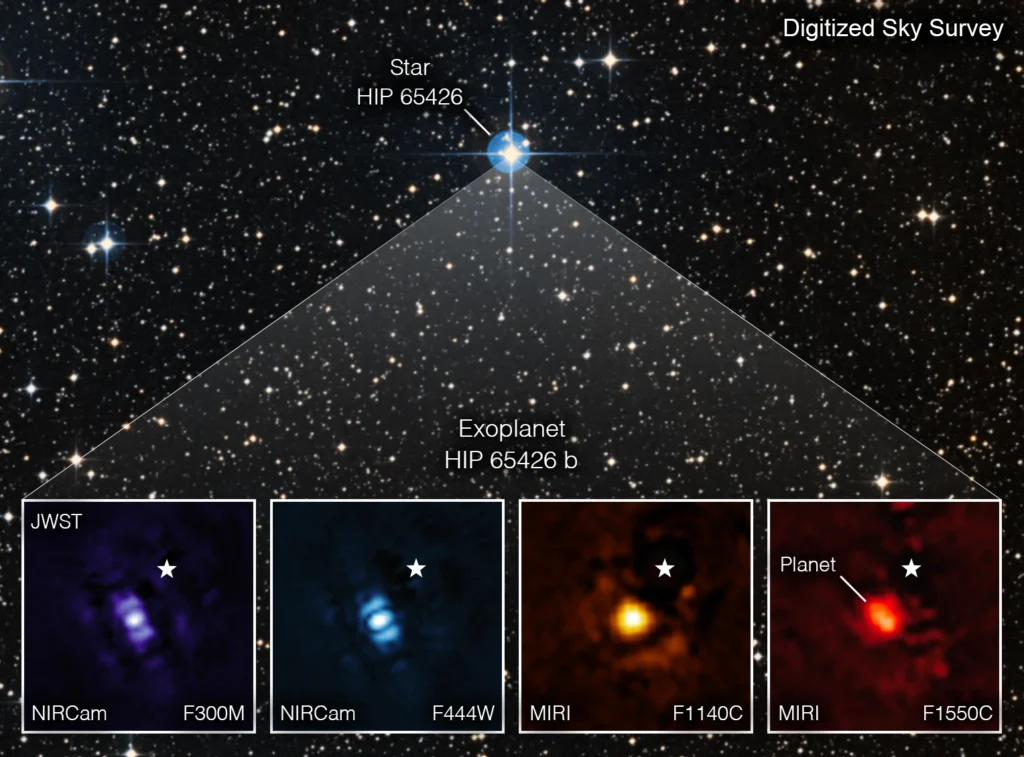
Exoplanet HIP 65426 b as captured by the James Webb Space Telescope: purple is the Near InfraRed Camera (NIRCam)’s view at 3.00 µm in wavelength and blue at 4.44 µm, while yellow and red show the Mid-InfraRed Instrument (MIRI)’s view at 11.4 µm and 15.5 µm in wavelength, respectively. The small white star in each image shows the host star. The bar shapes in the NIRCam images are artifacts of the telescope’s optics and not objects in the scene.
Image credit: NASA/ESA/CSA, A. Carter (UCSC), the ERS 1386 team, and A. Pagan (STScI).
On Nov. 22, 2022, Webb provided a molecular and chemical profile of exoplanet WASP-39b, a planet as massive as Saturn orbiting near its star closer than Mercury does around the Sun, detecting for the first time evidence of photochemistry (chemical reactions initiated by energetic stellar light) on exoplanets. These datasets are precious in that they also provide scientists insights into the abundance of the chemical elements in relation to each other, thus informing how this planet formed out of the disk of gas and dust surrounding the parent star in its younger years.
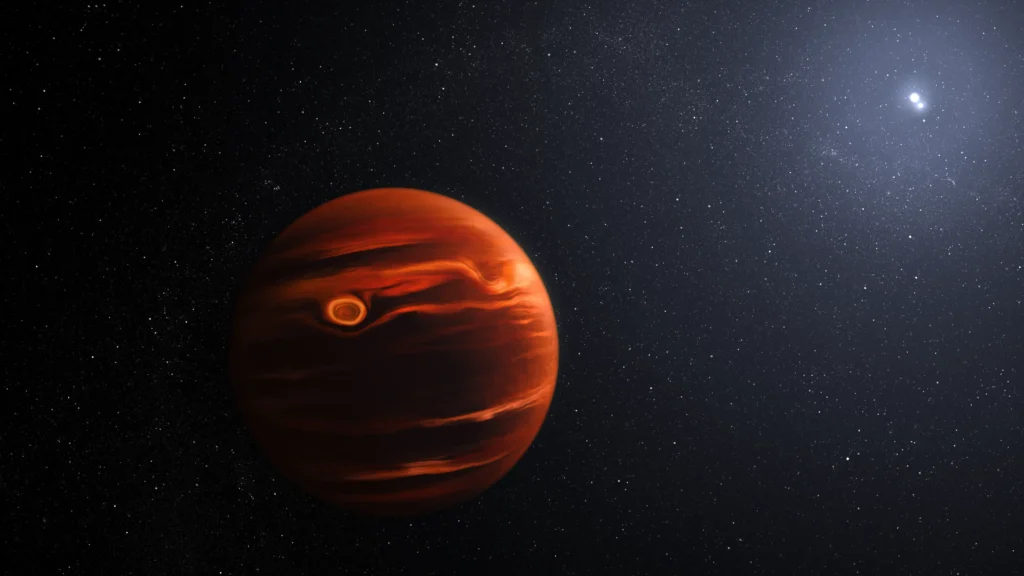
This illustration conceptualizes the swirling clouds identified by the James Webb Space Telescope in the atmosphere of exoplanet VHS 1256 b. The planet is about 40 light-years away and orbits two stars that are locked in their own tight rotation.
Credits: NASA, ESA, CSA, Joseph Olmsted (STScI)
However, Webb can also perform direct imaging of exoplanets via coronagraphs, that is, telescopic attachments designed to block out the direct light from a star so that nearby objects can be resolved. It’s like blocking sunlight with our hand when trying to look at something in the sky close to our bright Sun. In September 2022, Webb’s first picture of a distant world was released: HIP 65426 b, a gas giant about 6-12 times heavier than Jupiter located about 385 light-years away from Earth and about 15-20 million years old. Just a baby planet when compared to ours, which is 4.5 billion years old!
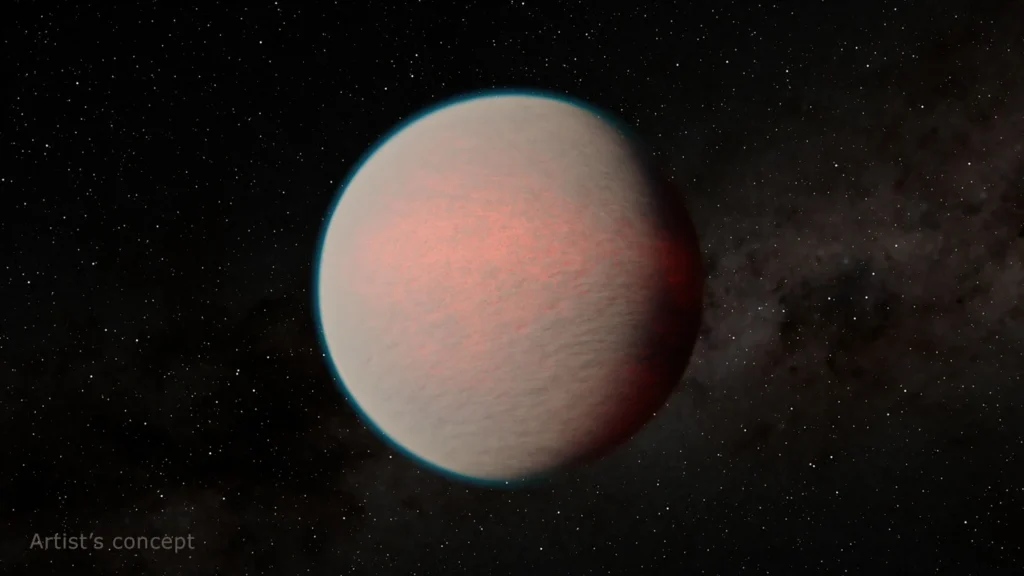
This artist’s concept depicts the planet GJ 1214 b, a “mini-Neptune” with what is likely a steamy, hazy atmosphere. A new study based on observations by NASA’s Webb telescope provides insight into this type of planet, the most common in the galaxy.
Credits: NASA/JPL-Caltech/R. Hurt (IPAC)
The study of exoplanets, as these planets are called, represents a relatively young area of investigation for scientists since two new worlds were discovered around a pulsar in the constellation Virgo in 1992. Only seven years later a planet was observed passing in front of its star, allowing astronomers to study the composition of its atmosphere. In a planetary system, in fact, the light of the host star (like our Sun), in passing through the atmosphere of a planet orbiting around it, is diffracted much like a prism decomposes white light in a rainbow of colors, thus revealing the elements the planet atmosphere is made of. Specifically, different types of chemicals in the atmosphere absorb different colors of the starlight spectrum, so the colors that are missing tell astronomers which molecules are present. Starting with ground telescopes and even the Hubble Space Telescope, since 2003 several telescopes have been hunting for and analyzing exoplanets including the Microvariability and Oscillations of Stars Telescope (MOST), the Spitzer Space Telescope, the Convection Rotation and planetary Transits (CoRoT) telescope, Kepler and the Transiting Exoplanet Survey Satellite (TESS). James Webb has joined this highly respected group of telescopes capable of providing us unprecedented data on these exotic worlds that fill our universe. While Webb was not designed to detect exoplanets, it can follow up on those that have been discovered by such telescopes and target them for analysis.
In the first five images and datasets revealed on July 12, 2022 were data characterizing the atmosphere of exoplanet WASP-96 b at 1150 lightyears from Earth in our galaxy. Data revealed presence of water, possibly clouds and haze, on this hot, gaseous planet that orbits its Sun-like star every 3.5 days with temperature greater than 538°C.
Discoveries with Webb are happening at a very fast pace and are providing unique insights into the inner workings of the cosmos
In January 2023, Webb confirmed its first exoplanet, LHS 475 b, as hinted by TESS at 41 lightyears away. This turned out to be an Earth-sized rocky planet, a few hundred degrees warmer than Earth, which completes an orbit around its red dwarf star in just two days. The scientists could not make any definitive statements on the existence and composition of the planet’s atmosphere, whose transmission spectrum appears featureless. Nonetheless, this information still allowed them to say what is definitely not there (methane, for example) were an atmosphere to be present.
Just in March 2023, researchers spotted silicate cloud features in the atmosphere of exoplanet VHS 1256 b, which orbits its binary star system at a distance four times larger than Pluto from the Sun. The clouds are constantly rising, mixing and moving during the planet’s 22-hour day, bringing hotter material up and pushing colder material down. The resulting brightness changes are so dramatic that it is the most variable planetary-mass object known to date. Researchers also made very clear detections of water, methane and carbon monoxide, and found evidence of carbon dioxide. This is the largest number of molecules ever identified all at once on an exoplanet.
Discoveries with Webb are happening at a very fast pace and are providing unique insights into the inner workings of the cosmos as well as its history and evolution. Being able to learn this level of details about other worlds was unthinkable a few decades ago. Webb has literally just opened a new window on the universe, which will make us dream even more as it brings a wealth of new information closer and closer to our eyes.
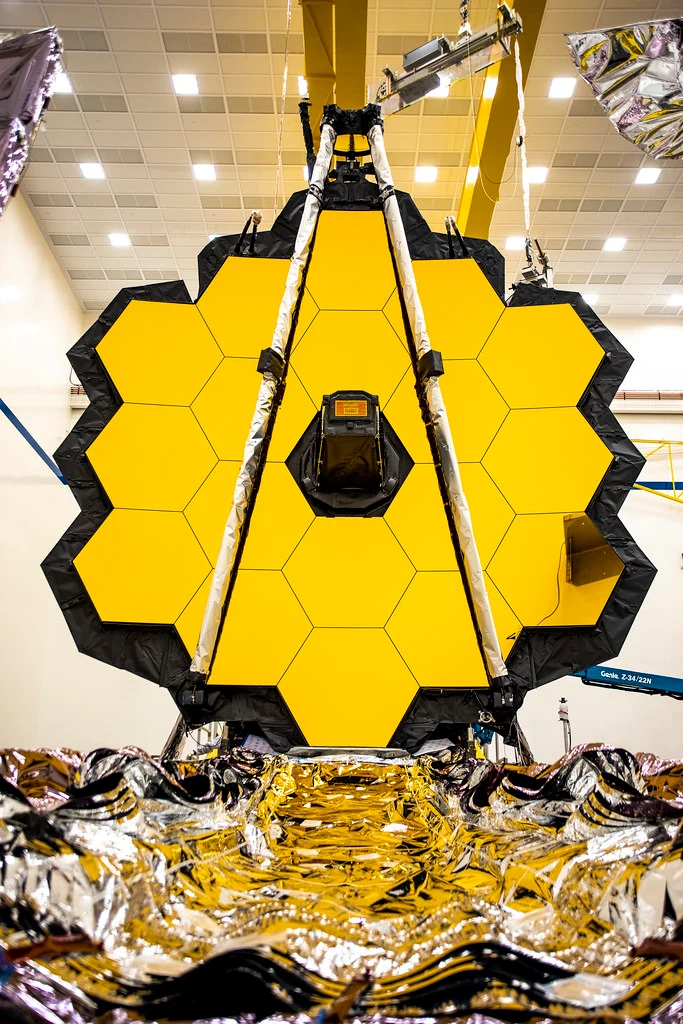
The James Webb Space Telescope being successfully tested close to launch date. – Credits: NASA, Northrop Grumman