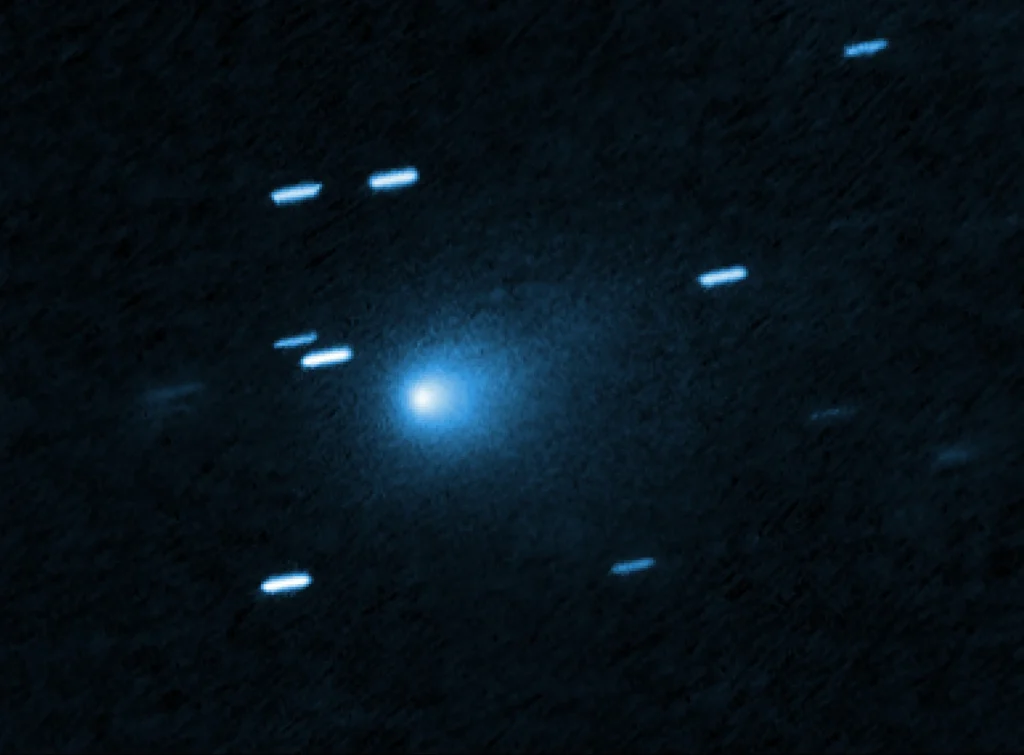
In July 2025, astronomers using the ATLAS survey system in Chile identified a faint, fast-moving object on a hyperbolic trajectory. Shortly thereafter, it was officially designated 3I/ATLAS, becoming only the third confirmed interstellar object ever detected in our Solar System — after 1I/‘Oumuamua (2017) and 2I/Borisov (2019).
As scientists mobilized to observe this rare visitor, 3I/ATLAS quickly became the focus of intense scrutiny. Its trajectory, composition, and activity patterns are unusual compared to typical Solar System comets. While NASA and most planetary scientists interpret 3I/ATLAS as a peculiar but natural interstellar comet, Harvard astrophysicist Avi Loeb has advanced a provocative alternative: that 3I/ATLAS might be an artificial, technological object — perhaps even an interstellar spacecraft.
This article reviews the state of the science, the key observational facts, and the ongoing debate surrounding one of the most intriguing astronomical discoveries of the decade.
What Is 3I/ATLAS? The Confirmed Facts
Discovery and Classification
- Discovered on 1 July 2025 by the Asteroid Terrestrial-impact Last Alert System (ATLAS).
- Designated 3I/ATLAS (“3I” meaning third recognized interstellar object).
- Trajectory is decisively hyperbolic, meaning it is not gravitationally bound to the Sun.
Trajectory and Proximity
- Perihelion (closest to the Sun): ~30 October 2025 at ~1.4 AU (just inside Mars’ orbit).
- Closest approach to Earth: ~1.8 AU (over 270 million km).
- Conclusion: No threat to Earth, and not on an impact trajectory.
Physical Characteristics
- Displays unmistakably cometary behavior:
- A visible coma
- A developing tail and anti-tail
- Outgassing of volatiles
- Spectroscopy from major observatories and the James Webb Space Telescope indicates:
- A high CO₂-to-water ratio, significantly different from many Solar System comets.
- Activity detectable at relatively large solar distances.
Scientific Significance
3I/ATLAS offers a rare chance to sample material formed in another planetary system. Variations in its chemical makeup may reflect different ice-line boundaries, grain compositions, or formation histories relative to comets native to our own Sun.
Why 3I/ATLAS Is Unusual — Even Without Aliens
While most researchers support a natural explanation, certain features have sparked deeper inquiry:
1. Highly Unusual Composition
The observed CO₂-rich outgassing and apparently low water activity could signal formation in a cold region of an alien solar nebula — or simply an atypical comet nucleus.
2. An Anti-Tail (Sunward Jet)
A sunward-pointing feature is uncommon but not unprecedented. Some models show that complex dust dynamics or anisotropic sublimation can create this effect.
3. Non-Gravitational Acceleration
As with many comets, 3I/ATLAS shows small deviations from purely gravitational motion. Early in the observation campaign, this sparked speculation about possible non-natural forces.
Recent preprints, however, have shown that ordinary outgassing physics can plausibly account for the observed thrust.
4. Ecliptic Alignment
Its retrograde trajectory lies strikingly close to the plane of the Solar System. This could be coincidence — but given the tiny sample of interstellar objects, its statistical meaning is unclear.
Avi Loeb’s Alternative Hypothesis: “Is 3I/ATLAS Alien Technology?”
Harvard astrophysicist Avi Loeb has gained notoriety for challenging conventional explanations of interstellar objects, including his earlier argument that 1I/‘Oumuamua might have been artificial.
For 3I/ATLAS, Loeb has again proposed a bold alternative.
Loeb’s Core Thesis
Loeb argues that certain characteristics of 3I/ATLAS could be consistent with a powered or controlled interstellar probe, potentially one performing a deliberate maneuver as it passed near the Sun.
He does not claim certainty. Instead, he estimates a ~40% probability that 3I/ATLAS is technological.
Key Points in Loeb’s Argument
Loeb identifies up to nine “anomalies.” Among the most frequently discussed:
- Precise ecliptic-plane alignment, unusual for a random interstellar trajectory.
- A sunward jet, which he suggests could resemble active braking rather than sublimation.
- Claims of unusual nickel emission lines, reminiscent (in his interpretation) of engineered alloys.
- Low water content combined with strong CO₂ activity.
- Possible non-gravitational acceleration inconsistent with standard comet models.
- The timing of perihelion, which placed 3I/ATLAS briefly behind the Sun from Earth’s view — a moment Loeb argues could conceal a maneuver.
- Theoretical possibility of a reverse Solar Oberth maneuver, something a spacecraft might exploit to change velocity efficiently.
Loeb frames his work as a form of scientific risk assessment: given the enormous implications of detecting alien technology, he asserts that the hypothesis deserves exploration.
Scientific Counterarguments
The majority of astronomers disagree with Loeb’s speculative interpretation. Their key arguments include:
1. Normal Comet Physics Explains the Data
Updated sublimation models show that 3I/ATLAS’s activity, including its motion, can be explained by anisotropic CO/CO₂ outgassing without invoking artificial thrust.
2. Anti-Tails Are Not Unprecedented
Dust-orbit geometries and jet anisotropies can naturally produce apparent sunward features.
3. A Small Sample Bias
With only three interstellar objects ever observed, “unusual” characteristics are expected — the baseline is uncertain.
4. No “Smoking Gun” Evidence
There are no radio signals, no confirmed controlled acceleration, and no unequivocal signs of engineered materials.
Caution is required before concluding anything extraordinary.
5. Extraordinary Claims Require Extraordinary Evidence
A core principle of scientific reasoning: alien spacecraft hypotheses demand truly decisive evidence — which has not yet been observed.
Despite disagreements, Loeb’s critics often acknowledge that considering such hypotheses pushes science to collect better data and refine models.
Where the Debate Stands Today
Both sides agree on several points:
- 3I/ATLAS is highly unusual, even among the tiny class of known interstellar objects.
- We lack comprehensive models for objects formed in other star systems.
- More data is essential.
For most researchers, the natural comet explanation remains the default. Yet Loeb’s willingness to entertain a technological hypothesis has kept the broader conversation open, stimulating fresh thinking about interstellar probes, technosignature frameworks, and how we interpret unexpected phenomena.
What Comes Next?
As 3I/ATLAS moves outward from perihelion, astronomers will focus on:
- Tracking its post-perihelion trajectory for any unexpected accelerations
- Refining composition measurements (dust, volatiles, possible metals)
- Modeling its activity patterns
- Comparing it with ʻOumuamua and Borisov
- Searching for subtle technosignatures, however unlikely
The next months and years will solidify whether 3I/ATLAS becomes merely a fascinating footnote in cometary science — or the starting point of a much deeper mystery.
Conclusion
3I/ATLAS is one of the most scientifically valuable objects to enter the Solar System in decades. It is exotic, rare, and full of clues about planetary formation beyond the Sun.
While NASA and most comet scientists view it as an unusual but natural interstellar comet, Avi Loeb’s alternative hypothesis — that 3I/ATLAS might represent alien technology — highlights the epistemic frontier where rigorous astronomy meets profound uncertainty.
The debate surrounding 3I/ATLAS is not merely about one object. It reflects a larger question that science has only begun to explore seriously:
How should we approach the possibility that technological artifacts may someday enter our Solar System?
For now, 3I/ATLAS leaves us with more questions than answers — and a reminder of how much remains unknown about the space between the stars.