

By @thunderAL_Foto
When we observe the night sky, we see almost exclusively objects that belong to our galaxy, the Milky Way. All visible points of light — stars such as Aldebaran or Betelgeuse, as well as open and globular star clusters like the Pleiades — are part of this galaxy. With the unaided eye, that is, without instruments such as binoculars or telescopes, no objects outside the Milky Way are visible. On a cosmic scale, the entire starry sky thus lies directly within our galactic neighborhood.
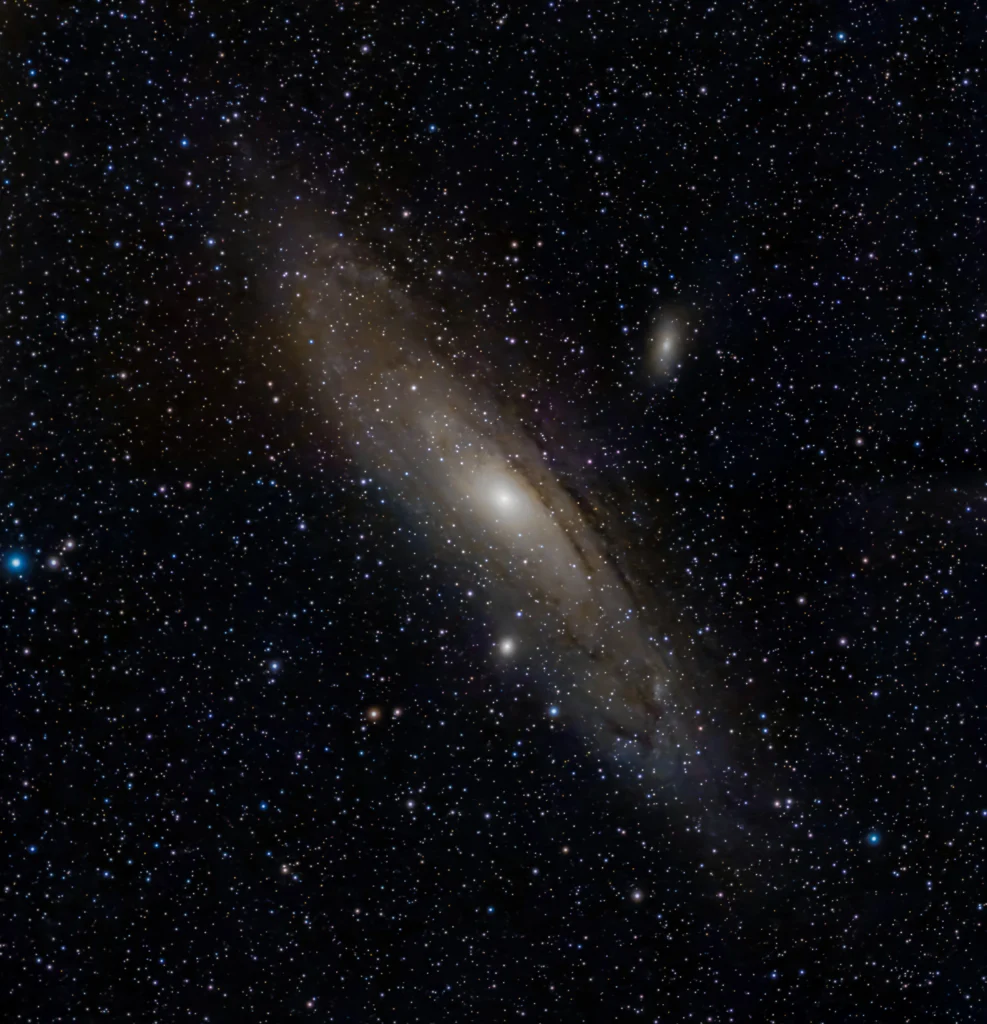
Andromeda M31 – by @thunderAL_Foto
Under a very dark rural sky, however, two objects can be observed with the naked eye from the Northern Hemisphere that do not belong to the Milky Way. The first is the Triangulum Galaxy (M33), whose observation requires exceptionally low light pollution. The second is the Andromeda Galaxy (M31), regarded as the Milky Way’s sister galaxy.
Like our own Milky Way, the Andromeda Galaxy is a member of the so-called Local Group of galaxies. It is the most distant object visible to the naked eye in the night sky. At a distance of about 2.5 million light-years, it is also the closest spiral galaxy to the Milky Way. Its surface brightness is approximately 13.5 mag/arcmin², and its apparent dimensions are about 191′ × 62′. For comparison, the full Moon has an apparent diameter of roughly 30′.
These characteristics make the Andromeda Galaxy a rewarding target for astrophotography. Due to its size and brightness, it can be captured even with relatively simple equipment. Even without tracking or image stacking, initial photographs can be obtained. Modern smart telescopes with a wide field of view or mosaic mode are particularly well suited for this purpose.
For experienced astrophotographers, M31 offers additional challenges, such as revealing the galaxy’s faint outer regions, balancing the exposure between the bright core and the spiral arms, or highlighting the H II regions and dust lanes.
The Andromeda Galaxy is therefore an object that provides both beginners and advanced observers with appealing opportunities for observation and photography.
Want to take amazing astronomy images with a Smart Telescope?
Mysteries and Beauty of the universe should not be territory trodden only by scientists and astronomers, but should be accessible to all who have the curiosity to explore. With this vision, DwarfLab came into existence. That’s why Smart Telescope such as Dwarf3 exist.
Thanks for sharing. I read many of your blog posts, cool, your blog is very good.
5jyqj8