

Join the mailing list Free weekly briefing, no spam.
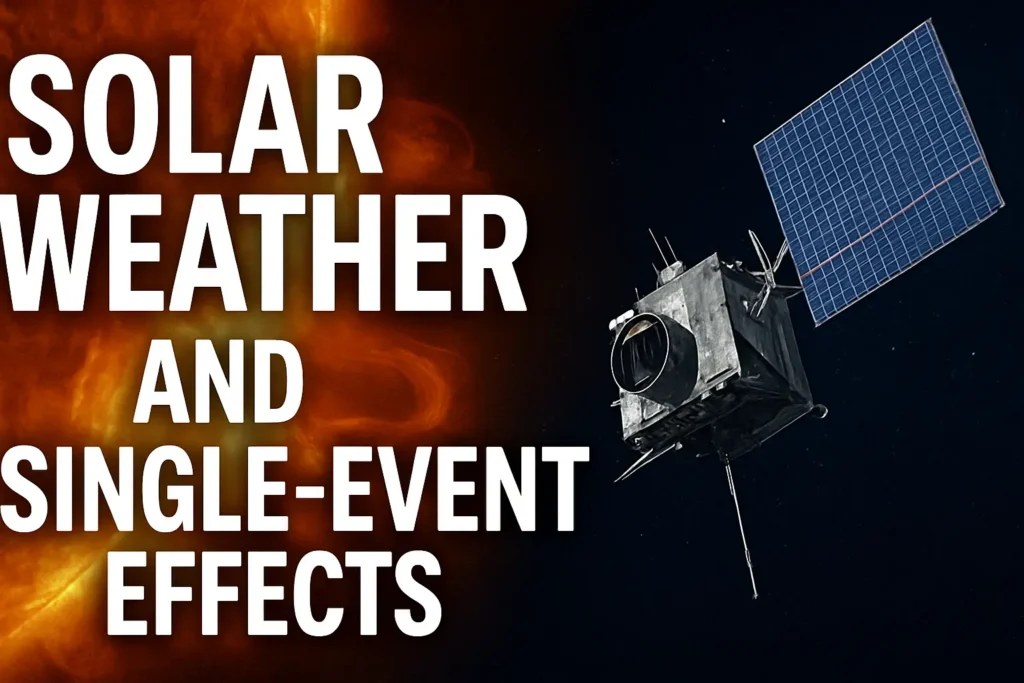
When people imagine space hazards, they often think of meteoroids, radiation belts, or hardware failures. But for modern spacecraft, one of the most persistent and least intuitive threats comes from our own Sun—and specifically from the invisible rain of high-energy particles that permeates interplanetary space. These particles can flip bits, scramble logic, and in extreme cases bring down entire spacecraft systems.
As recent events in the aviation world have reminded us, solar weather and single-event effects (SEE) are not exotic edge-cases: they are real engineering constraints that shape the design, testing, and operation of every modern satellite and deep-space mission.
In orbit and beyond, where atmospheric shielding disappears and particle flux increases by orders of magnitude, understanding these effects is not optional—it is mission-critical.
What Solar Weather Really Is
Solar weather refers to the dynamic conditions created by the Sun’s electromagnetic and particle emissions. Its key drivers include:
• Solar flares
Explosive releases of X-rays and energetic particles from the Sun’s surface. Flares can accelerate protons to relativistic energies within minutes.
• Coronal Mass Ejections (CMEs)
Huge clouds of magnetized plasma hurled into space. When directed toward Earth, they compress the magnetosphere and dramatically increase radiation exposure in near-Earth space.
• Solar energetic particle (SEP) events
Streams of highly energetic protons and heavy ions capable of penetrating spacecraft shielding and depositing charge directly inside sensitive electronics.
Why this matters:
While Earth’s magnetic field and atmosphere protect us on the surface, spacecraft above ~20 km—and especially above the Van Allen belts—operate in an environment where high-energy particles routinely pass through electronic components.
This is where Single-Event Effects come into play.
Single-Event Effects (SEE): The Micro-Scale Space Weather Hazard
SEE is an umbrella term describing disruptions in electronic systems caused by individual high-energy particles—usually protons or heavy ions—striking semiconductor components.
The most important categories are:
✓ Single-Event Upset (SEU) – “bit flips”
A charged particle alters the state of memory or logic, turning a 0 into a 1 or vice-versa.
Effects range from harmless to catastrophic depending on which register or memory cell is hit.
✓ Single-Event Latchup (SEL)
A particle induces a parasitic current path inside a CMOS circuit, causing runaway current. If not detected and power-cycled, it can destroy the component.
✓ Single-Event Burnout (SEB)
Usually occurs in power transistors. The energy deposition creates permanent damage, often leading to immediate component failure.
✓ Single-Event Functional Interrupt (SEFI)
A particle flips a bit in control logic that governs entire subsystems (e.g., attitude control, payload instruments), causing temporary or persistent lockups.
Why Spacecraft Are Especially Vulnerable
Spacecraft electronics are exposed to:
- Higher radiation levels (no atmospheric shielding)
- Large fluxes of solar energetic particles during flares and CMEs
- Heavy ion strikes from galactic cosmic rays
- South Atlantic Anomaly passes, where trapped protons penetrate LEO spacecraft repeatedly
- Long mission durations, meaning cumulative risk increases over years
Additionally, modern spacecraft electronics use advanced CMOS nodes (28 nm, 14 nm, 7 nm). Shrinking feature sizes require less charge to cause a bit flip, increasing SEU sensitivity.
The paradox of progress is that the more efficient and powerful electronics become, the more vulnerable they are to radiation—unless specifically hardened.
How Engineers Mitigate SEE in Spacecraft
1. Radiation-Hardened Components (“Rad-Hard”)
Space-grade processors (e.g., RAD750, GR712RC, LEON3-FT) are built with:
- Wider transistors
- Enclosed transistor layouts
- Guard rings
- Error-tolerant logic
These designs increase SEE resistance but are expensive and less powerful than commercial processors.
2. Error Detection and Correction (EDAC/ECC)
Memory systems use parity checks, Hamming codes, and scrubbing cycles to detect and correct SEUs.
3. Triple-Modular Redundancy (TMR)
Critical computation pathways are triplicated. If one instance differs from the majority, the system automatically discards it.
4. Current Limiting & SEL Protection
Fast-acting circuitry detects latchup and resets power to prevent permanent damage.
5. Software Fault Tolerance
Robust software can handle transient bit flips, gracefully reboot subsystems, and reject impossible sensor data.
6. Operational Strategies
Mission control can mitigate risks by:
- Entering safe mode during major solar storms
- Pausing sensitive operations (e.g., thruster burns)
- Using real-time solar monitoring for anomaly correlation
Historical Examples: Spacecraft Affected by SEEs
Spacecraft have been hit by single-event effects for decades:
- Galaxy 15 (2010) – SEFIs believed to have caused a loss of control for months.
- SOHO (1998) – A suspected SEU played a role in a spacecraft attitude loss event.
- Rosetta – Experienced numerous SEUs throughout its 10-year deep-space journey.
- Hubble Space Telescope – Requires continual memory scrubbing to correct SEUs in its on-board computers.
Even the International Space Station regularly reports radiation-induced anomalies.
Why Interest Is Rising Now
The solar cycle is approaching a period of heightened activity. Solar Cycle 25 has already produced anomalously strong flares, and spacecraft operators are preparing for an elevated rate of:
- SEUs in memory and avionics
- Navigation sensor resets
- Radiation alarms in crewed spacecraft
- Communication outages due to solar radio bursts
Beyond that, the recent aviation-sector incident linked to cosmic-ray-induced bit flips highlighted a broader truth: SEEs are not only a space problem. They affect high-altitude electronics, avionics, and even ground-based systems during extreme solar events.
Spacecraft engineers have known this for decades—but now the public is seeing how pervasive the issue really is.
Looking Ahead: Building the Next Generation of Radiation-Resilient Space Systems
Future spacecraft will require:
- AI-assisted anomaly detection, able to distinguish SEEs from system failures
- Radiation-aware redundancy architectures
- Chip-level hardening in advanced nodes
- On-orbit reconfigurable FPGA systems with real-time error correction
- Integrated space-weather forecasting frameworks
As humanity moves toward lunar bases, Mars missions, and high-value satellite constellations, solar-weather resilience will be as important as propulsion or power systems.
The Sun is not merely a source of warmth—it is a dominant environmental threat that spacecraft must live with for every moment of their operational life.
Conclusion
Solar weather and single-event effects are not hypothetical. They reshape how we design spacecraft, plan operations, and protect long-duration missions. As we move deeper into space, the ability to withstand radiation will increasingly define mission success.
Spacecraft are, and always will be, on the front line of our planet’s relationship with the Sun. Understanding—and engineering against—these cosmic hazards is fundamental to the future of space exploration.
x3pt8b