
Join the mailing list Free weekly briefing, no spam.
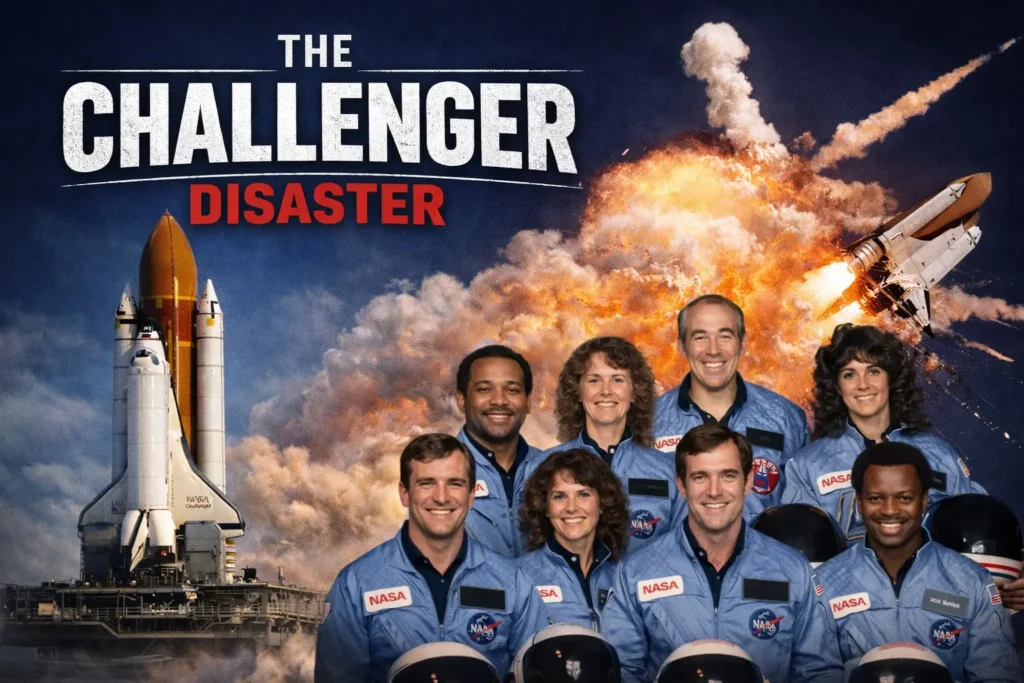
The Space Shuttle Challenger disaster stands as one of the most significant and heartbreaking events in the history of human spaceflight. On January 28, 1986, NASA’s Space Shuttle Challenger (mission STS-51-L) was destroyed shortly after liftoff, resulting in the loss of all seven crew members. The tragedy profoundly reshaped NASA’s approach to safety, engineering ethics, and risk management.
Overview of the Challenger Mission
Challenger launched from Kennedy Space Center in Florida at 11:38 a.m. EST. The mission was notable for carrying Christa McAuliffe, a civilian schoolteacher selected through NASA’s Teacher in Space Project, which brought unprecedented public attention to the launch.
Just 73 seconds after liftoff, the shuttle disintegrated in midair, an event broadcast live to millions of viewers worldwide.
Executive Guide to Space at Space Park Leicester: Three Days Inside a Space Mission
MO-Nav on Talon-A: What a Mach 5 GPS-Denied Test Proves

Scariest Objects in Space: Ghost Nebula, Witch Head Nebula and the Demon Star
Griffin-1 Lunar Lander Completes Environmental Testing at NASA JPL
NASA 4-D Executive Space Programme: Eight Questions Answered by Paul Hawkins

Halloween Fireballs 2026: When to See the Orionid and Taurid Meteor Showers
Perseverance Passes Opportunity’s Driving Record: What 45 Kilometers on Mars Really Means
Why Space Teams Fail: Paul Hawkins on NASA’s 4-D Leadership System
The Crew of STS-51-L
The seven astronauts aboard Challenger were:
- Francis R. “Dick” Scobee – Commander
- Michael J. Smith – Pilot
- Ronald McNair – Mission Specialist
- Ellison Onizuka – Mission Specialist
- Judith Resnik – Mission Specialist
- Gregory Jarvis – Payload Specialist
- Christa McAuliffe – Payload Specialist (Teacher in Space)
Each crew member was highly trained, accomplished, and dedicated to advancing space exploration.
Technical Cause of the Challenger Disaster
The immediate cause of the accident was the failure of O-ring seals in the right solid rocket booster (SRB). These rubber seals were designed to prevent hot combustion gases from escaping the booster during launch.
Role of Cold Weather
On the morning of the launch, temperatures at Kennedy Space Center were near freezing, far colder than any previous shuttle launch. The low temperatures caused the O-rings to become brittle and inflexible, preventing them from sealing properly.
As a result:
- Hot gases escaped the SRB
- The gases burned through the external fuel tank
- The shuttle structure failed catastrophically
Organizational and Management Failures
Beyond the technical malfunction, the disaster exposed systemic issues within NASA’s decision-making culture.
Engineers from contractor Morton Thiokol had explicitly warned that launching in cold temperatures posed a serious risk to the O-rings. However:
- These concerns were overridden by management
- Schedule pressure and public expectations influenced the final decision
- Risk was normalized rather than addressed
The Rogers Commission, formed to investigate the accident, concluded that organizational failures were as critical as engineering flaws. Physicist Richard Feynman, a member of the commission, famously stated that “reality must take precedence over public relations, for nature cannot be fooled.”
Impact on NASA and Spaceflight Safety
The Challenger disaster led to sweeping changes across NASA and the aerospace industry:
- The Space Shuttle program was suspended for 32 months
- Solid rocket boosters were redesigned with improved O-ring systems
- NASA restructured its safety oversight and communication channels
- Greater emphasis was placed on engineering authority and dissenting opinions
These reforms aimed to prevent similar tragedies in future missions.
Legacy and Lessons Learned
The Challenger disaster remains a defining lesson in aerospace history. Its legacy emphasizes:
- The importance of listening to engineers and subject-matter experts
- The dangers of schedule-driven decision-making
- The ethical responsibility to prioritize crew safety over organizational pressure
The event is frequently studied in engineering, management, and ethics programs worldwide.
Conclusion
Nearly four decades later, the Space Shuttle Challenger disaster continues to influence how space agencies approach risk, safety, and accountability. While the loss of Challenger and its crew was devastating, the lessons learned have helped shape safer practices in human spaceflight and serve as a lasting reminder of the cost of ignoring scientific and technical warnings.