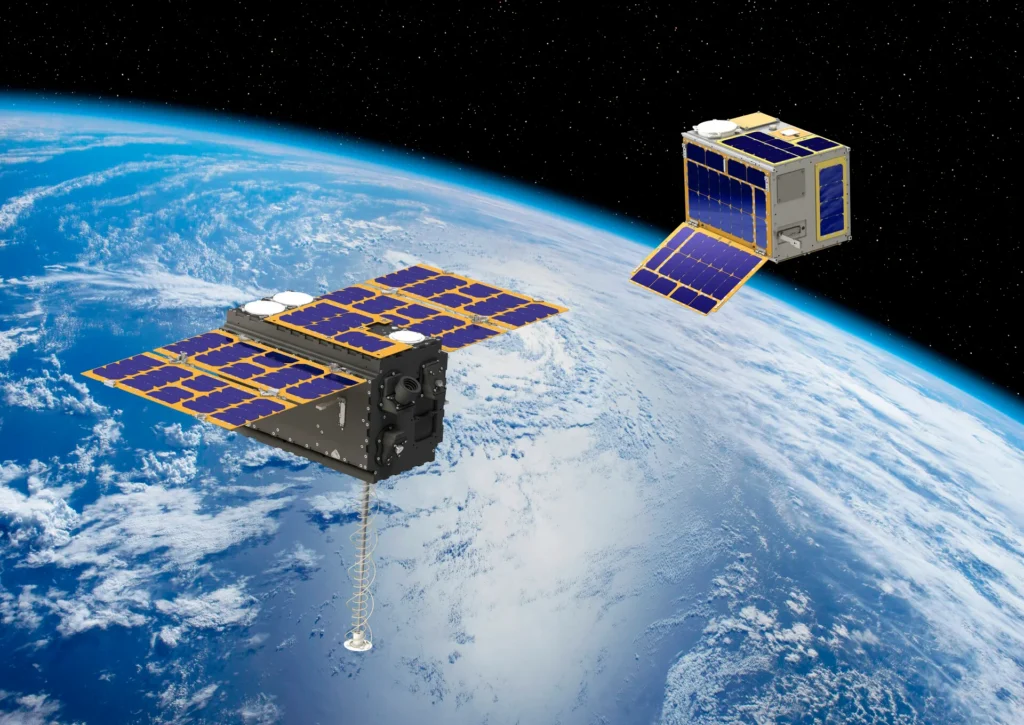
ESA’s Celeste LEO-PNT (Low Earth Orbit Positioning Navigation and Timing) – Credits ESA – D. Ducros
On 28 March, the European Space Agency (ESA) marked a significant milestone in the evolution of satellite navigation. The first two satellites of the Celeste mission were successfully launched into orbit aboard a Rocket Lab Electron rocket from New Zealand, opening a new chapter in Europe’s pursuit of more resilient and advanced positioning systems.
This mission represents the beginning of an ambitious effort to complement Europe’s flagship navigation constellation, Galileo, by introducing a new layer of satellites in low Earth orbit (LEO).
A New Layer for Navigation
For decades, satellite navigation systems like Galileo and EGNOS have relied primarily on satellites operating in medium and geostationary orbits. Celeste aims to change that by demonstrating how a LEO-based constellation can enhance existing infrastructure.
The two newly launched satellites—developed by GMV and Thales Alenia Space—successfully separated from their launcher approximately one hour after liftoff. They are now entering their early operations phase, where mission teams will prepare them for full functionality in orbit.
Why Low Earth Orbit Matters
Operating much closer to Earth than traditional navigation satellites, LEO spacecraft offer several key advantages:
- Stronger signals, improving accuracy and reliability
- Reduced latency, enabling faster data transmission
- Enhanced coverage, particularly in challenging environments
Celeste will test new signals across L- and S-band frequencies, ensuring compliance with international regulations while unlocking new service capabilities.
This closer proximity to Earth could significantly improve navigation performance in urban canyons, remote regions such as the Arctic, and even indoor environments—areas where current systems often face limitations.

Designing for Space by Kamakhya Arora
by Kamakhya AroraSpace exploration is one of humanity’s boldest endeavours—driven by our relentless curiosity, imagination,…

Astronomy Basics
🌠 Explore the Universe Like Never Before!🔭 Discover the secrets of stars, planets, and galaxies…

[Preview] Orbital Mechanics – An Introduction
Discover the fundamentals of orbital mechanics in this beginner-friendly course—no prior experience needed! Explore how…

Human Factors and Performances
Human factors and human performance in space are critical areas of study in spaceflight operations,…
Space Physics – Basics
Explore the dynamic forces that shape our space environment in this exciting journey beyond Earth’s…
Real-World Applications
Beyond technological validation, Celeste is designed as a versatile in-orbit testbed for next-generation applications. Among its most promising use cases:
- Autonomous vehicles requiring high-precision positioning
- Railway, maritime, and aviation navigation enhancements
- Emergency response systems with improved communication and positioning during disasters
- Tracking for Internet-of-Things (IoT) devices
- Potential indoor navigation solutions
These capabilities could redefine how navigation technologies integrate into everyday life, from smart cities to critical infrastructure.
A Constellation in the Making
The two satellites launched this week are just the beginning. By 2027, ESA plans to expand Celeste into a full 11-satellite demonstration constellation, offering a broad platform for experimentation across multiple frequencies, environments, and user scenarios.
The mission is also notable for its adoption of a New Space-inspired development approach, emphasizing speed, flexibility, and innovation. This strategy enables faster deployment cycles and encourages collaboration across Europe’s growing space ecosystem.
Strengthening Europe’s Space Independence
Celeste is more than a technology demonstrator—it is a strategic investment in Europe’s autonomy and resilience in space-based services.
As satellite navigation becomes increasingly embedded in modern society—supporting everything from transportation to financial systems—ensuring robust, secure, and independent infrastructure is critical.
The mission aligns with ESA’s broader European Resilience from Space (ERS) initiative, which aims to address security challenges while laying the foundation for future strategic capabilities.
Looking Ahead
Following its demonstration phase, Celeste will move into its In-Orbit Preparatory (IOP) phase, supported by ESA Member States. This next step will focus on validating technologies in space and building the groundwork for a potential operational LEO navigation layer.
Ultimately, the insights gained from Celeste will inform future decisions by the European Union on whether to deploy a full-scale LEO-based navigation system to complement Galileo and EGNOS.
A New Frontier for Navigation
With Celeste now in orbit, Europe is actively exploring the next frontier of satellite navigation. By combining traditional systems with innovative LEO capabilities, ESA is positioning itself at the forefront of a rapidly evolving field—one that will shape the future of mobility, connectivity, and global infrastructure.
As the constellation grows and testing progresses, Celeste may well become the blueprint for the next generation of navigation systems worldwide.