
Join the mailing list Free weekly briefing, no spam.
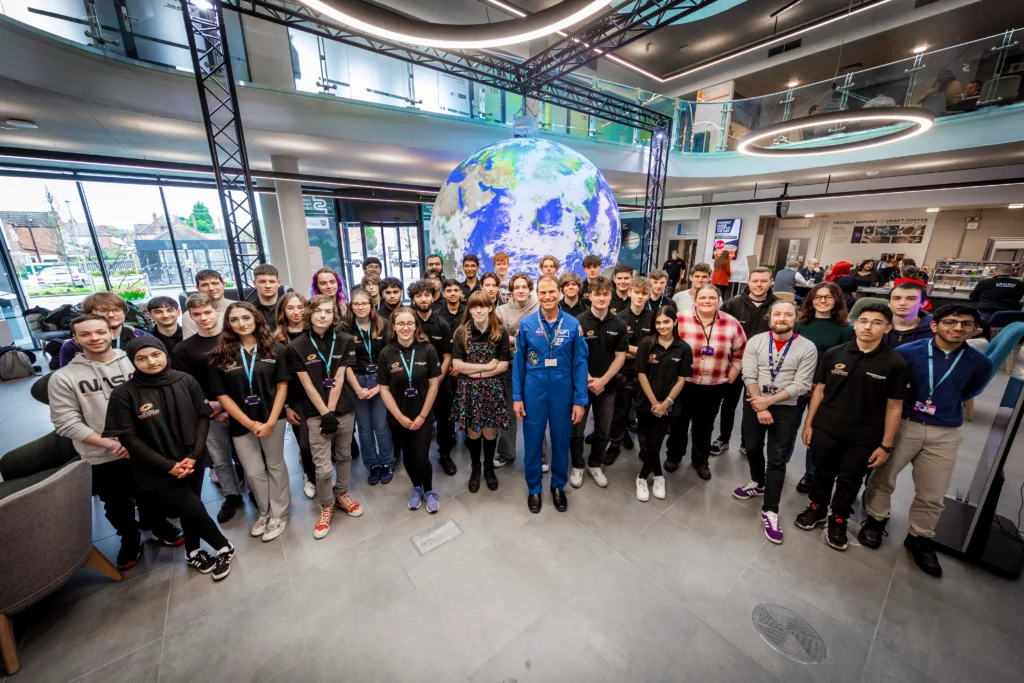
NASA astronaut popular with Leicester space fans – Credits SPL
When NASA’s Artemis II roared into history this April, it marked far more than a return to crewed lunar exploration. Behind the astronauts traveling farther into space than any humans in over half a century stood a familiar voice—one that space enthusiasts in Leicester already knew well.
That voice belonged to Dr Stanley G Love.
The Human Link Between Space and Earth
While astronauts captured global attention aboard Artemis II, Dr Love played one of the most critical roles on the ground: lead CAPCOM (Capsule Communicator). In NASA missions, CAPCOM is the only person who speaks directly with astronauts in space—a role that demands both technical precision and deep trust.
From mission control, Dr Love translated the decisions of flight directors into clear instructions for the crew, while also relaying the astronauts’ needs back to Earth. It’s a position that blends engineering, communication, and calm decision-making under pressure.
And for those who met him during his 2024 visit to Space Park Leicester and the National Space Centre, it’s no surprise he was at the heart of such a historic mission.
Astronomy Basics
🌠 Explore the Universe Like Never Before!🔭 Discover the secrets of stars, planets, and galaxies…
[Preview] Orbital Mechanics – An Introduction
Discover the fundamentals of orbital mechanics in this beginner-friendly course—no prior experience needed! Explore how…
Human Factors and Performances
Human factors and human performance in space are critical areas of study in spaceflight operations,…
Space Physics – Basics
Explore the dynamic forces that shape our space environment in this exciting journey beyond Earth’s…
A Mission Decades in the Making
Launched on April 1, Artemis II is NASA’s first crewed lunar mission since the era of Apollo program. The mission’s dramatic flyby of the Moon has reignited global excitement about human spaceflight—and laid the groundwork for a sustained human presence beyond Earth.
According to Professor John Bridges of the University of Leicester, the mission represents a pivotal moment:
Artemis II is not just a return—it’s a transition toward long-term lunar exploration and future journeys to Mars.
For scientists, engineers, and space fans alike, this mission signals the beginning of a new chapter in understanding both the Moon and the wider Solar System.
From Shuttle Astronaut to Artemis Architect
Dr Love’s journey to Artemis II reflects decades of experience. A planetary scientist by training, he previously flew aboard the Space Shuttle Atlantis and has supported multiple shuttle missions as CAPCOM.
Today, his work extends beyond operations. At NASA, he contributes to the design of next-generation spacecraft systems, helping shape how astronauts will interact with vehicles like Orion spacecraft.
This combination of flight experience and engineering insight makes him uniquely suited to bridge the gap between astronauts and mission control—a role that proved essential during Artemis II.
Leicester’s Growing Role in the Space Sector
Dr Love’s connection to Leicester highlights something bigger: the city’s rising influence in global space exploration.
Space Park Leicester has quickly become a leading center for innovation, bringing together academia and industry to push forward technologies in satellite systems, Earth observation, and planetary science.
Opened in 2022 by Tim Peake, the facility is part of a broader “Space City” initiative positioning Leicester as a key node in the UK’s space ecosystem.
From Apollo to Artemis: A New Era of Discovery
As Artemis builds on the legacy of Apollo, scientists are preparing to answer deeper questions about the Moon’s origins—and, by extension, the evolution of Earth and other terrestrial planets.
Upcoming public talks, such as Professor Bridges’ “From Apollo to Artemis: A New View of the Moon,” aim to bring these ideas to a wider audience, exploring how past discoveries are shaping future missions.
A New Generation Inspired
Artemis II is more than a mission—it’s a signal.
It tells us that humanity is not done exploring. That the Moon is not a destination of the past, but a gateway to the future. And that behind every spacecraft, every trajectory, and every milestone, there are people—like Dr Stanley G Love—quietly ensuring that exploration continues.
For the students, researchers, and dreamers who met him in Leicester, that connection makes the journey to the Moon feel just a little bit closer.