
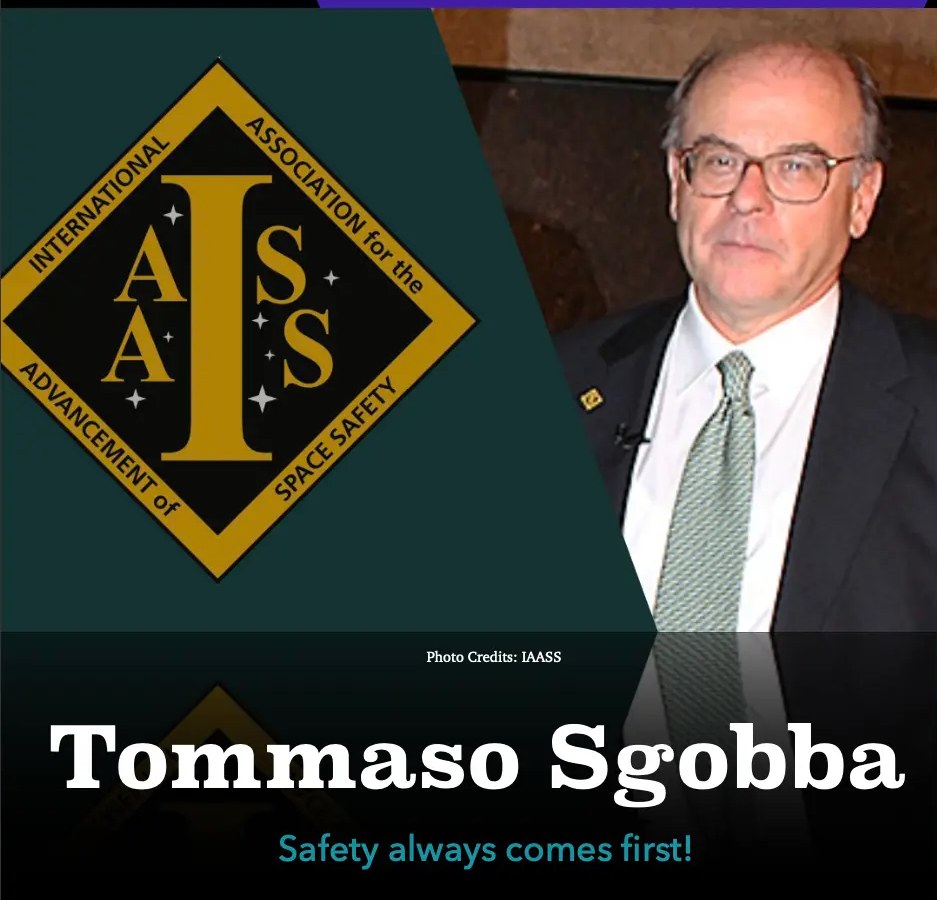
Tommaso Sgobba on Space Safety: Interview with the IAASS President
Safety always comes first!
Tommaso Sgobba is President and co-founder of the International Association for the Advancement of Space Safety (IAASS), a global organization uniting premier space safety experts. A former Head of the Independent Safety Office at the European Space Agency (ESA), he began his career in the aeronautical industry and joined ESA in 1989. In this interview, first published in Edition 21 of the SpaceInfo Magazine, he looks back at the Columbia accident that led to the creation of IAASS and at the safety challenges of commercial spaceflight, orbital debris, mega-constellations and deep-space missions.
Key Takeaways
- After the Columbia accident in 2003, Sgobba, whose office was responsible for the safety of the European payload, concluded that NASA’s safety function was not independent enough and that debris risks to aviation were underestimated, which led to the founding of IAASS in 2004.
- He argues that an independent safety organization is crucial and that a “safety case” combines prescriptive requirements, performance requirements and safety analysis; he stresses that “absolute safety” does not exist and that risk must be reduced to an acceptable level.
- On new space activities, he says commercial spaceflight has seen no progress in safety rules and that uncontrolled reentries of satellites, now far more frequent because of mega-constellations, must be forbidden.
At a Glance
- Role
- President and co-founder, International Association for the Advancement of Space Safety (IAASS)
- Previously
- Head of the Independent Safety Office, European Space Agency (ESA)
- Career
- Started in the aeronautical industry; joined ESA in 1989; product assurance and safety manager for European manned missions on the Shuttle, the MIR station and the European facilities for the ISS
- Books
- Co-editor of Safety Design for Space Systems and of The Need for an Integrated Regulatory Regime for Aviation and Space; co-author of Safety Design for Space Operations and Space Safety and Human Performance (Elsevier)
- Focus
- Space safety, independent safety assessment, regulation of commercial spaceflight, space debris
About the Interview
Ten questions on the history and mission of IAASS, the principles of independent safety, space tourism, collision avoidance, education, international cooperation, mega-constellations and deep-space missions. The answers are presented as written up in the SpaceInfo Magazine, with notes from the writer.
The Interview
As the Executive Director of the International Association for the Advancement of Space Safety (IAASS), could you provide an overview of the organization’s mission and its role in promoting space safety?
It all started in April 2004, after the accident of Space Shuttle Columbia (which occurred on February 1st, 2003). Mr Sgobba was personally involved in the accident since ESA had most of the payload on that mission. He and his office were in charge of the safety of the payload, thus when the tragedy occurred they started by gathering the office and putting together the documentation to start the investigation.
As a matter of fact, he had a delegation to certify the European payload onboard the Space Shuttle as well as on the International Space Station. One of the reactions of NASA was to suspend the delegation until the investigation was terminated. This was a direct consequence of the accident in the short term. In the following months the investigation showed that the payload had no responsibility in the accident.
At a higher level, the problem was the non-existing role of the Safety Office at NASA at the time: no direct involvement was envisaged in the safety design. To make this clearer, this means that an organization of such dimension and importance was not really involved in safety.
Secondly, NASA seemed to underestimate the consequence of falling debris from the vehicle. We don’t mean the protective shield detaching from the Shuttle when lifting off; we mean the debris of the whole vehicle falling from the higher layers of the atmosphere (troposphere and stratosphere) when the accident occurred during re-entry. High risk for aviation was real! On that day, debris fell very close to Dallas Airport and one airplane crossed them very closely two times!
At the end of the investigation, when the safety report was published, at ESA there was a small internal panel to review the results and implement recommendations for the Agency. Lessons learned and impacts were picked up by engineers, by the director of human space flight and program managers. In particular, the latter took control of the meeting and steered the conclusion to say that no action was to be done: they were already doing everything fine…
However, this was the time he realized that something had to be done.
In those years Mr Sgobba was the representative of the Multilateral Mission Assurance Board, a very important one: they gathered among different agencies like NASA, Roscosmos, JAXA, and the Canadian Space Agency. He directly asked the Agencies to establish a forum to guarantee safety from then on. This is how the Association (IAASS) was established with the purpose of reducing the percentage of accidents.
Knowledge is of paramount importance as well as improving the understanding of how safety is crucial in Space Operations.
It is this way that people identified the need of safety, not only while launching huge rockets into orbit, but for each phase, from construction to operation.
In those days people realized that safety analysis, a pillar of the whole safety discipline, was necessary!
But how is this discipline practiced in everyday operations? Space is a very innovative field, so safety analysis applies also in a predictive way, because of the innovative nature of the space environment. Space Shuttle and ISS followed these pillars of safety.
For the predictive approach to be effective, you need to deeply understand the technology and how it works.
If you come from the world of aviation, be careful with similarities!
Aviation was established with attention to safety, but with no available tools for safety analysis…
It was quite common to actuate the following approach: fly, accident, learn, and fly again.
There is a quote from professor Gabrielli: “Every airplane is soaked in blood, and the more it is soaked the better it’s been developed”. This is not the way Space works.
Prescriptive requirements, how the planes were built and no safety orientation were some of the most common problems with safety. Think about this: “The parking brake has to stop the plane onto some inclined surface” – end of the requirement. So if you are testing this, it happens that you follow the procedure “blindly”, covering those prescriptive requirements; but a lot of corner cases are neglected. The Space approach is different: a goal is set and then the way to get to the goal is found. This approach was true and fully applicable until the 1980s, when computers started to come in: the command chain for a conventional vehicle is: (A) human (procedures, etc.), (B) software (no matter what you do, it can still fail…), (C) hardware.
Due to this new actor in the play, Safety became a RELIABILITY problem, something also subjected to analysis: occurrences and data.
Think about a problem of this approach: Boeing 737 MAX. Separating these three factors (hardware, software, human) is no good. For this reason there is a transition happening now from rule/requirement based design to performance based design.
Drawing from your experience as the former Head of the Independent Safety Office at the European Space Agency (ESA), what are the key principles and practices that you believe are crucial for ensuring safety in space missions?
One principle lies in the name itself: the office was called “independent safety office”. “INDEPENDENT” is the key word.
Think about history, from ballistic missiles, through Apollo 1 up to the Space Shuttle, accidents occurred. Particularly for Shuttle Columbia and Challenger, apparently there were no known hazards, but something went wrong anyway. So what is the reason?
They were basically organizational hazards.
We should never forget that no design is perfect, but let’s take the example of the Space Shuttle: hazards manifested clearly to the astronauts and people operating this incredibly complex machine, but NASA had no money to fix every glitch. The US cancelled all the space transportation programs thus the Shuttle had to fly as much as possible and everything had to be accomplished by the Shuttle itself. A very dangerous combination was growing: less and less money together with more and more workload to be done…
So what happened?
A lot of grey areas began forming inside NASA at the time. As often, issues are not just black or white, but they are the result of a combination of minor ones. At the time, the safety authority of NASA was actually embedded inside the Agency’s space programs: they were also responsible for cost and management!
You clearly understand how interests come very fast into conflict. When your budget and funds are more and more shrunk, your target is to accomplish your task and eventually the whole Shuttle program. Defects and hazards were presented usually as minor issues… Already after the Challenger accident this was clear at NASA (1986), but only after the Columbia (2003) it was enough to take action and change the processes.
The result is now forged into everyone’s memory.
Today the process is completely different and no program manager is able to change a requirement without it being reported to the Safety Office.
So the answer to the question can be summarized with three bullet points: prescriptive requirements, performance requirements and safety analysis. Together they form what is called a “safety case”.
An independent organization is crucial in the analysis and judgment of a safety case.
Space tourism is gaining momentum with the involvement of private companies. How do you see the role of IAASS in establishing safety standards and best practices for this emerging sector?
When the association was established, we were in the aftermath of the Columbia accident, but also at the beginning of Space Tourism. We expected the industry – read “commercial operators” – to knock on IAASS’ door…
Very surprisingly this never happened. They preferred spending billions over billions lobbying against safety regulations…
There is a dichotomy between safety and strategy/vision of Space Tourism.
Everything started with a couple of people, one with aviation experience (Burt Rutan) and one with no aviation experience.
The idea of the first was against over-regulation, if this was imposed by the authority that would cause an economical disruption for the majority of Aviation Companies. Indeed, to get an airplane safety certified, even if it’s a very small one, you need a lot of money!
He was coming from the aviation world, which is a “prescriptive world”; however, as we’ve seen, in space you need “performance” requirements: just prescribing that a system simply “does” something is not enough: you need to reach a minimum level of acceptability in that “doing something”.
Do you remember we’re talking about two guys? So, the other one had no idea about what he was talking about, he talked about “absolute” safety. But this approach would have killed space flight: absolute safety is something which does not exist.
You have to consider what is relative and reduce a risk to an acceptable level. That’s what is done with risk management. The fact that this opinion was also shared within the US Congress for sure did not play a positive role for the whole environment.
Something that will stay forever in the mind of the writer of this article is for sure this quote by Mr Sgobba’s friend: “There is nothing like absolute safety, only vodka can be absolut”.
On the other side, we don’t have to completely under-evaluate safety analysis. The fact that risk is always relative does not make safety an opinion: it is science, engineering, thus has to be faced with a proper approach.
Be careful about the growing Space Commercial Business; the key is in this last word: business people want to sell a business, they don’t really take care about it being space or anything else…
Let’s think about a very common idea these days: according to someone, you can define yourself an astronaut if you’ve been in Space. But what does “in Space” mean? You are technically “in Space” when you are flying above the Karman line.
In 2004 there was a moratorium in FAA regulation, which expired on January 1, 2024 (an extension was pending at the time of writing). It granted flight safety, but not for the people onboard.
Indeed, we read from the Federal Aviation Administration’s website that “Congress, with few exceptions, limits the FAA’s regulatory oversight of the health and safety of commercial human space flight occupants […] Federal law requires an informed consent framework so flight crew and space flight participants are fully aware of the risks and hazards involved in human space flight launch and reentry operations. […] The FAA does not certify launch or reentry vehicles as safe for carrying humans. Further, the FAA requires launch service providers to inform crew and space flight participants prior to flight that the agency has not certified the vehicle as safe.”
Some time ago, the industry developed a standard for commercial space systems. The Society of Automotive Engineering International published a standard into language adaptation for NASA’s proven requirements, rephrasing the Agency’s requirements, so they didn’t have to do it. This standard was published and an event was organized with SAE International presenting the standard with the president of the Commercial Space Flight Association.
Surprisingly, after a few days SAE had to withdraw the standard…
You can find this standard published as a collection: IAASS-SSI1700.
There is one exception: think about the Dragon (Cargo and Crew) capsule. NASA has to certify these vehicles exactly following the principles of system safety engineering.
Space situational awareness and collision avoidance are critical aspects of space safety. What advancements or strategies do you think are necessary to improve our ability to monitor and prevent collisions in space?
Collision avoidance is a technique started with the operation of the International Space Station. The method covers all the aspects of debris avoidance, from detecting a potential hazard up to actuating a maneuver, which includes the definition of a safety virtual box around the ISS.
Note from the writer: if you follow SpaceInfo from the beginning you know that not everyone has been a good boy: more than once Chinese testing vehicles ended up spreading debris in orbit. However, as much as possible, agencies try to track debris and when necessary the ISS trajectory is corrected accordingly.
To improve our behavior and be ready for a crowded future, a couple of points should be highlighted: we need technologies and rules.
1. The first is to ensure that no alarm is called when unnecessary: the orbits of these objects are little perturbed, not perfectly drawn, so a better technology will allow a better tracking of potentially dangerous debris.
2. You need rules for traffic.
Very often, small satellites by Universities and small companies have no maneuverability or analytical capability to plan those maneuvers. IAASS had proposed to a forum at the United Nations COPUOS (Committee on the Peaceful Uses of Outer Space) a cooperative approach in this sense. Small companies and entities need guidance in their analytical capabilities, which are usually very limited, for sure not on their fault!
IAASS is involved in education and training programs related to space safety. Can you elaborate on the importance of educating the next generation of space professionals in the field of space safety, and what initiatives IAASS is undertaking in this regard?
What the association has done over the years is to publish three textbooks which cover the topics at university level, so they are intended for professionals and people actively working in the field. They are: (1) Safety Design for Space Systems, by Tommaso Sgobba, Gary Eugene Musgrave, Gary Johnson and Michael T. Kezirian; (2) Safety Design for Space Operations, by Tommaso Sgobba, Firooz Allahdadi, Isabelle Rongier and Paul Wilde; (3) Space Safety and Human Performance, by Barbara G. Kanki, Tommaso Sgobba, Jean-François Clervoy and Gro Sandal.
Each one is published by Elsevier.
The third book is particularly interesting if you’re looking for human performance. In particular it shows how to keep the human in the loop and how to train the human for the space system. These books have been very successful so that “Safety Design for Space Systems” was translated also into Chinese!
On top of this there is the Journal for members, published once every quarter.
If you are looking for higher level training, coaching and classes, IAASS is very active in promoting space safety within universities, as well as releasing courses to obtain a certificate in space safety: an in-class program over ten weeks, where five weeks are dedicated to system safety design, then operation and finally regulation.
Space exploration involves international collaboration. From your perspective, how can global cooperation contribute to enhancing space safety, and what challenges need to be addressed in fostering this collaboration?
Space is an arena of competition. Competition to be the first to orbit Earth, to be the first to land on the Moon, et cetera…
Recently a former NASA administrator said: “When we launched the human spaceflight program it was because we wanted to demonstrate some kind of National capability. Then technology advantages are just a consequence, the so called spin-offs”.
Thus, you clearly understand that a primary purpose of a collaboration would be a political one.
When the USA and Russia started dialoguing in the 1970s, trying to set up a docking between US and Russian vehicles to be prepared for an eventual rescue mission, the whole thing was sustained by politics and even the design solutions had to be discussed not only on the engineering side, but also on the political one, with strong influences from this.
There are some political barriers today that prevent a cooperation between the major players (USA and China).
IAASS launched a proposal for international cooperation at least for SAR (Search And Rescue) capabilities on the Moon.
Hopefully, collaborating on something which is not a political matter but a humanitarian one would trigger an initial international cooperation.
Emerging technologies such as satellite mega-constellations pose challenges for space traffic management. What considerations and measures do you think should be in place to ensure the safe deployment and operation of these large satellite networks?
A big issue lies here: before the arrival of the mega-constellations, the operations in LEO (Low Earth Orbit) implied an atmospheric reentry for a spacecraft and they were mainly under governmental control. But they were a rare event, specifically an uncontrolled event.
So NASA established a rule for a threshold based on event, based on the mass of the spacecraft and a safety parameter, e.g. people killed on ground every 1000 events, just to make an example. This drives you to a mass threshold. So if a spacecraft is above a certain value of mass you need a controlled reentry, otherwise not.
Therefore, mega-constellations have high numbers of satellites, but they have small mass. Did you know that the number of reentries in the summer of 2023 in two months was 120?! Almost 2 per day. As a comparison reference, the year before reentries were 180 over the whole year.
We need to change the formula to define a safety standard.
It is Tommaso’s opinion, and not only his, that “uncontrolled reentry” must be forbidden. Then everyone can fail, but that probability must be kept under a very close threshold, qualify the thing as “rare”, not as “uncommon”!
On top of this, there is an increasing concern for aviation. Do you remember what we said in question one? During the Columbia disaster fragments almost hit an airplane approaching Dallas airport, and Shuttle launches were not that frequent…
Don’t forget that there is a link with the kinetic energy of the item falling down. If a fragment is impacting the ground, probably it is light enough to have small kinetic energy, but if it collides with a 900 km/h flying airplane the story is different…
In your view, what are the most significant advancements in space safety practices and technologies in recent years, and how do they impact the overall safety of space missions?
There has been a lot of progress on awareness for space debris, including international cooperation.
However, including commercial space flight, no progress was made.
Actually a degradation happened. IAASS is just one among the few proposers, but overall no progress was really made in this sense.
With the increasing interest in lunar exploration and plans for human missions to Mars, what unique safety challenges do these deep-space missions present, and how is IAASS involved in addressing these challenges?
There are two kinds of problems: one is about environmental hazards, because missions occur outside the protecting magnetic field of Earth, where solar flares, just to make an example, can threaten unprotected living organisms and humans. These events can compromise the life of astronauts.
In addition, hazards related to the human body being exposed for a long time to low or micro gravity have consequences on the skeletal and muscular systems, as first impacted, as well as on other systems as secondary effects – at SpaceInfo we started a series of articles on Human Physiology in Space: go give a look if you want to know more.
Even more importantly, the interaction between the humans onboard has to be considered. When people are constrained in a small environment tension rises. Various techniques are considered when the selections of members occur. One of the challenges of long duration flights is to be sure that they don’t kill each other before arriving at Mars…
Going on with examples, also consider the degradation of eyesight; astronauts have to train to keep themselves in shape.
A usually underestimated aspect is acoustic noise, which is considered a safety requirement, not because of its intensity, but because it is continuous.
As the leader of IAASS, what do you consider to be the top priorities for advancing space safety globally, and how can the space industry, governments, and academia collaborate to achieve these goals?
As for everything in our lives, we need to ensure safety, which means here progress for the whole space activity.
Think about civil engineering: you cannot separate a safe building from being also a comfortable one: these two aspects have to be developed together when building a house, a bridge or some kind of structure. It is not possible to start building a skyscraper only thinking about how good looking and attractive it will be for people who will live and work inside of it without considering its safety from the very beginning, because once the thing is built, no modification is possible. The same concept applies to Space.
For this reason you need Education and Research.
Money for the research is crucial: just 1% of the budget of a big company would be enough to establish steady progress in this direction, with results already in the short-middle term.
This interview was first published in Edition 21 of the SpaceInfo Magazine (January 2024).
Editorial note. This interview was conducted by The SpaceInfo Club and reflects the situation at the time of the original publication in January 2024; regulations and figures mentioned may have changed since. Statements are those of the interviewee. Spotted an error or want to suggest a correction? Contact us.