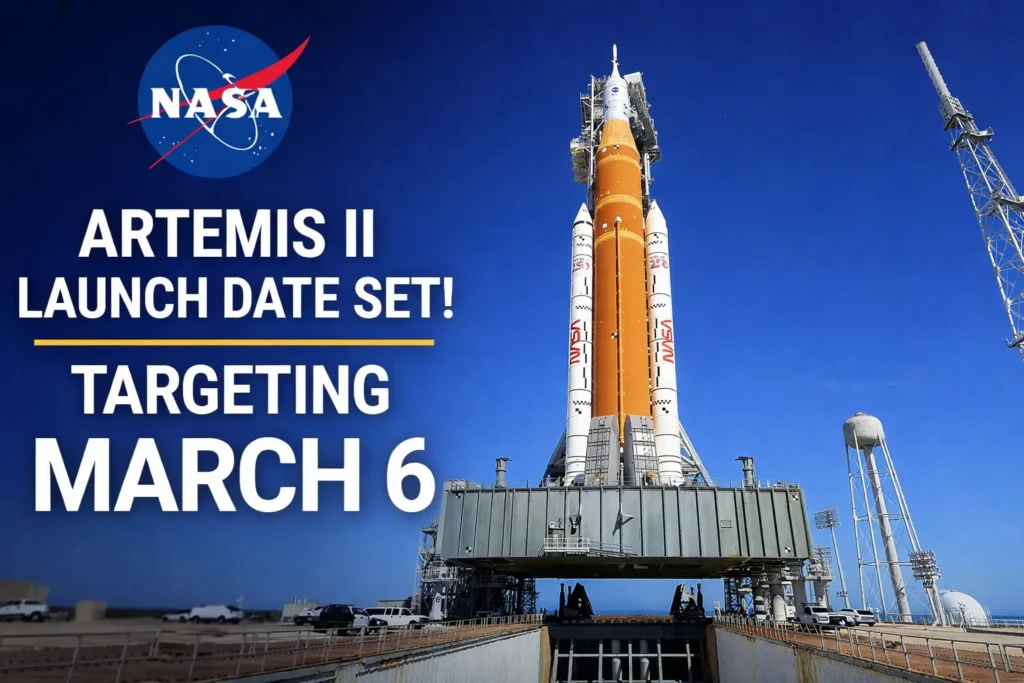
NASA has cleared a significant milestone in preparations for Artemis II, edging the agency closer to what could be a historic March 6, 2026 liftoff — the first crewed mission beyond low Earth orbit in more than five decades. This progress follows the completion of a comprehensive wet dress rehearsal on the Space Launch System (SLS) rocket and the Orion spacecraft at Kennedy Space Center.
Milestone Wet Dress Rehearsal Successfully Completed
During the February 19–20 countdown simulation, engineers fully fueled the SLS core and upper stages with hundreds of thousands of gallons of cryogenic propellant, executed multiple countdown holds, and validated terminal count procedures that mirror launch day operations. Teams also rehearsed closing out the Orion crew module and verified performance of critical ground support systems.
Officials described the nearly 50-hour exercise as a major step toward flight readiness. Most notably, the tanking campaign proceeded without significant hydrogen leaks — an issue that had challenged earlier testing — giving mission managers confidence to designate March 6 as the earliest potential launch date within the March window.
NASA leadership and Artemis launch managers characterized the rehearsal as a strong indicator that corrective actions taken earlier this month have proven effective. Remaining milestones include final system verifications, Flight Termination System testing, and the Flight Readiness Review prior to committing to launch.
Artemis II will carry four astronauts — three from NASA and one from the Canadian Space Agency — on an approximately 10-day mission that will send them around the Moon and back to Earth. The flight will test deep-space life-support systems, navigation, and crew operations beyond low Earth orbit for the first time since the Apollo era.
Looking Back: Hydrogen Leak and February Delay
Earlier in February, Artemis II’s schedule encountered a setback during a prior wet dress rehearsal. Engineers detected a persistent liquid hydrogen leak at the interface between the rocket’s fueling umbilical and the SLS core stage. Leak rates exceeded established safety thresholds, prompting teams to halt the countdown and scrub the February launch opportunity.
Liquid hydrogen is notoriously difficult to manage because of its extremely small molecular size and cryogenic temperature, which can cause seals and fittings to contract and allow microscopic escape paths. Similar challenges had surfaced during earlier SLS testing campaigns.
In addition to the hydrogen leak, teams addressed related ground-support issues and conducted thorough inspections of seals, valves, and filters within the propellant transfer system. NASA subsequently replaced suspect components and implemented procedural adjustments to mitigate recurrence.
The successful follow-up wet dress rehearsal demonstrated that those corrective measures were effective, restoring confidence in the rocket’s fueling systems and enabling NASA to shift its focus back toward launch preparations.
Strategic Importance of Artemis II
Artemis II represents a pivotal step in NASA’s broader Artemis campaign. As the first crewed mission of the program, it serves as a proving ground for the systems that will later support lunar surface missions, including the planned Artemis III landing near the Moon’s south pole later this decade.
While March 6 is currently the earliest target, officials emphasize that launch will occur only when all safety and readiness criteria are satisfied. Additional opportunities remain within the March launch window should minor adjustments be required.
With the successful wet dress rehearsal now complete, NASA moves into the final phase of preparations — bringing humanity one step closer to returning astronauts to deep space and eventually to the lunar surface.