What happened
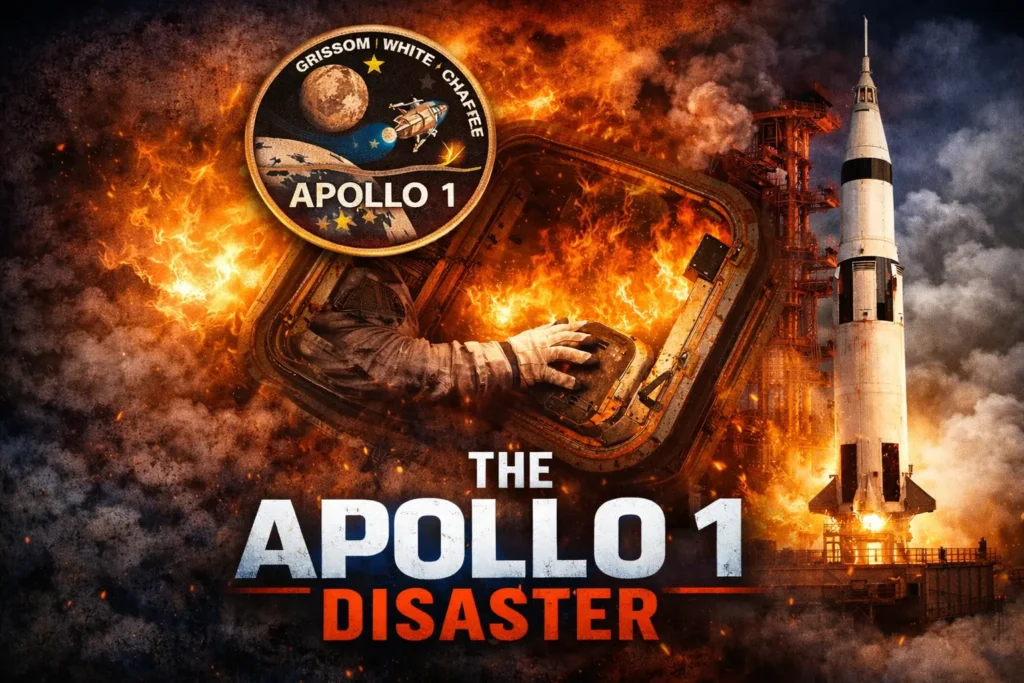
- Date: January 27, 1967
- Crew:
- Virgil “Gus” Grissom (Commander)
- Edward H. White II (Senior Pilot)
- Roger B. Chaffee (Pilot)
The astronauts were inside the Apollo Command Module on the launch pad at Cape Kennedy (now Kennedy Space Center) conducting a “plugs-out” test. This was a rehearsal meant to simulate a launch countdown, but no rocket fuel was loaded—it was supposed to be a non-dangerous test.
During the test, a fire broke out inside the cabin.
The Apollo 1 disaster stands as one of the most sobering events in the history of human space exploration. On January 27, 1967, a catastrophic fire during a routine ground test claimed the lives of three NASA astronauts and forced a fundamental reassessment of spacecraft design, risk management, and organizational culture. Although Apollo 1 never flew in space, its legacy profoundly shaped the success and safety of subsequent Apollo missions, including the historic Moon landing of Apollo 11.
Starlink Gen2: Engineering Evolution of SpaceX’s Next-Generation Broadband Constellation

A Community-Driven Vision for the UK National Earth Observation Conference 2026

Dark Matter’s Hidden Web: Webb Reveals the Invisible Architecture of the Universe
Breaking: NASA Troubleshoots Artemis II Upper Stage Issue — Preparing to Roll Back

NASA’s Artemis II Mission Advances Toward March 6 Launch After Successful SLS Wet Dress Rehearsal

£1 Million Boost for Arts and Humanities Research into Outer Space
Sequence of Events Leading to the Fire
During the test, communication issues and electrical anomalies were reported. At approximately 6:31 p.m. local time, astronauts transmitted a final message indicating a fire inside the cabin. Within seconds, flames spread rapidly throughout the Command Module.
The fire was extinguished only after ground crews managed to open the hatch, but by then all three astronauts had perished. The speed and intensity of the blaze left virtually no opportunity for escape.
Root Causes of the Apollo 1 Disaster
1. Pure Oxygen Cabin Environment
The Apollo Command Module was pressurized with 100% oxygen at higher-than-atmospheric pressure during ground testing. While oxygen simplifies life-support systems, it also dramatically increases fire risk. In such an environment, materials ignite easily and burn with extreme intensity.
2. Flammable Materials Inside the Spacecraft
The cabin contained a large amount of combustible materials, including nylon netting, Velcro fasteners, foam padding, and plastic insulation. These materials became fuel once the fire started, accelerating flame propagation.
3. Electrical System Vulnerabilities
Investigators concluded that the most likely ignition source was an electrical spark caused by damaged or poorly insulated wiring. While the exact source could not be conclusively identified, the spacecraft’s electrical system was found to be inadequately protected against arcing.
4. Hatch Design and Escape Limitations
The Apollo 1 hatch opened inward and required several steps to release. The rapidly increasing internal pressure caused by the fire made it physically impossible for the crew to open the hatch. Ground personnel were also unable to access the cabin quickly enough from the outside.
Findings of the Investigation
The official investigation identified systemic failures, not individual error, as the primary cause of the tragedy. Key conclusions included:
- Insufficient attention to fire safety during ground operations
- Poor integration between contractors and NASA oversight
- A culture that prioritized schedule pressure over risk mitigation
These findings prompted a sweeping review of NASA’s engineering standards and management practices.
Safety Reforms and Engineering Improvements
The Apollo 1 disaster resulted in some of the most significant safety changes in aerospace history:
- Adoption of a mixed oxygen-nitrogen atmosphere for ground tests
- Removal or replacement of flammable materials
- Redesign of the Command Module hatch to open outward in seconds
- Major improvements in wiring, quality control, and testing protocols
These changes delayed the Apollo program by nearly two years but ultimately made it far safer.
Long-Term Impact and Historical Significance
Although Apollo 1 ended in tragedy, its lessons were instrumental in enabling the success of later missions. Every crewed Apollo flight that followed benefited directly from the safety reforms inspired by the accident.
The mission designation “Apollo 1” was officially retained to honor the fallen astronauts, marking a rare acknowledgment of a mission that never left the ground.
In the broader context of spaceflight history, Apollo 1 established a lasting principle: failures must be confronted openly, analyzed rigorously, and used to drive meaningful change.
Conclusion
The Apollo 1 disaster was not merely an accident; it was a defining moment that reshaped NASA’s approach to engineering, safety, and accountability. The loss of Grissom, White, and Chaffee underscored the inherent risks of space exploration and the necessity of uncompromising safety standards.
Their sacrifice ultimately contributed to one of humanity’s greatest achievements—the successful landing of astronauts on the Moon—and continues to influence spaceflight design and safety philosophy to this day.