
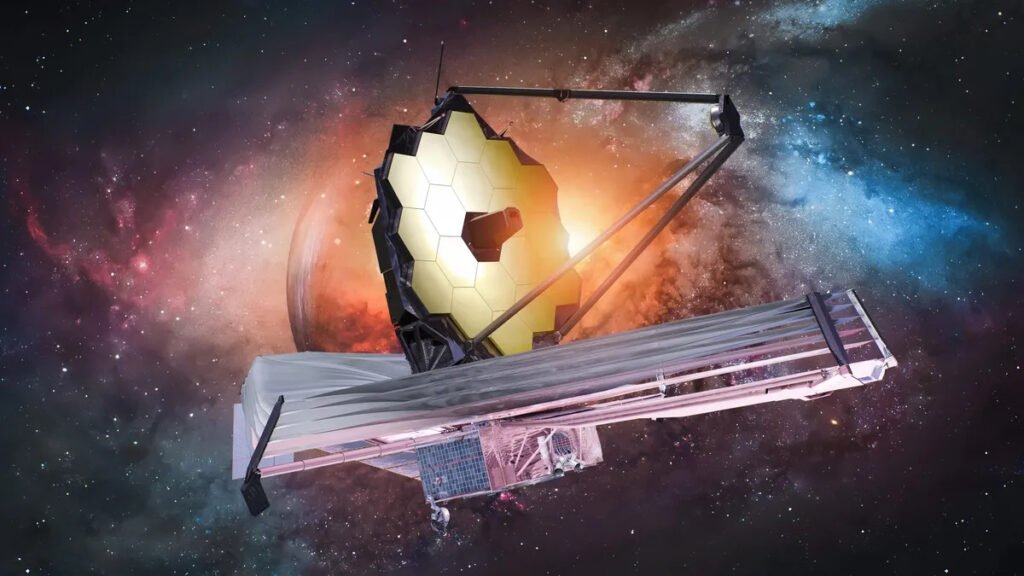
Photo: James Webb Space Telescope by Getty Images
1. A Telescope Built for the Unknown
Astronomy periodically reaches moments when its existing tools can no longer keep pace with its questions. By the early 21st century, scientists found themselves at such a turning point. Observations had revealed galaxies forming in the distant past, planets orbiting other stars, and hints of complex chemistry beyond our solar system—but many of the universe’s deepest mysteries remained just out of reach.
To move forward, astronomers needed more than incremental improvement. They needed a fundamentally new kind of observatory, one designed not merely to sharpen existing views, but to explore regions of cosmic history that had never been seen before. That need gave rise to the James Webb Space Telescope, often described as humanity’s most ambitious space observatory to date.
2. The Limits of Earlier Space Telescopes
Space telescopes revolutionized astronomy by escaping Earth’s atmosphere, but even the most iconic instruments had natural limitations.
Visible-light telescopes excel at capturing stars and galaxies that shine brightly in optical wavelengths. However, much of the universe is hidden behind thick clouds of cosmic dust that scatter or block visible light. Regions where stars and planets are born, as well as the earliest galaxies, often remain obscured when viewed this way.
Distance presents another challenge. As the universe expands, light from extremely distant objects stretches into longer wavelengths—a phenomenon known as redshift. By the time light from the first galaxies reaches Earth, much of it no longer lies in the visible spectrum.
Simply building a larger visible-light telescope could not overcome these barriers. To see further and deeper, astronomers needed to observe the universe in a different way.
Long March-10: The Rocket That Could Take China to the Moon

The Liqing-2 Engine: Powering China’s Commercial Reusable Rockets

China Tests a 240-Ton Reusable Rocket Engine
Taking AI to a New REALM: Space-Optimised Machine Learning Comes of Age at Space Park Leicester
UK Planetary Scientists Discuss Future Mission to Enceladus at Space Park Leicester

Government Minister Visits Space Park Leicester, Highlighting the UK’s Growing Space Ecosystem
3. Why Infrared Is the Key to the Early Universe
Infrared astronomy offers a powerful solution. Infrared light can pass through dust clouds that block visible wavelengths, revealing hidden structures where stars and planets take shape. In star-forming regions, infrared observations allow scientists to peer directly into stellar nurseries that were previously invisible.
Infrared light is also essential for looking back in time. As the universe expands, light from the earliest stars and galaxies is stretched into the infrared by the time it reaches us. Observing in these wavelengths effectively turns the telescope into a time machine, capturing images from billions of years ago.
By studying galaxies across cosmic time in infrared light, astronomers can trace how galaxies grow, merge, and evolve—connecting the universe’s earliest structures to those we observe today.
4. Science Goals That Shaped the Mission
The design of Webb was driven by ambitious scientific goals.
One primary objective is the study of the first stars and galaxies that formed after the Big Bang. These objects transformed the early universe, yet remain among the least understood.
Another key goal is understanding how stars and planetary systems form. Webb’s infrared instruments can examine protoplanetary disks—vast rings of gas and dust around young stars—revealing the conditions that lead to planet formation.
Perhaps most captivating is Webb’s role in exoplanet science. By analyzing starlight that passes through a planet’s atmosphere, Webb can detect the chemical fingerprints of molecules such as water vapor, carbon dioxide, and methane. These measurements provide critical clues about atmospheric composition and potential habitability.
5. Engineering a Revolutionary Observatory
Achieving these goals required engineering on an unprecedented scale. Webb’s primary mirror consists of 18 hexagonal segments coated in gold, chosen for its ability to reflect infrared light efficiently. When fully deployed, the mirror spans 6.5 meters—far larger than any previous space telescope mirror.
Equally striking is Webb’s sunshield, roughly the size of a tennis court. This multi-layered structure blocks heat from the Sun, Earth, and Moon, allowing the telescope to cool to extremely low temperatures. Such thermal stability is essential for detecting faint infrared signals.
Webb operates far from Earth, orbiting the Sun near the second Lagrange point (L2), about 1.5 million kilometers away. This location provides a stable environment and uninterrupted views of the cosmos.
6. A Global Scientific Effort
The James Webb Space Telescope is the product of decades of planning and international collaboration. Led by NASA, with major contributions from European Space Agency and Canadian Space Agency, the mission represents one of the most complex cooperative scientific projects ever undertaken.
Such missions demand patience and persistence. Technical challenges, long development timelines, and rigorous testing are unavoidable when building an observatory designed to operate flawlessly millions of kilometers from Earth. Webb’s success reflects the collective commitment of thousands of scientists, engineers, and institutions worldwide.
7. Conclusion: A Telescope Designed for Discovery
The James Webb Space Telescope was not built simply to refine what we already knew. It was designed to explore the unknown—to look beyond cosmic dust, peer deeper into time, and reveal phenomena never before observed.
As Webb continues its mission, it is already reshaping our understanding of the universe. More importantly, it is doing exactly what it was intended to do: not just answering long-standing questions, but raising entirely new ones. For astronomy, these new eyes on the cosmos mark the beginning of a transformative era of discovery.
Thanks for sharing. I read many of your blog posts, cool, your blog is very good.