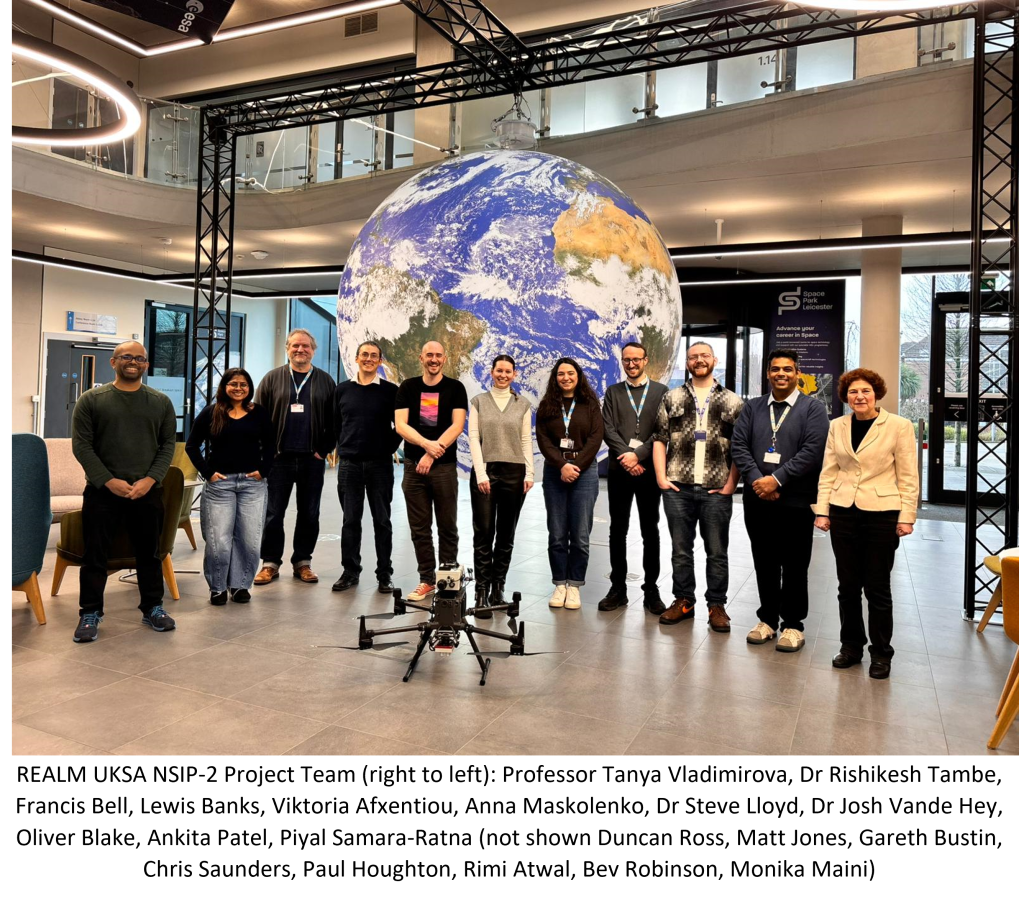
REALM Team – Credits: SPL
Artificial intelligence is rapidly reshaping the space sector — but deploying AI beyond Earth remains a formidable technical challenge. A new initiative from the University of Leicester, based at Space Park Leicester, aims to change that.
With more than £680,000 in support from the UK Space Agency through its National Space Innovation Programme (NSIP), an interdisciplinary team has launched REALM — Rapid information extraction for environmental remote sensing on board spacecraft through Application of Light Machine Learning models in payload computing systems.
The ambition is clear: make space-based AI more efficient, more affordable, and more mission-ready.
The Core Challenge: AI in a Resource-Constrained Environment
Artificial intelligence systems on Earth benefit from virtually unlimited cloud computing power, large memory capacity, and constant updates. Satellites and spacecraft, on the other hand, operate under strict constraints:
- Limited onboard memory
- Restricted computational power
- Power consumption limitations
- Radiation-hardened hardware requirements
- No real-time cloud fallback
REALM addresses this head-on by delivering an end-to-end, space-optimised machine learning service — from algorithm design and training to validation and in-space deployment.
The programme is led by Professor Tanya Vladimirova, a recognised expert in machine learning for space systems, alongside co-investigators Piyal Samara-Ratna, Dr Joshua Vande Hey, and Oliver Blake. Their goal is not simply to adapt terrestrial AI for space, but to engineer AI systems specifically for orbital environments.
Smarter, Lighter Neural Networks
A key breakthrough within REALM lies in the optimisation of Convolutional Neural Networks (CNNs), widely used in computer vision tasks such as Earth observation.
Using an innovative Sparse-Split-Parallelism framework, the team demonstrated that high-performing CNN models can be reduced in size by over 50% — without sacrificing accuracy.
This is a crucial step forward. In orbit, reducing model size directly translates into:
- Lower memory footprint
- Reduced computational load
- Faster execution
- Improved onboard autonomy
The result is more feasible deployment of deep learning directly on spacecraft, enabling real-time analysis without constant data downlink to Earth.
BepiColombo Separates From Its Transfer Module Today
BepiColombo separates from its Mercury Transfer Module today, 3 September 2026, at 14:00 CEST (12:00…

BepiColombo Sheds Its Transfer Module as the Mercury Arrival Begins
After eight years and nine planetary flybys, ESA–JAXA’s BepiColombo mission is about to reach a…

A SpaceX Rocket Stage Is About to Crash into the Moon. Here’s Why Scientists Are Excited
Juno Peers Beneath Io’s Surface and Finds Heat Rising From Within

NASA Reveals “Asteroid” Is Actually an Active Comet, Highlighting the Importance of Precision Planetary Defense

Psyche’s Close Encounter with Mars Gives NASA a Crucial Dress Rehearsal
Ariane 6 Sets a New European Record with Upgraded Boosters

Spacewear CEO Corinna Sperandini Receives Italy’s “Le donne di ora” Award – But Let’s talk about Technology and Innovation
Cover Image: Le Donne di Ora Prize – Credits Invitalia The recognition highlights a growing…
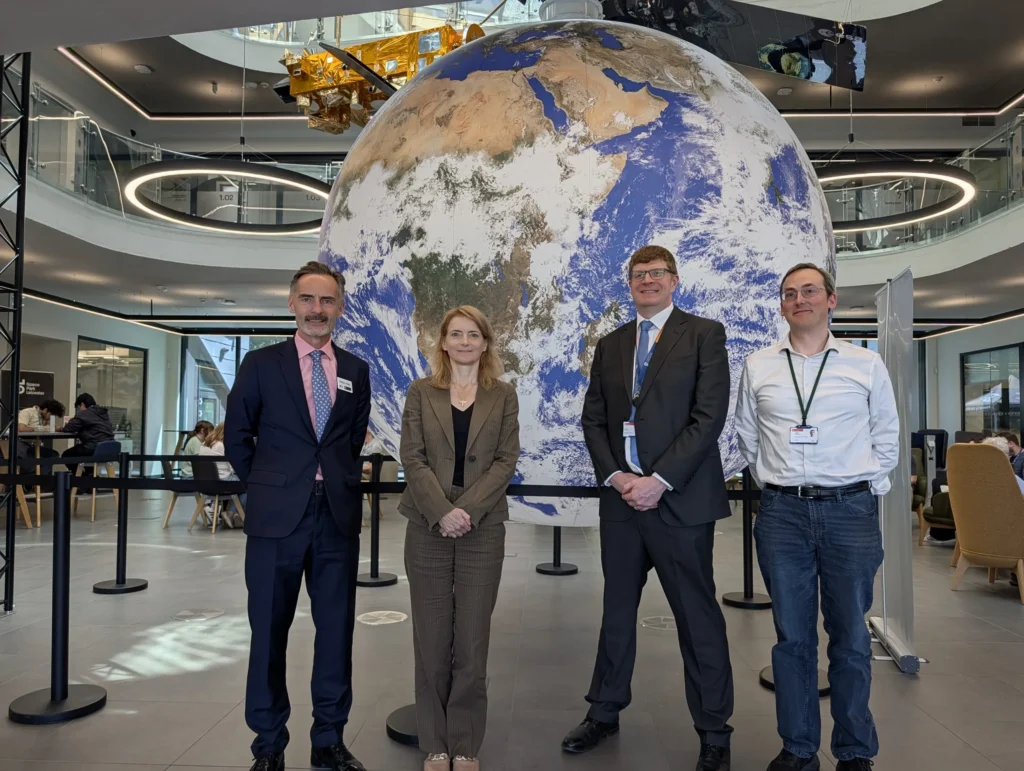
Leicester Showcases Why the UK Space Sector Is More Than Just Launches
From Lab to Real-World Applications
REALM is not just theoretical research. Through UK Space Agency funding, its capabilities have already been applied to:
- Traffic monitoring
- Early wildfire detection
Both applications demonstrate how onboard AI can extract actionable information from Earth observation data in near real-time — potentially accelerating response to environmental and societal challenges.
As Iain Hughes, Head of the National Space Innovation Programme at the UK Space Agency, highlighted, initiatives like REALM strengthen the UK’s position at the forefront of space innovation while enabling practical solutions for planetary monitoring.
A Complete End-to-End Pipeline
REALM’s strength lies in its integrated approach:
1. Custom AI Algorithm Development
The team develops mission-specific CNN-based architectures tailored to payload constraints.
2. Advanced Training Data Generation
Training datasets are built from diverse sources, including:
- Earth Observation archives
- Custom drone and aircraft data
- Visible, multispectral, hyperspectral, LiDAR, and infrared datasets
- Synthetic multi-spectral Earth observation data developed in collaboration with atmospheric chemistry experts GRASP and in-space servicing, assembly and manufacturing (ISAM) initiatives
3. Cost-Effective Validation
Instead of relying solely on expensive spaceflight demonstrations, REALM utilises:
- An in-house drone laboratory
- Custom and off-the-shelf drone platforms
- Onboard GPUs for real-time validation
- Aircraft demonstrations
This dramatically reduces cost and risk prior to space deployment.
4. Space-Optimised Hardware
The team is also developing a novel space-optimised GPU designed to interface with a wide range of payloads. The first in-space demonstration is scheduled for Q3 2026 — a milestone that could further solidify the UK’s role in onboard AI innovation.
Why This Matters for the Future of Space
As satellite constellations grow and data volumes explode, downlinking all raw data to Earth is neither efficient nor scalable. The future lies in edge computing in orbit — satellites that can think, filter, and decide autonomously.
REALM accelerates this shift by:
- Reducing AI deployment barriers
- Lowering development and validation costs
- Shortening time-to-mission
- Increasing mission return on investment
For Earth observation, climate monitoring, disaster response, and even future deep-space missions, lightweight onboard intelligence will become indispensable.
The Bigger Conversation: AI & Data Centres in Space
At SpaceInfo Club, we have recently explored how artificial intelligence and data processing are evolving beyond Earth in our latest video dedicated to datacenters and AI in space.
That discussion complements the REALM initiative perfectly: while orbital data centres and in-space processing architectures are gaining attention globally, REALM demonstrates how practical, mission-ready AI solutions are already being engineered today.
If you want to understand how edge AI, orbital computing, and next-generation space infrastructure intersect, you can watch our latest deep dive on the SpaceInfo Club YouTube Channel.
A Strategic Move for the UK Space Ecosystem
The University of Leicester has long been recognised for its research excellence, and initiatives like REALM reinforce its position as a key contributor to the UK’s growing space ecosystem.
By combining academic expertise, government backing, and practical validation infrastructure, Space Park Leicester is not only advancing AI technology — it is building the operational foundation for autonomous space missions.
The message is clear: the future of space is intelligent, autonomous, and increasingly data-driven. REALM represents a significant step toward making that future scalable and accessible.
And for those building the next generation of space systems, that’s a development worth watching closely.