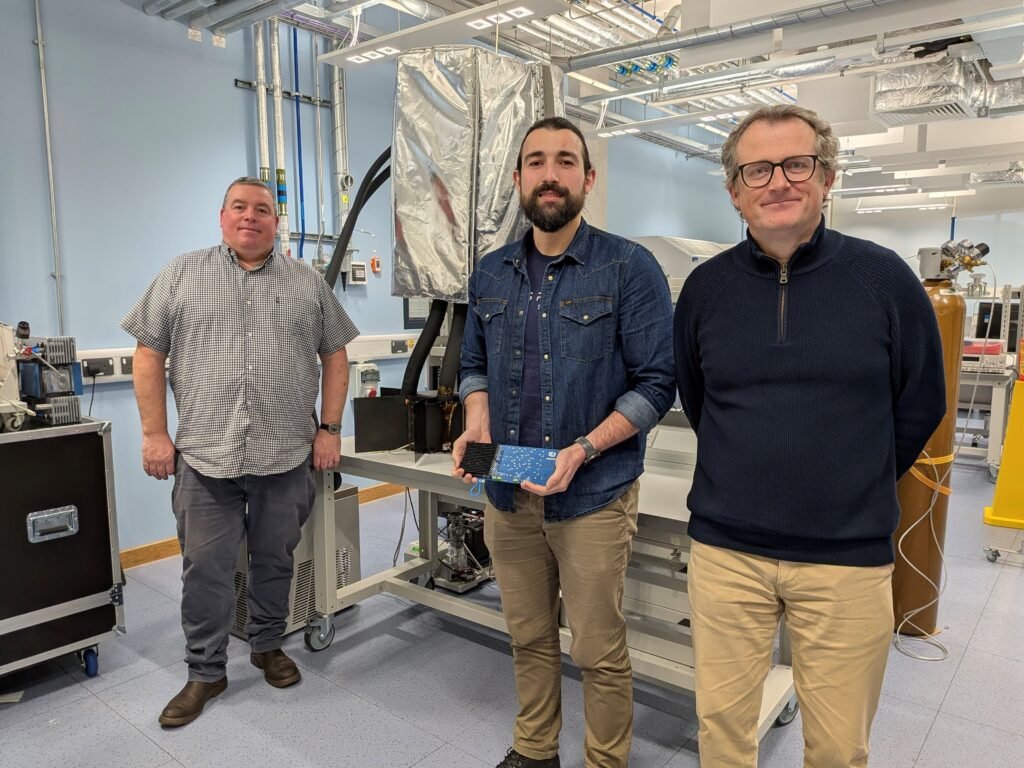
SPL and Oviedo team – Photo University of Leicester
A major milestone in space power systems has just been reached through a collaboration between the University of Leicester and leading Spanish institutions, marking a significant step toward more resilient and efficient planetary exploration.
Engineering teams from the UK and Spain have successfully completed the first end-to-end validation of a hybrid power architecture that combines radioisotope and solar energy—two technologies traditionally used separately in space missions. The result could redefine how future spacecraft operate in some of the most extreme environments in the Solar System.
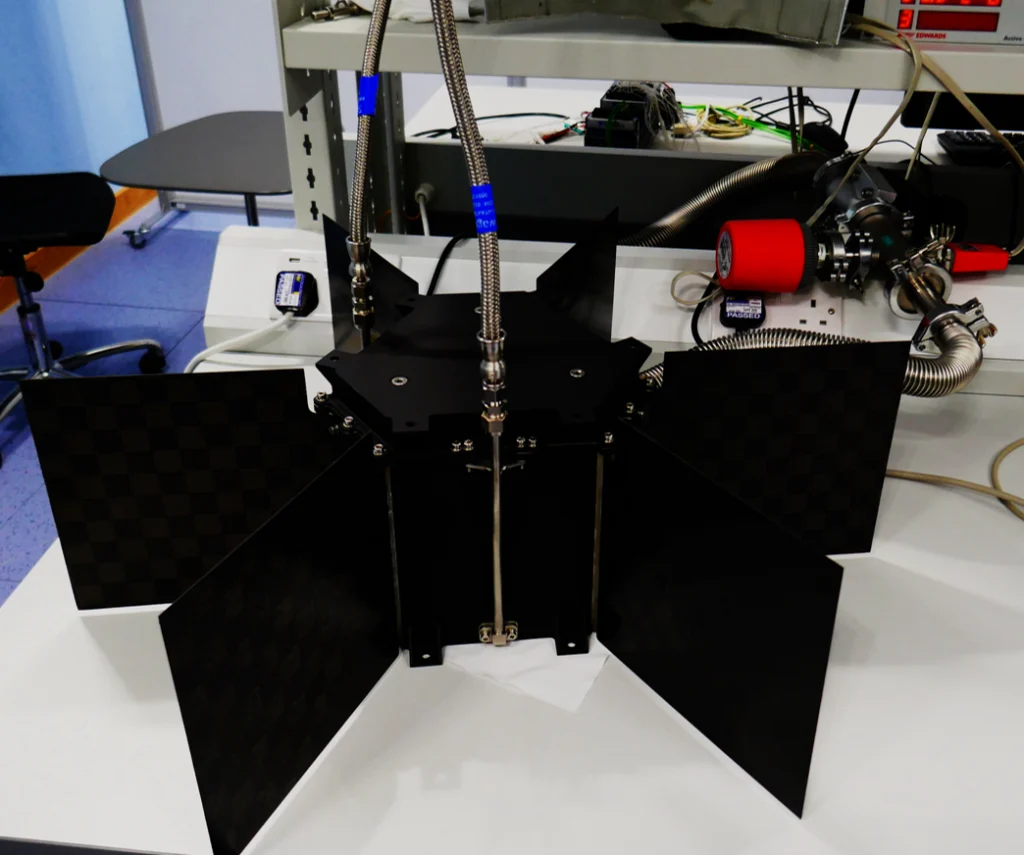
RTG on test in lab – Photo University of Leicester
Solving the “Power Gap” in Space Exploration
Power availability remains one of the most critical constraints in mission design. Solar panels, while widely used, become far less effective in low-light conditions—such as on Mars during dust storms or on the Moon during its two-week-long night. On the other hand, Radioisotope Thermoelectric Generators (RTGs), powered in this case by Americium-241, provide a steady and long-lasting energy source but are typically limited in peak power output.
This new hybrid system addresses that limitation by intelligently combining both technologies.
The architecture allows spacecraft to:
- Draw high peak power from solar arrays when sunlight is available
- Rely on continuous RTG output to maintain operations and thermal stability during darkness or harsh environmental conditions
- Optimize system mass, freeing up capacity for scientific instruments
Rather than choosing between solar or nuclear power, this approach enables missions to dynamically switch between the two depending on environmental conditions and operational needs.
Celeste Takes Flight: Europe’s Next Step in Satellite Navigation Innovation

Dallas Campbell to Bring the Story of Space Exploration to Life at Space Park Leicester
UK Space Science Sets Course for 2035: Leicester Event to Shape the Future
Boeing Starliner – Key Anomalies Analysis
Long March-10: The Rocket That Could Take China to the Moon
The Liqing-2 Engine: Powering China’s Commercial Reusable Rockets
China Tests a 240-Ton Reusable Rocket Engine
Taking AI to a New REALM: Space-Optimised Machine Learning Comes of Age at Space Park Leicester
Tested in the UK, Built on European Collaboration
The system was validated at Space Park Leicester, a £100 million innovation hub dedicated to space research and technology. The testing demonstrated full end-to-end performance, confirming that the hybrid concept is not just theoretical—but operationally viable.
The project brought together:
- The University of Leicester, contributing expertise in radioisotope power systems and thermal management
- The University of Oviedo, specializing in power electronics and system architecture
- The University of Vigo, providing advanced thermal simulations and environmental modelling
The work was carried out under a programme funded by the European Space Agency (ESA), highlighting Europe’s growing investment in next-generation space infrastructure.
Industry Link: From Research to Real Missions
A key player in translating this research into real-world applications is Perpetual Atomics, a spinout from the University of Leicester. With over two decades of expertise in deep-space nuclear systems, the company focuses on the full value chain—from nuclear fuel to integrated power systems.
This vertical integration is particularly important for missions targeting extreme environments, where reliability and longevity are mission-critical.
Why This Matters
The implications of hybrid power systems are far-reaching.
Future missions to the Moon, Mars, and beyond will increasingly demand:
- Longer operational lifetimes
- Greater autonomy
- The ability to survive extreme temperature cycles
Hybrid RTG-solar systems could become a baseline architecture for:
- Lunar rovers operating through long nights
- Mars missions facing global dust storms
- Deep space probes venturing far from the Sun
As Dr. Ramy Mesalam from the University of Leicester noted, the future of space power is no longer about choosing one technology over another—but about integrating them intelligently.
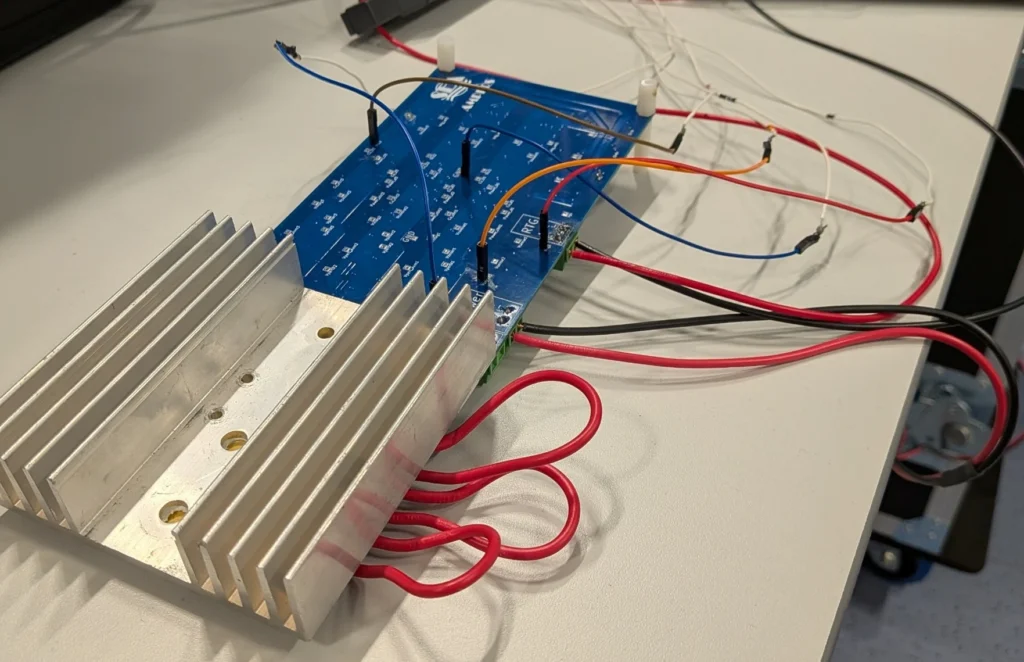
Testing Power Management Development Board – Photo University of Leicester
A Glimpse of the Next Generation
This successful demonstration represents more than a technical achievement—it’s a shift in design philosophy.
By combining constant nuclear power with flexible solar generation, engineers are building systems that are not only more robust, but also more adaptable to the unknowns of planetary exploration.
In a future where missions push further into the Solar System and operate in increasingly hostile environments, hybrid power could be the key that unlocks the next era of discovery.