Analysis by a Space Systems Engineer
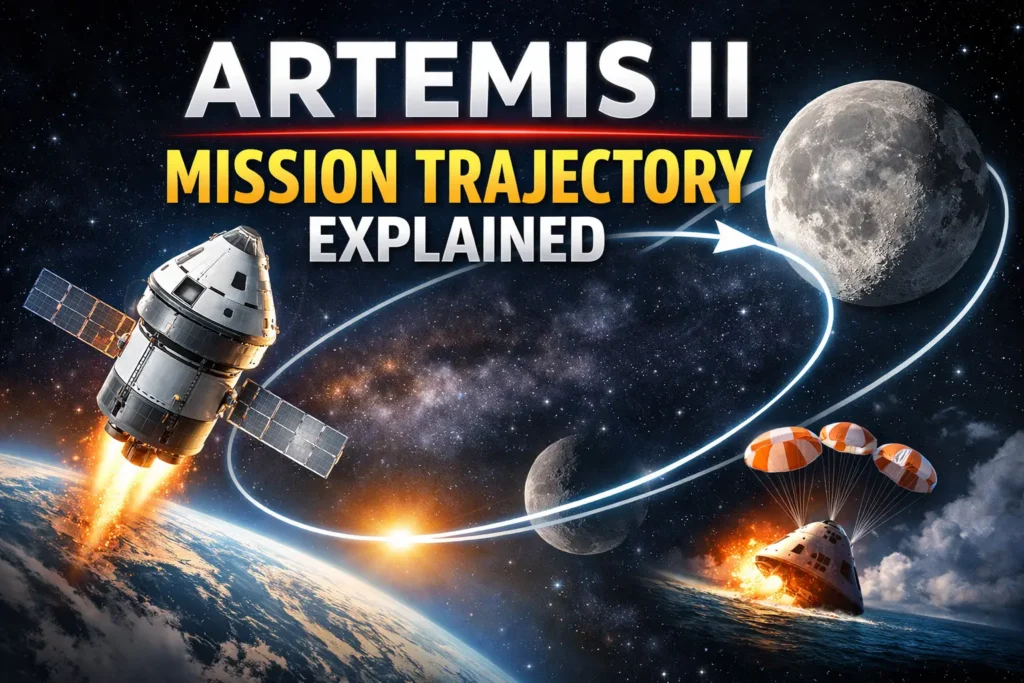
NASA’s Artemis II mission represents a historic return of human spaceflight beyond low Earth orbit. For the first time since Apollo 17 in 1972, astronauts will travel to the vicinity of the Moon. While Artemis II will not land on the lunar surface, its trajectory design is one of the most critical and sophisticated aspects of the mission.
This article explains the Artemis II flight path, from launch to splashdown, and why NASA chose a hybrid free-return trajectory for this crewed lunar flyby.
Overview of the Artemis II Mission
Artemis II is the first crewed mission of NASA’s Artemis program, using the Space Launch System (SLS) rocket and the Orion spacecraft. The mission’s primary objectives are to:
- Validate Orion’s life-support, navigation, and propulsion systems with astronauts onboard
- Demonstrate safe human operations beyond low Earth orbit
- Prove the spacecraft’s ability to travel to the Moon and return safely
The mission duration is expected to be approximately 10 days, carrying a crew of four astronauts.
Phase 1: Launch and Initial Earth Orbit
Artemis II will launch from Kennedy Space Center, Florida, aboard the SLS rocket. After liftoff:
- Orion is inserted into a temporary low Earth orbit (LEO)
- The spacecraft completes initial system checks
- Crew members verify life-support, guidance, and communications systems
This phase allows engineers to confirm spacecraft health before committing to lunar departure.
Phase 2: Highly Elliptical Earth Orbits
Unlike Apollo missions, Artemis II does not perform an immediate trans-lunar injection. Instead:
- Orion completes two highly elliptical Earth orbits
- Each orbit raises the spacecraft’s apogee (farthest point from Earth)
- This gradual buildup reduces risk and allows additional system verification
From an engineering perspective, this staged approach provides abort flexibility, a major safety upgrade compared to earlier lunar missions.
Celeste Takes Flight: Europe’s Next Step in Satellite Navigation Innovation

Dallas Campbell to Bring the Story of Space Exploration to Life at Space Park Leicester

UK Space Science Sets Course for 2035: Leicester Event to Shape the Future
Boeing Starliner – Key Anomalies Analysis
Long March-10: The Rocket That Could Take China to the Moon
The Liqing-2 Engine: Powering China’s Commercial Reusable Rockets
China Tests a 240-Ton Reusable Rocket Engine

Taking AI to a New REALM: Space-Optimised Machine Learning Comes of Age at Space Park Leicester

UK Planetary Scientists Discuss Future Mission to Enceladus at Space Park Leicester
Phase 3: Trans-Lunar Injection (TLI)
Once all systems are confirmed nominal:
- Orion performs a Trans-Lunar Injection (TLI) burn
- This burn places the spacecraft on a lunar-bound trajectory
- Orion separates from the SLS upper stage and begins independent flight
At this point, the mission fully commits to leaving Earth orbit and entering deep space.
Phase 4: Hybrid Free-Return Trajectory
What Is a Free-Return Trajectory?
A free-return trajectory is a flight path where gravity — not propulsion — brings the spacecraft back to Earth after passing the Moon.
For Artemis II, NASA selected a hybrid free-return trajectory, which offers:
- Passive safety: if major propulsion systems fail, Orion will still return to Earth
- Improved thermal and communications conditions
- Flexibility for small trajectory correction maneuvers
This design reflects decades of advances in orbital mechanics, navigation, and risk modeling.
Phase 5: Lunar Flyby on the Far Side
Approximately four days after launch, Orion reaches the Moon:
- The spacecraft passes behind the Moon, out of direct contact with Earth
- Closest approach occurs at thousands of miles above the lunar surface
- Orion does not enter lunar orbit
This wide, distant flyby minimizes fuel use while fully testing deep-space operations, navigation accuracy, and spacecraft autonomy.
Phase 6: Return to Earth
After the lunar flyby:
- The Moon’s gravity bends Orion’s trajectory back toward Earth
- Only small correction burns are required
- The spacecraft accelerates to re-entry speeds exceeding 39,000 km/h
Before atmospheric entry:
- The service module separates
- The crew module aligns for heat-shield-first re-entry
Phase 7: Atmospheric Re-Entry and Splashdown
Orion re-enters Earth’s atmosphere at one of the highest speeds ever experienced by a crewed spacecraft. Key events include:
- Extreme thermal loads on the heat shield
- Rapid deceleration
- Deployment of parachutes
- Pacific Ocean splashdown and crew recovery
This phase validates Orion’s ability to safely return humans from lunar-distance missions — a requirement for future Artemis landings.
Why the Artemis II Trajectory Matters
From an engineering standpoint, Artemis II is not about spectacle — it is about certification.
This trajectory allows NASA to:
- Prove crew safety beyond low Earth orbit
- Validate navigation and communications in cislunar space
- Test mission operations for long-duration lunar flights
- Reduce risk before committing to lunar orbit and surface missions
Every trajectory choice reflects lessons learned from Apollo, Space Shuttle, and modern autonomous spacecraft.
Looking Ahead
Artemis II sets the foundation for:
- Artemis III, which aims to land astronauts on the Moon
- Sustained human presence in lunar orbit and on the surface
- Future missions to Mars
The success of this carefully designed trajectory is a prerequisite for humanity’s next giant leap.
About SpaceInfo Club
SpaceInfo Club is dedicated to clear, accurate, and expert-level insights into space science, engineering, and exploration.