
Join the mailing list Free weekly briefing, no spam.
SpaceX launched Starship Flight 15 from Starbase, Texas, on November 13, 2026, and on November 14 the launch tower caught the Ship 42 upper stage in its arms. It is the first time SpaceX has caught a Starship upper stage. The booster did not repeat the feat: Booster 22 aborted its own catch and came down in the Gulf of Mexico.
What happened on Flight 15
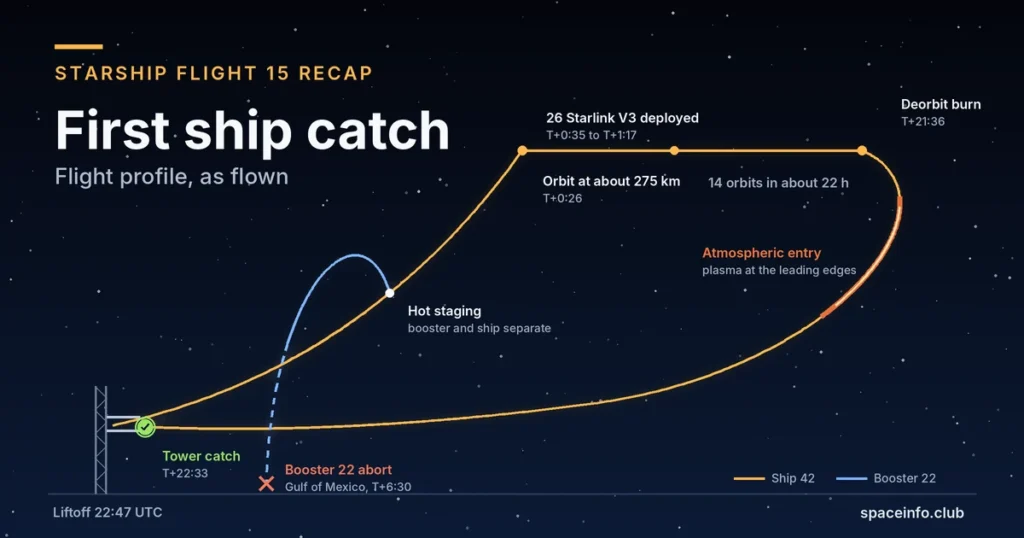
Liftoff came at 5:47 p.m. EST (22:47 UTC) on Friday, November 13, from Pad 2 at Starbase, two minutes after the planned time. The vehicles were Super Heavy Booster 22 and Ship 42, both Block 3 hardware.
Ship 42 finished its ascent burn about 26 minutes after liftoff and entered orbit at roughly 275 km. Starship has now reached orbit twice. Flight 14 did it first, on September 28.
Deployment began around the 35-minute mark. All 26 Starlink V3 satellites were out by 1 hour 17 minutes. SpaceX then passed on the early ocean-return option and flew the full mission, 14 orbits in about 22 hours.
On Saturday, November 14, the ship fired one engine for 10 seconds at about 3:23 p.m. EST (20:23 UTC) to leave orbit. SpaceX called the burn nominal. Plasma formed along the leading edges during reentry. At about 4:20 p.m. EST (21:20 UTC) the two chopstick arms on the Starbase tower closed around Ship 42, about 22.5 hours after liftoff. Source: Space.com live coverage.
Why Booster 22 did not come back
SpaceX wanted to catch Booster 22 on Pad 2 as well. It would have been the first recovery of a Version 3 Super Heavy. The company had already caught three V1 boosters and reused two of them.
The flight data show a chain of small departures. One of the 33 Raptor engines dropped out after stage separation, so boostback ran on 32. SpaceX later said early indications pointed to a low fuel mass alarm that ended the boostback burn early. The landing burn started with 13 engines lit, as planned, but the booster detected that it was not in position for a catch and aborted on its own. It hovered, cut its engines, and its flight termination system fired just above the Gulf of Mexico, about 6.5 minutes after liftoff.
SpaceX has not named a root cause. The abort itself worked as designed, since the booster chose a safe offshore zone over a bad approach to the tower.
What the ship catch changes
Catching a booster saves one stage. Catching the ship removes the last expendable step in the Starship cycle, since the upper stage used to end each flight in the ocean. SpaceX has now shown that a ship can survive an orbital reentry, find the tower and be held by the arms.
Full reuse still needs both stages on the same flight, and that has not happened. Interesting Engineering notes that SpaceX has not yet recovered both stages on one mission. The heat shield also remains a question: the ship came back, but the inspection load per flight is unknown.
SpaceX is investigating the booster abort, and the coverage I reviewed gives no date for Flight 16. Sources: Interesting Engineering and Space.com.
An engineer’s view
What struck me most was the precision of control over a vehicle this large, and how well the aerodynamics were mastered during the descent. What struck me even more was the range of dynamics involved. A ship at orbital velocity and a ship almost hovering in front of the catch structure are in very different regimes of force, inertia and speed. SpaceX took one vehicle from the first to the second in a single flight.
Frequently asked questions
Did SpaceX catch Starship on Flight 15?
Yes, the ship. The tower arms at Starbase caught Ship 42 at about 4:20 p.m. EST (21:20 UTC) on November 14, 2026. The booster was not caught.
How long did Flight 15 last?
About 22 hours 33 minutes, from liftoff at 22:47 UTC on November 13 to the catch. Ship 42 completed 14 orbits.
What did Starship carry on Flight 15?
It deployed 26 Starlink V3 satellites, starting about 35 minutes after liftoff.
Why did the booster not land at the tower?
Booster 22 detected that it was out of position for a catch and aborted to an offshore zone in the Gulf of Mexico. SpaceX had not confirmed a root cause as of November 14.
Sources
- Space.com, Flight 15 live updates
- Space.com, booster abort report
- Interesting Engineering, Ship 42 catch
About the author
Sebastiano is a space engineer. He runs SpaceInfo Club, where he writes about spaceflight and aerospace engineering.