
Join the mailing list Free weekly briefing, no spam.
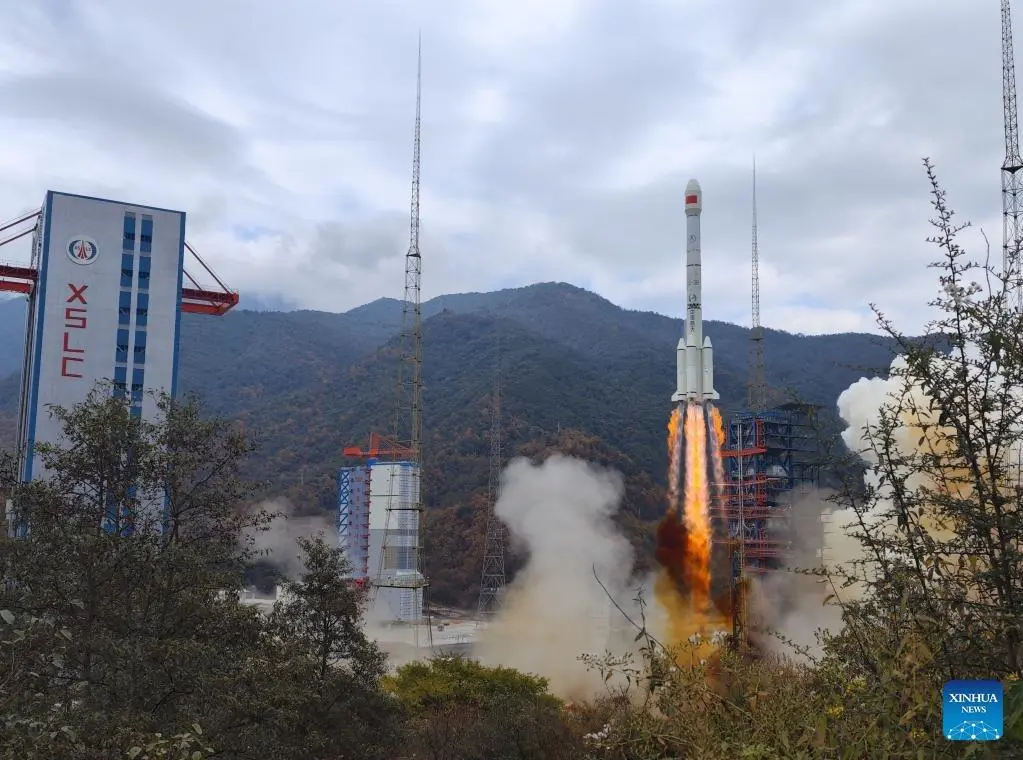
Long March 3B – Credit XINHUA
One of the most important milestones in China’s lunar exploration program occurred on February 11, 2026, when the country conducted a key flight test of the Long March-10 rocket and the new Mengzhou crewed spacecraft.
The mission was designed to validate several critical systems for future human missions to the Moon.
The test began with a low-altitude demonstration flight of a prototype Long March-10 rocket launched from the Wenchang Space Launch Site in southern China. Mounted on top of the rocket was a prototype of the Mengzhou spacecraft, which will eventually carry astronauts on lunar missions.
During the ascent, engineers triggered a maximum dynamic pressure (Max-Q) abort test, one of the most demanding safety scenarios in crewed spaceflight. Max-Q is the moment when aerodynamic forces on a rocket are at their strongest. If a failure occurs during this phase, the spacecraft must be able to escape the rocket immediately.
In the test, the Mengzhou spacecraft successfully separated from the rocket and descended under parachutes, splashing down safely in the ocean.
At the same time, the rocket’s first-stage booster continued its flight before performing a controlled descent and splashdown in the sea. Engineers later simulated recovery operations using telemetry data, testing procedures that could be used for reusable booster systems.
The test accomplished several firsts for China’s space program:
- The first flight test of the Long March-10 prototype
- China’s first Max-Q abort test of a crewed spacecraft
- The first sea recovery of both a crew capsule and rocket stage
- The first launch from a new heavy-rocket launch tower at Wenchang
All of these elements are crucial for China’s long-term goal of landing astronauts on the Moon before 2030.
The Long March-10 will serve as the backbone of China’s crewed lunar architecture. It is designed to launch astronauts aboard the Mengzhou spacecraft, which will rendezvous with a lunar lander before traveling to the Moon’s surface.
With this successful test, China has moved one step closer to making its lunar ambitions a reality.
PRIMA Far-Infrared Telescope: NASA’s First Probe Explorer and What It Means for Astrophysics
Image Credits: NASA On September 23, 2026, NASA announced that PRIMA (PRobe far-Infrared Mission for…

HMS Daring Representative Visit Space Park Leicester as Royal Navy and Space Sector Strengthen Ties
tag: Space Park Leicester Cover image credits: SPL Representatives of HMS Daring have visited Space…

Starship Goes Orbital – How Flight 14 is going
Starship Flight 14 has put the world’s largest rocket into orbit for the first time….

BepiColombo Separates From Its Transfer Module Today
BepiColombo separates from its Mercury Transfer Module today, 3 September 2026, at 14:00 CEST (12:00…

BepiColombo Sheds Its Transfer Module as the Mercury Arrival Begins
After eight years and nine planetary flybys, ESA–JAXA’s BepiColombo mission is about to reach a…
A SpaceX Rocket Stage Is About to Crash into the Moon. Here’s Why Scientists Are Excited

Juno Peers Beneath Io’s Surface and Finds Heat Rising From Within