
Join the mailing list Free weekly briefing, no spam.
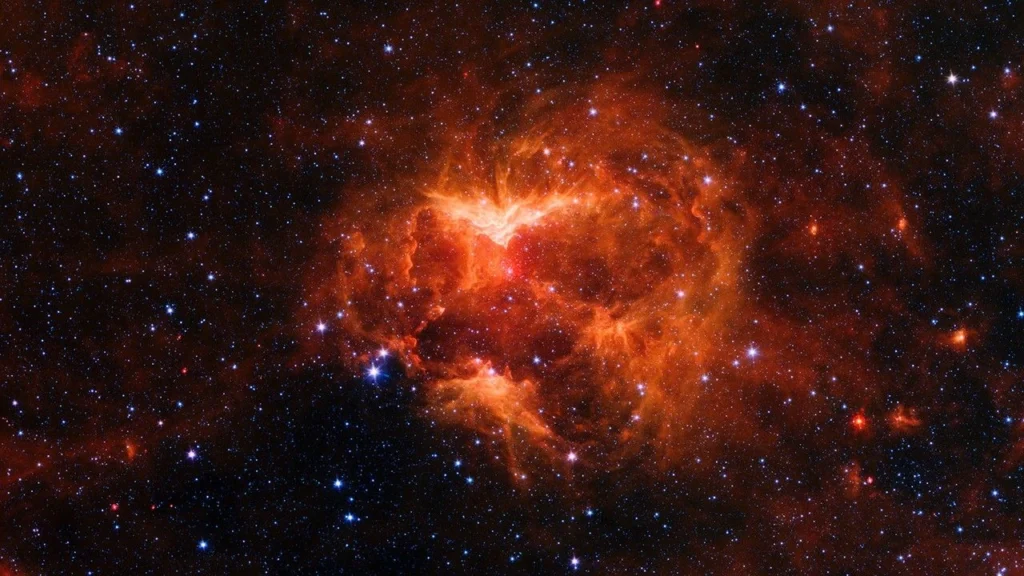
Jack-o’-lantern Nebula – Credits- NASA’s Science Mission Directorate, NASA, Caltech, JPL
Key takeaways
- The Orionid meteor shower peaks in the pre-dawn hours of 21–22 October 2026, but a bright, about 80% lit Moon sets only around 3 a.m., so the best window runs from moonset to dawn.
- The Taurids, nicknamed the “Halloween fireballs”, are predicted to peak on 5 November (South Taurids) and 12 November (North Taurids), both close to the 9 November new Moon, so dark skies are on your side.
- There is no full Moon on Halloween 2026. The Hunter’s Moon is on 26 October, and on 31 October the Moon will be a waning gibbous.
- The Taurids are not a big shower in numbers: their appeal is a few slow, bright fireballs, not a meteor storm.
What are the “Halloween fireballs”?
“Halloween fireballs” is the popular name for the bright meteors of the Taurid meteor showers. They earned the nickname because they are often seen from late October into early November, which is exactly when Halloween falls. The name is a nickname, not an official designation: the International Astronomical Union lists the South Taurids and North Taurids as two separate showers.
Both showers are linked to debris from Comet 2P/Encke. Earth crosses the stream twice, in different places, which is why there are two broad peaks a week apart. Neither peak is sharp: activity is spread over weeks and the two showers overlap from late October into early November.
Meteor shower calendar around Halloween 2026
| Date (2026) | Event | What to expect |
|---|---|---|
| 21–22 October | Orionids peak | Pre-dawn peak. Moon about 80% lit, setting around 3 a.m. local time. Activity runs from about 2 October to 7 November. |
| 26 October | Full Hunter’s Moon | Full at 04:12 UTC, five nights before Halloween. |
| 31 October | Halloween | No full Moon. The Moon is a waning gibbous. Taurid fireballs are possible. |
| 5 November | South Taurids peak (predicted) | Peak predicted around 19:00 UTC. Thin waning crescent Moon, rising shortly before dawn. |
| 9 November | New Moon | New Moon at 07:02 UTC. The darkest skies of the period. |
| 12 November | North Taurids peak (predicted) | Peak predicted around 18:00 UTC, three days after new Moon. |
Peak times for the Taurids are predictions and neither shower has a sharply defined maximum, so any clear night from late October to mid-November is worth a look.
Orionids 2026: the warm-up act (21–22 October)
The Orionids are fast meteors that come from the dust left behind by Halley’s Comet. Their radiant, the point in the sky they appear to come from, lies in Orion, which is why they carry that name. Under dark skies the shower typically offers up to around 20 meteors per hour at best.
In 2026 moonlight is the main obstacle. On the peak mornings the Moon is about 80% lit and sets around 3 a.m. local time, so the darkest viewing window is the stretch between moonset and the first light of dawn. If you can only go out once, aim for the hours just before dawn on 22 October.
Taurids 2026: slow, bright and unpredictable
Taurid meteors enter the atmosphere at a lower speed than most showers, so they cross the sky slowly and are often more dramatic than their numbers suggest. They are best known for fireballs: meteors brighter than the planets, sometimes colourful and sometimes breaking apart as they fly. In a typical year you may see only a handful of Taurids per hour, but a fireball can appear at any time.
Fireball-rich Taurid years seem to recur roughly every three to seven years. One explanation, proposed by researchers at the University of New Mexico, is that part of the stream is locked in a 7:2 resonance with Jupiter: the debris completes seven orbits around the Sun for every two of Jupiter. Jupiter’s gravity could then gather material into denser clumps, called a resonant swarm. The swarm is still a theory, and the authors say so.
The same group, led by Mark Boslough, predicted that Earth may pass through denser parts of the swarm in 2032 and 2036. In 2032 the encounter happens on Earth’s night side; in June 2036 it happens on the day side, where fireballs would be much harder to see. Their paper, published in Acta Astronautica on 29 October 2025, also states that there is no evidence for objects in the Taurid stream above the global catastrophe threshold, and that even an enhanced airburst risk would still be a low probability. So 2026 is not a swarm year, but it is a good year to learn what a Taurid fireball looks like.
Does the Moon ruin Halloween night?
Not completely. A full Moon on Halloween is rare: the last was in 2020 and the next will be in 2039. In 2026 the Hunter’s Moon is on 26 October and by 31 October it is already a waning gibbous: still bright, but it rises later each evening, leaving the early night hours darker. For the Taurids, the better dates are early to mid-November, around the 9 November new Moon.
How to watch: a simple plan
- Get away from lights. A dark site matters more than any equipment. Binoculars and telescopes are not useful for meteors: you want the widest possible view of the sky.
- Give your eyes 20–30 minutes to adapt to the dark, and avoid looking at your phone, or use a red light.
- Lie back and look up, a little away from the radiant: for the Orionids, look high and away from Orion; for the Taurids, which have a radiant in Taurus, midnight is a good time because Taurus is high in the sky.
- Be patient and dress warmly. A reclining chair and a blanket will do more for your results than any gadget.
- Count and note the time. Even a casual log, with the time and brightness of each meteor, makes the night more fun and useful if you report to a meteor organisation.
Frequently asked questions
When is the best night to see the Halloween fireballs in 2026?
The South Taurids are predicted to peak on 5 November and the North Taurids on 12 November 2026. Fireballs can appear from late October onward, so any clear night around Halloween is worth trying, but early to mid-November has the darkest skies around the 9 November new Moon.
Why are the Taurids called the Halloween fireballs?
Because their bright fireballs are often seen around Halloween, when the South and North Taurids overlap from late October into early November.
Is there a full Moon on Halloween 2026?
No. The full Hunter’s Moon is on 26 October 2026. A full Moon on 31 October last happened in 2020 and will next happen in 2039.
When do the Orionids peak in 2026?
In the pre-dawn hours of 21–22 October 2026. The Moon is about 80% lit and sets around 3 a.m. local time, so the darkest window runs from moonset to dawn.
Are the Taurids dangerous?
No. Meteor showers are harmless to people on the ground. Researchers have discussed a possible enhanced airburst risk from a denser swarm in 2032 and 2036, but they stress that the probability remains low and that no objects above the global catastrophe threshold have been identified in the stream.
Related reading
- Scariest objects in space: the Ghost Nebula, Witch Head Nebula and Demon Star
- Halloween on the International Space Station: how astronauts celebrate in orbit
Sources and how we checked this article
The SpaceInfo Club is an independent space and astronomy publication. We cross-checked dates and claims against the sources below, and we marked predictions as predictions. Times quoted in UTC can be converted to your time zone; in Italy (CEST, UTC+2) add two hours until 25 October and one hour afterwards.
- EarthSky: Taurid meteors, all you need to know (predicted peaks and new Moon time)
- EarthSky: Halloween fireballs, airburst in 2032 or 2036? (resonant swarm and the Acta Astronautica study)
- Farmers’ Almanac: Orionid meteor shower 2026 (peak date and Moon conditions)
- Farmers’ Almanac: Hunter’s Moon 2026 (full Moon date and time)
Meteor shower predictions can shift by hours or days, and Taurid activity is hard to forecast. We will update this article if the forecasts change.