
Join the mailing list Free weekly briefing, no spam.
The bottleneck nobody talks about
A satellite detects an anomaly. The data is downlinked at the next pass. A ground operator reads the report, opens a ticket, escalates, schedules a diagnostic command, waits for the next uplink window. By the time the loop closes, hours have passed.
In a benign environment, that is a nuisance. In a contested one, it is a mission-ending failure.
This is not a hypothetical. It is the operational reality of most satellite programs today, including many that carry the “new space” label.
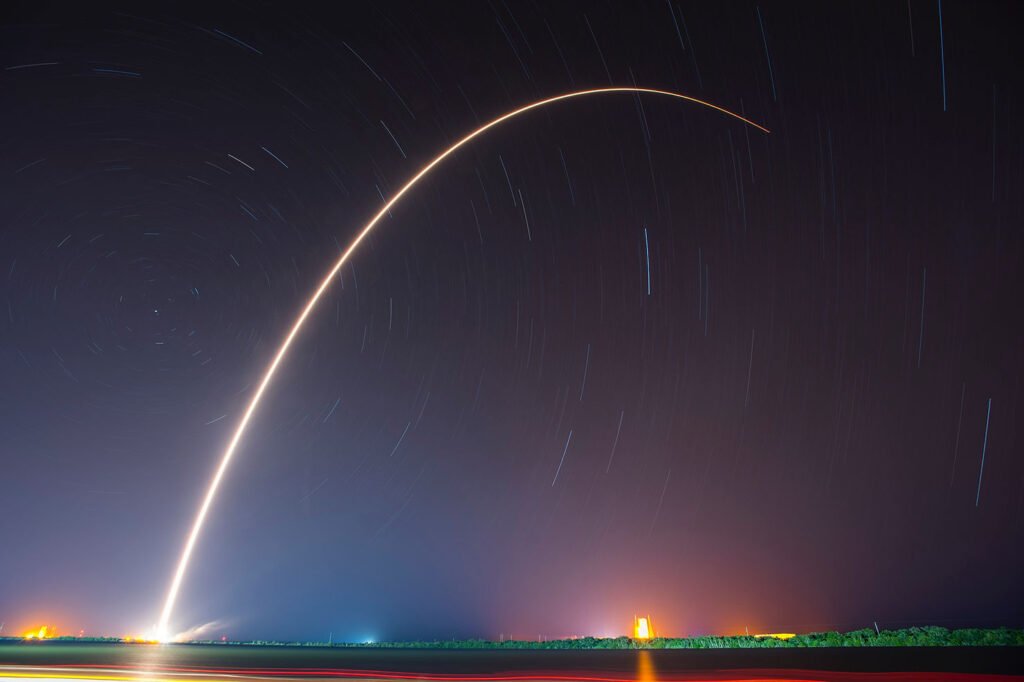
The industry has largely solved the hard physics. Launch costs dropped from roughly $54,500 per kilogram on the Space Shuttle to $1,400 on Falcon Heavy, a reduction of about forty times in a generation. Satellite buses are increasingly off-the-shelf. Sensors are commoditized. Constellations are proliferating at a pace that would have seemed absurd a decade ago. In 2025 alone, SpaceX deployed over 3,000 satellites. More than 15,000 satellites are now active in orbit; the trajectory points to 70,000 by 2030.
And almost none of them can make a decision without a human in the loop.
The bottleneck in new space is not the rocket. It is not the bus. It is not even capital, though Europe’s funding gap is real and significant. The bottleneck is the persistence of an operational paradigm designed for a world with a handful of satellites and unlimited response time. A paradigm that treats autonomy as a risk to be managed rather than a capability to be built.
The hardest part of building new space is not the physics. It is the software. And more than the software, it is the willingness to think differently about what a satellite is supposed to be.
What cognition actually means in orbit
“Autonomous” and “AI-enabled” have become marketing vocabulary, applied liberally to systems that are neither. Let’s be precise.
A cognitively capable satellite requires situational awareness at three distinct levels.
Platform awareness
The system monitors its own health (power budget, thermal margins, attitude control, subsystem status etc.) and can diagnose, isolate, and respond to anomalies without waiting for ground intervention. Not safe mode. Actual fault management with goal-directed behavior: the system knows what the mission requires, knows what is broken, and decides what to sacrifice and what to protect.
Orbital domain awareness
The system understands what is happening around it: debris proximity, conjunction risks, other assets in the vicinity, the RF environment. Space Domain Awareness is not a ground-segment function if you need it at machine speed. A satellite that depends on a ground update to know there is a debris cloud ahead is not autonomous. It is managed.
Mission context awareness
The system knows what is happening on the ground it is observing and can retask itself accordingly. A fire starts. A vessel changes course. An airfield becomes active. The satellite that waits for a human to notice, process, authorize, and uplink a new task is not a sensor network. It is an expensive camera with a very long shutter delay.
Most current architectures achieve fragments of the first level. Almost nothing of the second. Nothing at all of the third.
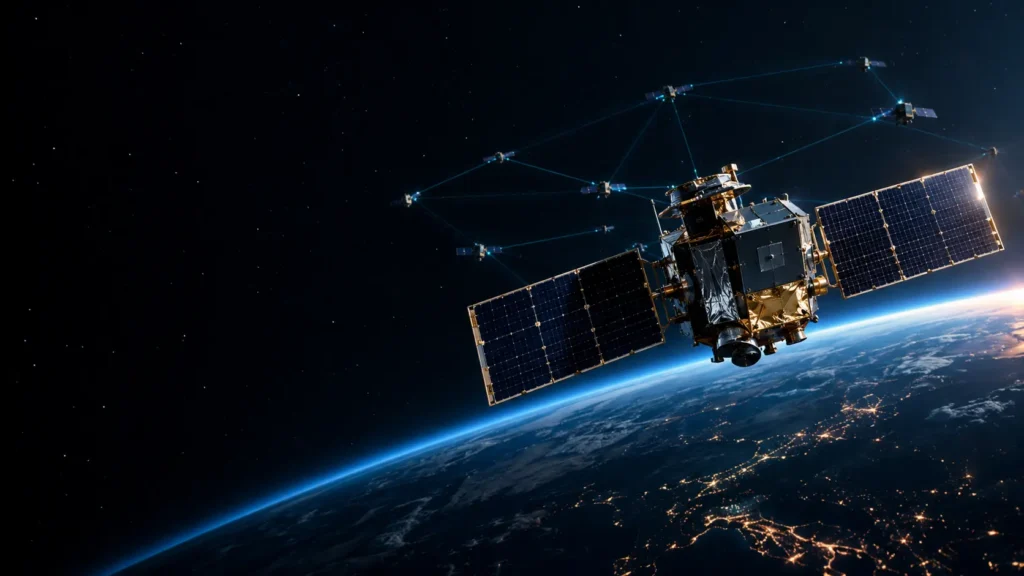
The consequence is that large constellations, in principle the most powerful distributed sensor networks ever built, are being throttled by the operators trying to manage them. At the scale of hundreds of satellites across contested theaters, man-in-the-loop is not a safety feature. It is a design flaw.
Who is doing it right, and why the rest of the industry is not following
SpaceX runs autonomous collision avoidance across the Starlink constellation without operator intervention. It is an architectural statement: at the scale of thousands of satellites, manual operations are not viable. SpaceX understood this early and built accordingly. Everyone else is still debating the governance model for autonomous decisions.
On the defense side, the logic has been made explicit. DARPA’s Blackjack program was built on the premise that monolithic, expensive GEO assets are targets in a contested environment, visible, predictable, irreplaceable. The answer is proliferated LEO nodes on commoditized buses, with autonomy software running distributed edge decisions. State-of-the-art architectures shall be designed specifically to enable on-orbit mission tasking, onboard processing, and dissemination at mission speed, not at ground-loop speed. The SDA transport layer builds on the same reasoning and, after a year of delays, is now reaching orbit.
Europe is not there, its ambition constrained by the machinery of institutional procurement: competitive dialogues, technology readiness gate reviews, standards designed for a world where hardware was the hard problem and timeline was a secondary concern. Since contract signature the estimated cost of IRIS2 has risen from €10.6 billion to about €15.6 billion, the constellation has grown to 348 satellites (66 added for defense), and service is not expected before 2030–31. The direction is right. The execution speed is not compatible with the window that exists.
Why don’t more actors follow SpaceX and SDA? The answer is not ignorance. It is incentives and structure.
Legacy prime contractors are optimized to deliver hardware to institutional clients who pay for development activity, not operational outcomes. Software that makes satellites self-sufficient reduces the surface area for ongoing services. There is little industrial lobby for autonomy. There is significant industrial interest in program continuity.
ESA, to its credit, is changing the procurement environment: new frameworks are starting to incorporate a shift toward outcome-based contracting and faster iteration. But the missing element is not procurement reform. It is the absence of true market-leading industrial actors with both the capability and the incentive to define new standards and impose them on the supply chain. In the US, SpaceX plays that role whether it intends to or not. In Europe, no equivalent actor exists, yet.
Next: the structural problem is not what you fix with a policy document
If better procurement were enough, Europe would already be there. It isn’t. In Part 2: where the growth capital disappears, why the engineers who could build cognitive satellites work somewhere else, and why the window to set the standard closes before anyone notices.