
Join the mailing list Free weekly briefing, no spam.
In short: The Executive Guide to Space is the three-day part of the NASA 4-D Executive Space Programme at Space Park Leicester, running from 11 to 13 November 2026. It explains how a space mission is conceived, designed, built, launched and operated, with the regulation, strategy and economics around it, for technical and non-technical professionals. You can book it alone or together with the two-day NASA 4-D leadership course.
This is part 3 of the SpaceInfo Club series on human performance in high-stakes environments. It follows the interview with Paul Hawkins on the whole programme. Last updated: 14 October 2026.
Key takeaways
- Three days, 11 to 13 November 2026, at Space Park Leicester, delivered by Space Park Leicester.
- Topics include the mission life cycle from concept to operations, space regulation and governance, the economic and security value of space, and the engineering problems of the space environment.
- The programme page lists no formal entry requirements and no assessment.
- It can be booked alone or with the two-day NASA 4-D course on 9 and 10 November.
- Registration is expected to close around 2 November.
What the three days cover
Space Park Leicester describes the Executive Guide to Space as a strategic overview of how space missions are conceived, designed, built, launched and operated. The course page lists four areas: space regulation and governance, the value of space to economies and security, the technical challenges of designing for the space environment, and the size of the space economy and the openings within it.
In his written answers to Space Park Leicester, Paul Hawkins, who leads the NASA 4-D part of the week, describes the three days as the technical anatomy of a mission. The topics he names are the UK and international space sector, mission objectives, orbital considerations, spacecraft systems, engineering processes, operations, and the legal and regulatory environment. Experts with hands-on mission experience teach the sessions. You can read his full answers in Part 2 of this series.
Why those topics belong in one course
This section is our explanation, not course content. A mission is a chain of decisions in which each choice limits the next one. Pick an orbit and you have also decided how often a satellite passes over a ground station, how much sunlight its solar panels get, how much radiation it meets and how long it stays up. Those facts feed into the power system, the thermal design, the radio link and the budget. A launch slot or a licence condition from a regulator can then force the plan to change again.
Someone who has followed that chain once finds it easier to ask an engineer the right question and to follow the answer. That is the practical gain for the manager, lawyer, buyer or finance lead who sits in the meeting where those trade-offs are discussed.
Why Leicester
Space Park Leicester is part of the University of Leicester, which Space Park says has more than six decades of space research behind it, including work with ESA, NASA and JAXA. Paul points to the facilities as part of the teaching: laboratories, workshops, cleanrooms, advanced computing and concurrent design capability, which make mission processes something you can see. Professor Nigel Bannister, Deputy Director at Space Park Leicester, describes the full programme as a pairing of leadership training with the centre’s expertise in space science, engineering, strategy and regulation.
The venue is Space Park Leicester, 92 Corporation Road, Leicester LE4 5SP, United Kingdom.
Who the sources say it is for
| Group | Where it is named |
|---|---|
| People entering the space sector | Space Park Leicester announcement |
| Technical specialists who want the wider picture | Space Park Leicester announcement |
| Professionals in project management, policy, marketing, legal, procurement or finance | Space Park Leicester announcement |
| Technical professionals changing sector, and organisations entering the space market | Programme page |
| Staff who need to upskill fast, for example in systems engineering or spacecraft operations | Programme page |
| Supporting roles such as marketing | Programme page |
What to expect, and what is not included
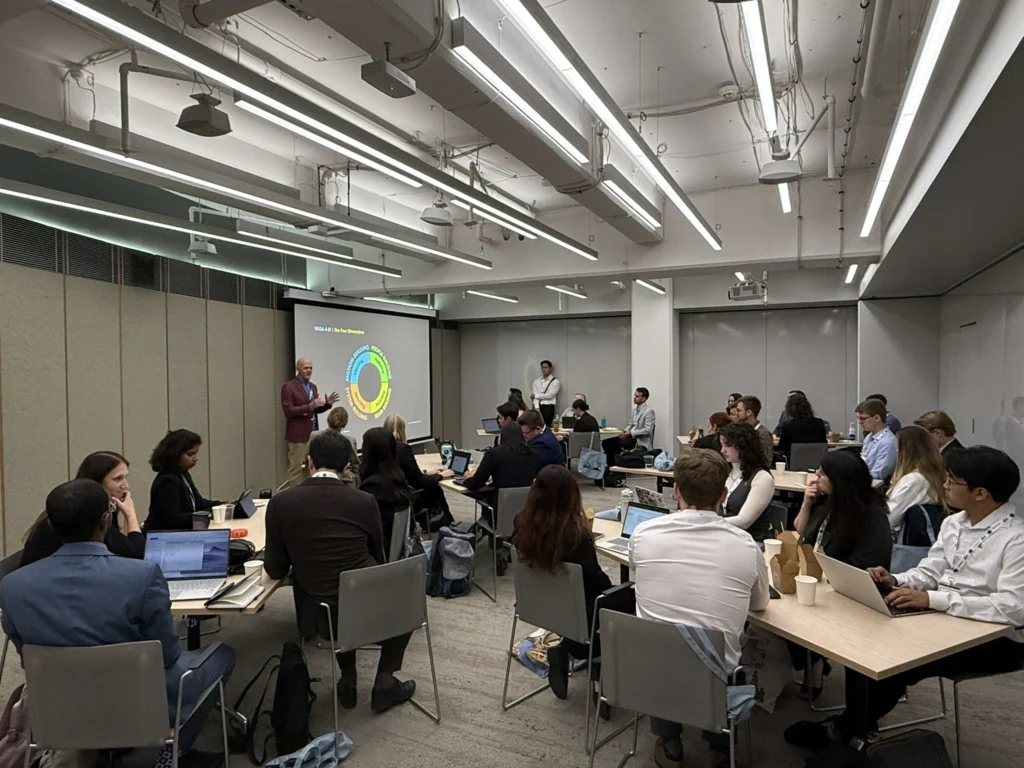
The programme page lists no assessment and no formal entry requirements. Preparation is limited to a few suggested articles. Paul calls the week intensive and highly participative. The combined five-day format is new to Leicester, so there are no results from a finished cohort yet, and he says so himself. He adds that people who took the Executive Guide to Space on its own have reported benefits from it.
How it fits with NASA 4-D
The two-day NASA 4-D Leadership Programme runs first, on 9 and 10 November, and the Executive Guide follows from 11 to 13 November. Each can be booked alone. NASA 4-D deals with the human side of missions: how information moves through a team and who feels able to speak. In our interview with Paul Hawkins on YouTube he explains why that side deserves the same attention as the hardware, and Part 1 summarises it. The Executive Guide supplies the technical map that those conversations happen on.
Dates, options and booking steps are on the official Space Park Leicester programme page.
Frequently asked questions
How long is the Executive Guide to Space?
Three days, from 11 to 13 November 2026, after the two-day NASA 4-D Leadership Programme on 9 and 10 November.
Do I need an engineering background?
No formal entry requirements are listed on the programme page. Space Park Leicester describes the course as suitable for technical and non-technical professionals.
Can I attend only the Executive Guide to Space?
Yes. Participants can book the full five days or either course alone.
Where does the course take place?
At Space Park Leicester, 92 Corporation Road, Leicester LE4 5SP, United Kingdom.
When does registration close?
The organisers say it will most likely close one week before the start, around 2 November 2026. The official page does not state a deadline, so confirm it there.
Sources
- Space Park Leicester: NASA-proven leadership training comes to Leicester
- Space Park Leicester: NASA 4-D Executive Space Programme page
- Crazy Might Work: NASA 4-D programme
- SpaceInfo Club interview with Paul Hawkins (YouTube)
About this article
Written by the SpaceInfo Club editorial team, founded by Sebastiano, an aerospace engineer, who interviewed Paul Hawkins for the series. Facts about the programme come from the sources above. Statements that are our own reading are marked as such, and figures supplied by Crazy Might Work are attributed to it.
More in this series
- Part 1: Why Space Teams Fail: Paul Hawkins on NASA’s 4-D Leadership System
- Part 2: Eight Questions Answered by Paul Hawkins
Next in the series: working in space without being an engineer (scheduled for 24 October 2026).
Image Credits: Crazy Might Work