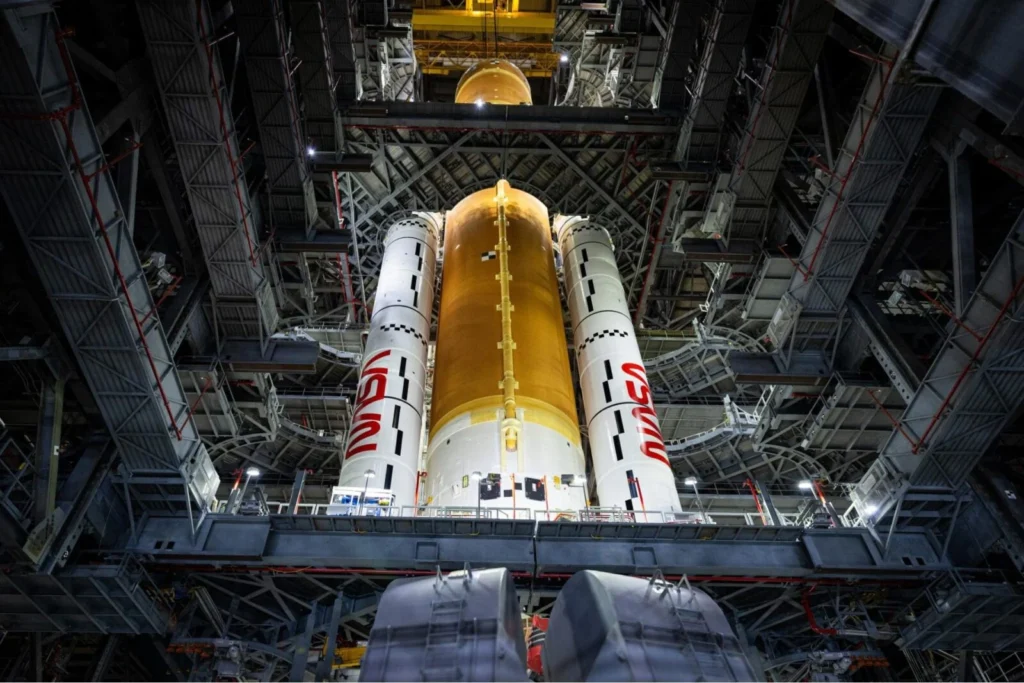
SLS Artemis 2 – Credit: NASA, Frank Michaux
NASA is preparing for a historic milestone in human spaceflight as the agency targets April 1, 2026, for the launch of the Artemis II mission. If successful, it will mark the first crewed mission to travel around the Moon since the Apollo era, opening the next chapter of deep-space exploration.
After several technical setbacks and weeks of troubleshooting, NASA officials have now confirmed that the rocket and spacecraft are ready to move forward toward launch.
A critical step for the Artemis program
Artemis II will be the first crewed flight of NASA’s deep-space architecture, combining the Space Launch System (SLS) rocket with the Orion spacecraft. The mission follows the uncrewed Artemis I test flight in 2022 and is designed to validate systems required for long-duration human missions beyond Earth orbit.
The mission will carry four astronauts on a roughly 10-day journey around the Moon and back to Earth:
- Reid Wiseman (NASA) – Mission Commander
- Victor Glover (NASA) – Pilot
- Christina Koch (NASA) – Mission Specialist
- Jeremy Hansen (Canadian Space Agency) – Mission Specialist
The spacecraft will perform a free-return trajectory around the Moon, meaning the flight path naturally returns the crew to Earth without requiring major propulsion burns—an approach designed for additional safety during this early test of the system.
Artemis II is intended to demonstrate that NASA’s new human deep-space transportation system can safely carry astronauts to lunar distances, a capability that has not been exercised since Apollo 17 in 1972.
Celeste Takes Flight: Europe’s Next Step in Satellite Navigation Innovation

Dallas Campbell to Bring the Story of Space Exploration to Life at Space Park Leicester

UK Space Science Sets Course for 2035: Leicester Event to Shape the Future
Boeing Starliner – Key Anomalies Analysis
Long March-10: The Rocket That Could Take China to the Moon
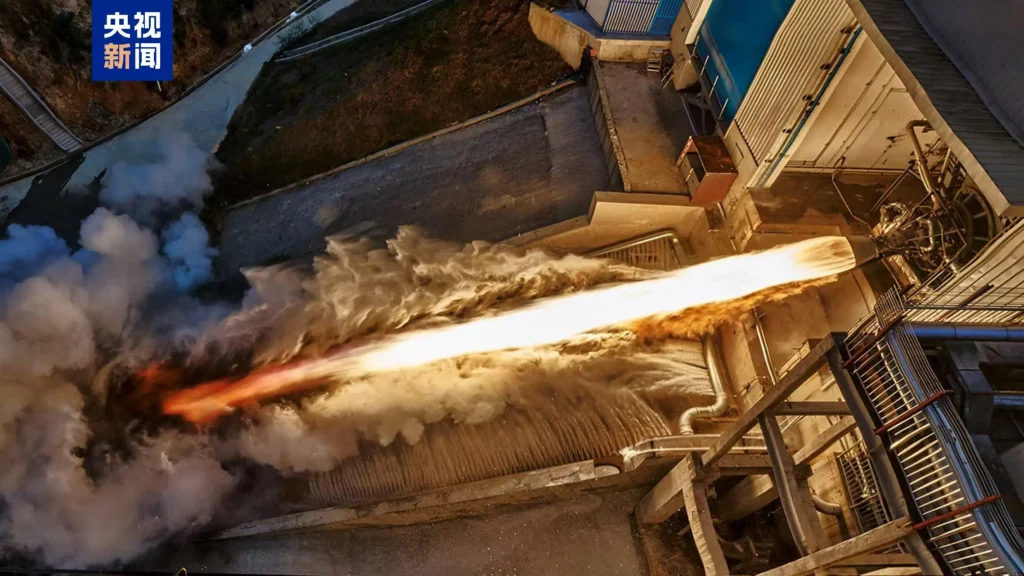
The Liqing-2 Engine: Powering China’s Commercial Reusable Rockets

China Tests a 240-Ton Reusable Rocket Engine
Resolving the technical issues
The road to launch has not been without complications. Earlier in 2026, engineers encountered fueling-related problems and a helium flow issue in the rocket’s upper stage, which forced NASA to halt launch preparations and return the vehicle to the Vehicle Assembly Building at Kennedy Space Center for repairs.
The issue was traced to a quick-disconnect seal affecting helium flow in the interim cryogenic propulsion stage, a component essential for maintaining proper tank pressurization during flight. After identifying the root cause, technicians completed repairs and verified that the system is functioning correctly.
Following these fixes, NASA completed a Flight Readiness Review, during which mission managers evaluated the vehicle, ground systems, and operational procedures. The review concluded with a “go” to proceed toward launch preparations.
The SLS rocket and Orion spacecraft are expected to roll out to Launch Complex 39B at Kennedy Space Center ahead of the planned launch attempt.
Launch window and mission timeline
NASA is targeting 6:24 p.m. EDT on April 1 for liftoff, with additional backup opportunities in the days immediately following if needed.
However, the available launch window is relatively narrow. If the mission cannot launch in early April, the next viable opportunity may not open again until later in the month.
Once in space, the Orion spacecraft will carry the astronauts thousands of kilometers beyond the Moon before beginning the return journey to Earth. The mission will test navigation, life-support systems, communications, and deep-space operations that will be required for future lunar missions.
Paving the way for lunar exploration
Artemis II is a test mission, but its success is essential for the long-term goals of the Artemis program. NASA aims to establish a sustained human presence on and around the Moon, while developing technologies and operational experience for eventual missions to Mars.
Upcoming Artemis missions will progressively increase the complexity of lunar operations. Current planning includes additional crewed missions later in the decade, with a future mission expected to conduct the first Artemis-era lunar landing and support infrastructure such as the Lunar Gateway station in orbit around the Moon.
If Artemis II launches successfully, it will not only represent a major technical achievement but also signal the return of humans to deep-space exploration, more than half a century after the final Apollo mission.
For NASA and its international partners, the mission is a crucial step toward a new era of sustained lunar exploration—and ultimately the journey to Mars.