
Join the mailing list Free weekly briefing, no spam.
Image Credits: jonasphotto
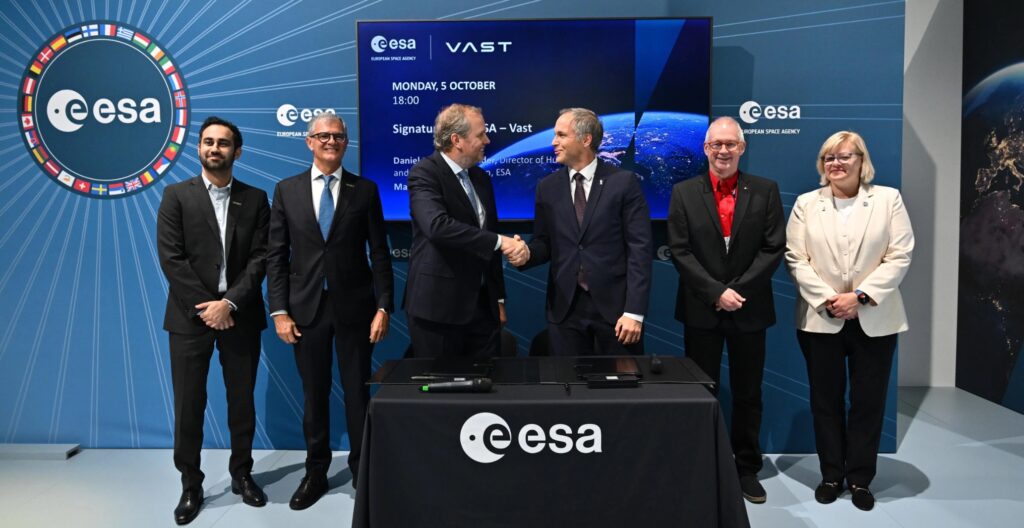
The European Space Agency has signed a new Memorandum of Understanding with Vast, the California-based company building the Haven space stations. The document replaces the 2024 agreement and broadens the scope of the collaboration, but it remains an exploratory agreement: its value is mainly strategic, because it shows how Europe is preparing for an era without the International Space Station, which is expected to end its operational life in 2030.
It is worth reading carefully, because it says a lot about what ESA already has in hand and what it does not yet have.
What was signed
ESA press release No. 61–2026 presents the MoU, signed during the 77th International Astronautical Congress (IAC 2026), as the continuation of a collaboration already under way, paving the way for possible future cooperation in low Earth orbit. It is part of the agency’s preparatory work ahead of the ISS’s end of service and controlled de-orbit. It builds on the 2024 memorandum, which the text describes as successfully implemented, and replaces it, broadening the cooperation to human spaceflight, science, technology and commercialisation.
The framework covers possible future astronaut missions aboard Haven, the station Vast is developing, and possible ESA hardware or infrastructure contributions. It also addresses the use of the Haven stations: jointly defined research campaigns, dedicated science accommodations, up-mass and down-mass capacity, and crew time to ensure continuity between one ESA mission and the next.
Another segment concerns the shared interest in exchanging information so that future European cargo and crew vehicles can serve the Haven station. It is a direct thread back to the 2024 memorandum, which already provided for a role for European industry, for European transport services and for docking certification.
The part that is already concrete: the 2027 missions
The most operational statement comes from Max Haot, Vast’s CEO. ESA and Vast are already collaborating on four crewed missions, across the ISS and Haven-1, planned for 2027, including the first crewed mission to the new station. The new MoU, Haot explained, looks beyond those milestones, to the post-ISS era.
It is an important distinction. The 2027 missions are the testing ground: if they go well, they will give ESA direct experience with a commercial operator. The memorandum, instead, serves to build the framework for what comes next.
Why ESA is diversifying
ESA Director General Josef Aschbacher described the ISS as one of the greatest examples of international cooperation in space. As Europe prepares its future exploration strategy, he explained, ESA is assessing a range of options for maintaining a presence in low Earth orbit, and the agreement with Vast is a step towards defining future opportunities for European astronauts, research and technology. Daniel Neuenschwander, Director of Human and Robotic Exploration, added that various options are being investigated to carry out science and technology demonstrations in microgravity and to create new flight opportunities for the astronaut corps.
According to ESA, the preparation involves securing options for continued access to microgravity research platforms and to flight opportunities for European astronauts. There is no European destination under construction, so the agency is betting on several commercial partners. Back in 2024, the trade press noted that Vast was the third commercial station operator with which ESA had signed an agreement of this kind.
In my opinion it is the right move: with a deadline set for 2030 and no certainty about which commercial station will actually be operational, putting everything on a single player would be imprudent.
Limits and risks
The first limit is the nature of the document itself. An MoU is not a contract: it runs for three years and starts with a joint feasibility study, which is to produce a roadmap and an indicative schedule for any binding agreements. The press release does not mention financial commitments.
The second is the schedule. Haven-1 has accumulated several delays and, according to international press, launch is now expected in early 2027. The station will have a single module, while Haven-2, conceived as the ISS’s successor, is meant to reach nine modules, to be deployed gradually. Its future also depends on NASA’s Commercial LEO Destinations programme.
The third concerns autonomy. European access to crewed space would still go through US infrastructure and launch vehicles, starting with the Dragon capsule. It remains an open issue for European space strategy.
What to watch in the coming months
The new MoU does not change the balance on its own, but it captures the situation well: Europe does not yet have a station of its own and is building options with commercial partners. The real test will come with the launch of Haven-1 and the 2027 missions.
Above all, watch the joint feasibility study: the roadmap that comes out of it will show whether the exploratory agreements turn into binding contracts, with dedicated resources. Only then will it be clear how much weight Vast will really have in ESA’s post-ISS strategy.