
Join the mailing list Free weekly briefing, no spam.
Cover Image Credits: Mars Express & HRSC
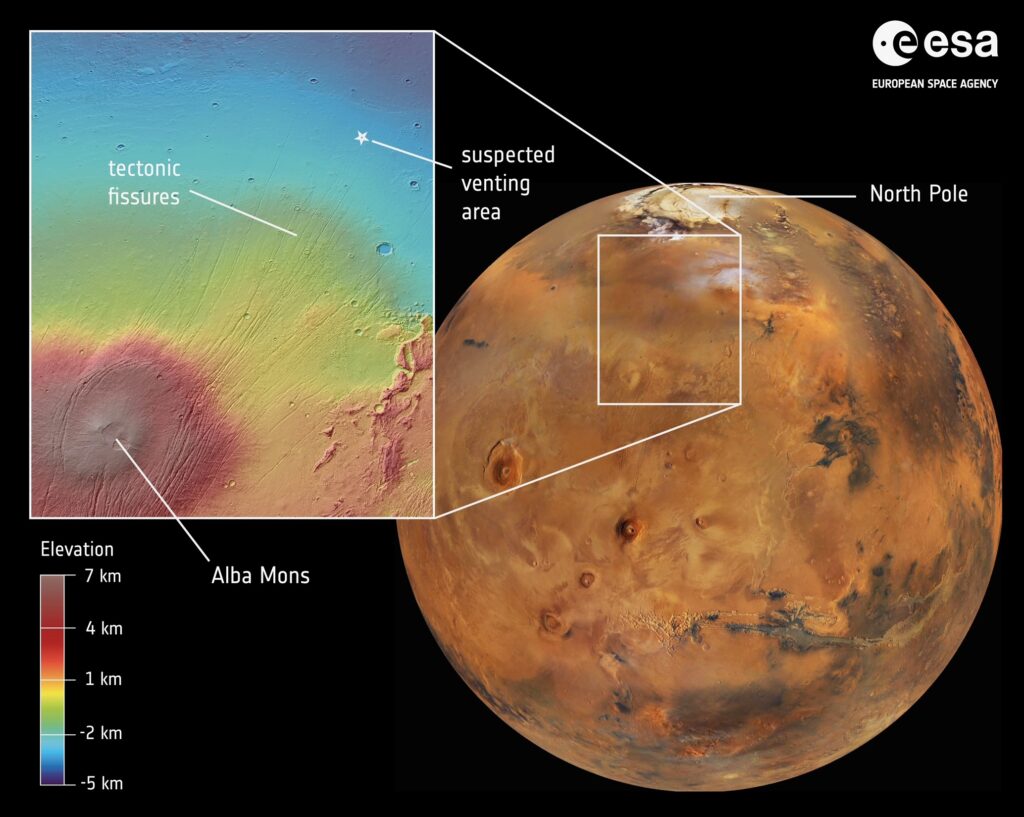
Mars has the largest volcanoes in the Solar System, yet nobody knows whether any of them is still alive. A new study based on data from the ExoMars Trace Gas Orbiter (TGO) offers the most intriguing hint so far: a puff of hydrogen chloride rising from fresh fissures on the flanks of Alba Mons. It is a strong clue, not a confirmation. Here is what was found, why it matters, and what is still missing.
Key points
- TGO detected hydrogen chloride (HCl) above fissures on Alba Mons in early northern summer, a time and place where the known seasonal cycle does not predict it.
- Images from the CaSSIS camera show fresh, narrow fissures there, some hundreds of metres long, with colour changes on the surface.
- The team proposes that magmatic gases rise through these fissures, possibly linked to a dormant magma chamber.
- No new lava flow or eruption has ever been observed on Mars. The volcanic explanation is an inference, not a direct observation.
What TGO measured
The ExoMars Trace Gas Orbiter, a joint ESA and Roscosmos mission, studies the martian atmosphere from orbit. In 2021 it reported hydrogen chloride in the martian air. On Earth, this gas is typically released by magmatic vents, which raised an obvious question: could the same be happening on Mars?
Hydrogen chloride on Mars follows a seasonal pattern. It peaks in northern hemisphere winter and mostly disappears in summer, and this variation appears tied to the planet’s dust and water cycles. The new study focuses on the one exception. In early summer, always at the same place, TGO’s Atmospheric Chemistry Suite (ACS) infrared spectrometers saw HCl strongly concentrated above volcanic fissures on the flanks of Alba Mons, just after the winter frost sublimates.
What the camera added
The second piece of evidence comes from a different instrument. TGO’s CaSSIS camera imaged the same region and revealed fresh, narrow fissures, some hundreds of metres long, surrounded by colour changes on the ground. On Earth, fumaroles, the vents that release volcanic gas, often leave discoloured deposits around them. The researchers suggest the same process could be at work here.
Combining a gas detection with a geological map is the strength of this work. Two independent instruments point to the same patch of ground.
The proposed explanation
According to the team, led by Alexander Trokhimovskiy, the fissures may act as a seasonal valve. During winter, temperatures drop as low as -120°C and ice may seal the cracks. When the ice sublimates in early summer, trapped gases escape and TGO can detect them. The source of the gas would be a dormant magma chamber, a volcanic plumbing system beneath the surface.
Daniel Mège, co-lead author and professor at the Space Research Centre of the Polish Academy of Sciences, said the findings suggest Mars retained enough internal heat to support volcanism until recently, “and possibly still does.”
Why caution is needed
This is where the story needs careful reading.
The chain of reasoning has a gap. Everything observed is indirect: a gas and some surface features. The link to magma is a deduction. Nobody has seen an eruption, a new lava flow, or a thermal signature from below.
Other explanations must be excluded. Chlorine chemistry on Mars is complicated, with dust, ice and surface salts all involved. The team says it examined the possible atmospheric chemical processes in detail, but a result like this will rightly be tested by other groups before it is accepted.
Tone matters. Phrases such as “smoking gun” make good headlines. In scientific terms, the finding is better described as a well-supported hypothesis.
What does support the broader picture is that other evidence already hints at a geologically alive Mars. Orbital images suggest some volcanoes were active within the last few million years, and seismometers have recorded marsquakes. Together with the new gas detection, these make a dormant but not dead interior plausible.
Why it matters for the search for life
If magma heats groundwater, the result could be warm, wet, chemically rich environments. Mège notes that looking for martian life in the seeping fissures of Alba Mons “would make a lot of sense”, because active hydrothermal systems could provide both energy and shelter from the harsh surface.
This remains speculation. No evidence of life exists, and no hydrothermal system has been confirmed. But it shows how a single gas detection can reshape where we might look next.
What would confirm it
Based on how the study is built, the next steps are fairly clear:
- Repeat the observations over several martian years to see whether the HCl release recurs in the same place and season.
- Look for other gases or traces typical of magmatic activity in the same region.
- Monitor the fissures with high-resolution imaging for changes over time.
- Compare the location with seismic data to look for activity at depth.
A match across several of these would turn a hint into a result.
Frequently asked questions
Is there an active volcano on Mars?
Not confirmed. The new data suggest that volcanic gases may be escaping from a dormant magma system under Alba Mons, but no eruption has been observed.
What is hydrogen chloride and why does it matter?
Hydrogen chloride (HCl) is a gas often released by volcanic vents on Earth. Finding it on Mars, in an unexpected season and place, led researchers to look for a volcanic source.
What is Alba Mons?
Alba Mons is a large volcano on Mars, located in the Tharsis region. The fissures studied here lie on its flanks.
Which instruments made the discovery?
The Atmospheric Chemistry Suite (ACS) spectrometers detected the gas, and the CaSSIS camera imaged the fissures. Both are on board ESA’s ExoMars Trace Gas Orbiter.
Does this mean there is life on Mars?
No. The study only suggests that heat and water could, in principle, create habitable niches in some places. No life has been detected.
Sources
- European Space Agency (ESA), European orbiter detects hints of volcanic activity on Mars
- Study published in Science Advances, led by Alexander Trokhimovskiy, with Daniel Mège as co-lead author.
The SpaceInfo Club
Sebastiano