
Join the mailing list Free weekly briefing, no spam.
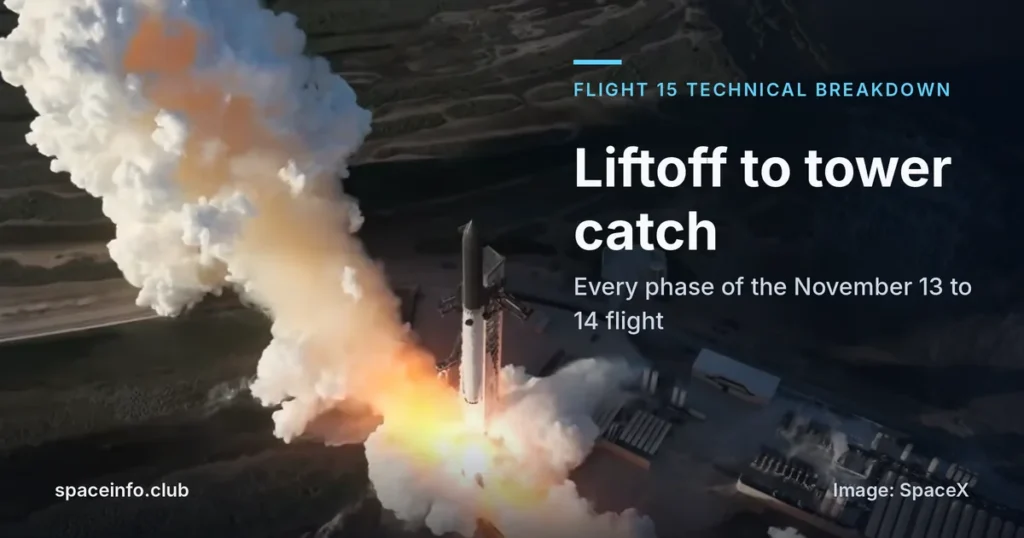
Flight 15 lasted 22 hours and 33 minutes, from liftoff at 22:47 UTC on November 13, 2026 to the tower catch at about 21:20 UTC on November 14. This article follows each phase and keeps two things apart: what SpaceX reported during the flight, and what the pre-flight plan listed.
Vehicles and mission profile
Flight 15 flew Super Heavy Booster 22 and Ship 42, the fourth Block 3 pair to fly, from Orbital Launch Pad 2 at Starbase. The payload was 26 Starlink V3 satellites. The ship was to orbit at about 275 km, complete 14 revolutions and return to Starbase after a flight of about 22.5 hours.
The recovery plan was the ambitious part. SpaceX announced on October 21 that it would try to catch both stages on the same flight, which would be the first double catch and the first time a V3 booster and ship came back to the launch site. In September Elon Musk put the odds of a first-attempt ship catch at 50 to 60 percent or better.
The plan also carried fallbacks. The booster had a Gulf of Mexico contingency if the tower was a no-go. The ship had return checkpoints during the coast (two near Hawaii and one near Chile) at which SpaceX could choose an ocean disposal instead of the tower. Pre-flight sources disagree on the exact list of alternative landing sites, so this article names only the checkpoints. Source: Wikipedia, Starship flight 15, read before the flight.
Ascent and booster phase
The pre-flight timeline had maximum dynamic pressure at T+0:58, booster main engine cutoff at T+2:19 and hot staging two seconds later. Booster 22 would then run a 36-second boostback, coast, relight for the landing burn at T+6:10 and be caught at T+6:35. The table sets that plan against what SpaceX reported.
| Event | Planned | Reported |
|---|---|---|
| Hot staging | T+2:21 | Ship 42 separated and Booster 22 began its return |
| Boostback | T+2:26 to T+3:02, 36 s | 32 of 33 Raptors lit after one dropped out; burn ended early on a low fuel mass alarm (early indication) |
| Landing burn | Start T+6:10 | Began with 13 Raptors, then the booster aborted to the offshore zone |
| Catch | T+6:35 | Hover, engine cutoff and flight termination just above the Gulf, about T+6:30 |
The abort logic is the interesting part. The guidance system compared the booster’s real state against the narrow window that the tower arms can accept, found a mismatch and sent the vehicle to the contingency zone. Sources: Wikipedia, Starship flight 15 (plan, read before the flight) and Space.com (reported).
Ship phase: orbit, coast and return
Once Ship 42 separated, the mission became a 22-hour orbital flight with three go or no-go checks before the return. The table lists each step in order and says whether the entry comes from the pre-flight plan or from SpaceX’s reporting.
| Time after liftoff | Event | Plan or report |
|---|---|---|
| T+0:08:09 | Ship engine cutoff on a suborbital trajectory | Plan |
| About T+0:26 | Orbital insertion burn, orbit at about 275 km | Reported |
| T+0:35 to T+1:17 | Deployment of 26 Starlink V3 satellites | Reported |
| T+1:27:46 | Early Hawaii return check | Plan; SpaceX chose to continue the full mission |
| T+7:15:35 | Mid Chile return check | Plan; ship continued |
| T+20:41:55 | Final Hawaii return check | Plan; ship continued |
| About T+21:36 | Deorbit burn, 10 s on one engine, about 3:23 p.m. EST | Reported, called nominal |
| T+22:10:46 | Atmospheric entry | Plan |
| T+22:29:34 | Transonic | Plan |
| T+22:32:16 | Landing burn starts; flip at T+22:32:18 | Plan |
| T+22:32:34 | Engine shutdown and catch | Plan |
| About T+22:33 | Tower arms catch Ship 42, about 4:20 p.m. EST | Reported |
The plan and the result agree closely. The ship deployed its payload, skipped the early outs and came home about where the schedule said it would. Sources: Wikipedia, Starship flight 15 (plan) and Space.com live coverage (reported).
An engineer’s view
What struck me most was the precision of control over a vehicle this large, and how well the aerodynamics were mastered during the descent. What struck me even more was the range of dynamics involved. A ship at orbital velocity and a ship almost hovering in front of the catch structure are in very different regimes of force, inertia and speed. SpaceX took one vehicle from the first to the second in a single flight.
For a shorter summary of the flight, see the Starship Flight 15 recap.
Frequently asked questions
What orbit did Ship 42 fly?
A low Earth orbit at roughly 275 km, reached about 26 minutes after liftoff. The ship circled the Earth 14 times.
When were the Starlink satellites deployed?
Deployment began around T+0:35 and all 26 Starlink V3 satellites were out by T+1:17.
How many engines did the booster use on boostback?
SpaceX said 32 of 33 Raptors lit after one dropped out following stage separation.
What does T+ mean in the timeline?
Time after liftoff in hours, minutes and seconds. Liftoff was at 22:47 UTC on November 13, 2026.
Sources
- Wikipedia, Starship flight 15, read before the flight and used only for planned times
- Space.com, Flight 15 live updates
- Space.com, booster abort report
About the author
Sebastiano is a space engineer. He runs SpaceInfo Club, where he writes about spaceflight and aerospace engineering.