
Join the mailing list Free weekly briefing, no spam.
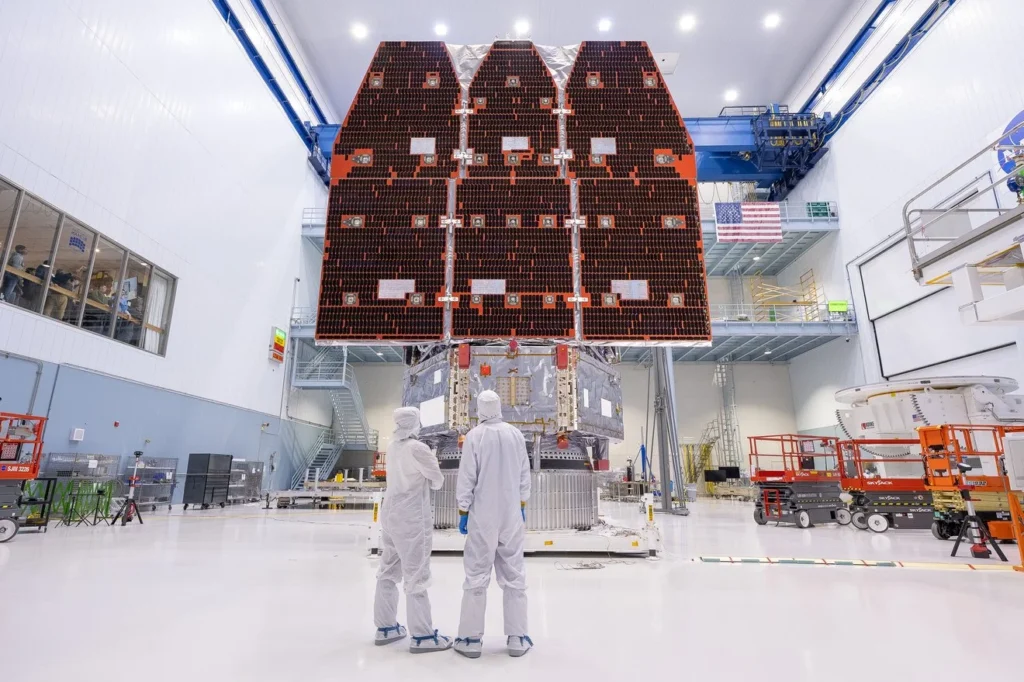
Cover Image: NASA’s Nancy Grace Roman Space Telescope – Credits NASA_Jolearra Tshiteya
The completion of the Nancy Grace Roman Space Telescope marks a pivotal milestone not only for NASA, but for the global astronomical community. With its assembly finalized at Goddard Space Flight Center, Roman now transitions from engineering triumph to scientific promise—poised to redefine how we observe and understand the universe.
Scheduled for launch no later than May 2027, and potentially as early as fall 2026, the observatory will ride aboard a SpaceX Falcon Heavy toward a destination roughly one million miles from Earth. From this vantage point, Roman will begin an ambitious mission: to map the cosmos with unprecedented scale and precision, while tackling some of the most profound unanswered questions in modern astrophysics.
Engineering Meets Ambition
Roman’s completion is not merely symbolic—it reflects years of disciplined engineering, iterative testing, and technological innovation. The integration of its inner and outer assemblies represents the culmination of a complex process designed to ensure operational excellence in the harsh environment of space.
At the heart of the mission lies a powerful synergy between wide-field observation and infrared sensitivity. Unlike its predecessor, the Hubble Space Telescope, Roman is engineered to survey vast portions of the sky in a fraction of the time, capturing data at a rate hundreds of times faster. This capability transforms astronomy from targeted observation into large-scale cosmic cartography.
Astronomy Basics
🌠 Explore the Universe Like Never Before!🔭 Discover the secrets of stars, planets, and galaxies…
[Preview] Orbital Mechanics – An Introduction
Discover the fundamentals of orbital mechanics in this beginner-friendly course—no prior experience needed! Explore how…

Human Factors and Performances
Human factors and human performance in space are critical areas of study in spaceflight operations,…
Space Physics – Basics
Explore the dynamic forces that shape our space environment in this exciting journey beyond Earth’s…
A Telescope Built for Big Questions
Roman’s scientific objectives are as expansive as its field of view. Among its primary goals is investigating the nature of dark energy—the mysterious force driving the accelerated expansion of the universe. Despite decades of research, this phenomenon remains one of the most significant enigmas in physics.
By mapping over a billion galaxies across cosmic time, Roman will allow astronomers to trace the large-scale structure of the universe, shedding light on both dark energy and dark matter. These observations could fundamentally reshape our understanding of space, time, and gravity.
Equally transformative is Roman’s ability to explore the dynamic universe. Through repeated observations of the same regions, it will create time-lapse “movies” of cosmic events—capturing supernovae, variable stars, and potentially entirely new phenomena that have so far eluded detection.
The Coronagraph: A Glimpse of Other Worlds
One of Roman’s most groundbreaking features is its coronagraph instrument, developed at Jet Propulsion Laboratory. This technology represents a major step forward in the direct imaging of exoplanets.
By blocking the overwhelming light of distant stars, the coronagraph enables the detection of faint planetary companions orbiting nearby systems. Unlike previous efforts, which have primarily revealed large, young, and hot exoplanets, Roman will target older, colder worlds—bringing us closer to imaging planetary systems that resemble our own.
While primarily a technology demonstration, the coronagraph’s success could pave the way for future missions capable of directly imaging Earth-like planets and analyzing their atmospheres for potential biosignatures.
A Data Revolution
Roman is not just a telescope—it is a data engine. Over its five-year primary mission, it is expected to generate approximately 20 petabytes of data. This immense dataset will include observations of:
- Over 100,000 exoplanets
- Hundreds of millions of stars
- Billions of galaxies
Such volume represents both an opportunity and a challenge. To maximize scientific return, NASA has committed to an open-data model, making Roman’s observations immediately accessible to the global community. This approach democratizes discovery, enabling researchers worldwide to extract insights simultaneously and accelerating the pace of scientific advancement.
Surveying the Universe: The Core Missions
Roman’s observing strategy is built around three flagship surveys:
1. High-Latitude Wide-Area Survey
A vast cosmological map combining imaging and spectroscopy to study galaxy evolution and the distribution of dark matter.
2. High-Latitude Time-Domain Survey
A dynamic exploration of the universe, capturing changes over time and refining measurements of dark energy.
3. Galactic Bulge Time-Domain Survey
A deep look into the Milky Way’s core, leveraging gravitational microlensing to detect exoplanets, rogue worlds, and isolated black holes.
Together, these programs will consume 75% of Roman’s primary mission, with the remaining time allocated to community-driven investigations through a General Investigator Program.
Honoring a Legacy
The telescope bears the name of Nancy Grace Roman, often referred to as the “Mother of Hubble.” Her vision was clear: to make the universe accessible through space-based observatories. Roman continues that legacy, not only through its scientific capabilities but also through its commitment to open access and collaborative discovery.
Looking Ahead
With construction complete, Roman enters its final phase of testing before shipment to Kennedy Space Center. What lies ahead is not just another mission, but a transformative leap in our ability to observe the cosmos.
If successful, the Nancy Grace Roman Space Telescope will do more than expand our catalog of celestial objects—it will challenge our assumptions, refine our models, and perhaps even answer one of humanity’s oldest questions: Are we alone?
In the coming decade, Roman may well become the instrument that turns speculation into understanding—and curiosity into discovery.