
Join the mailing list Free weekly briefing, no spam.
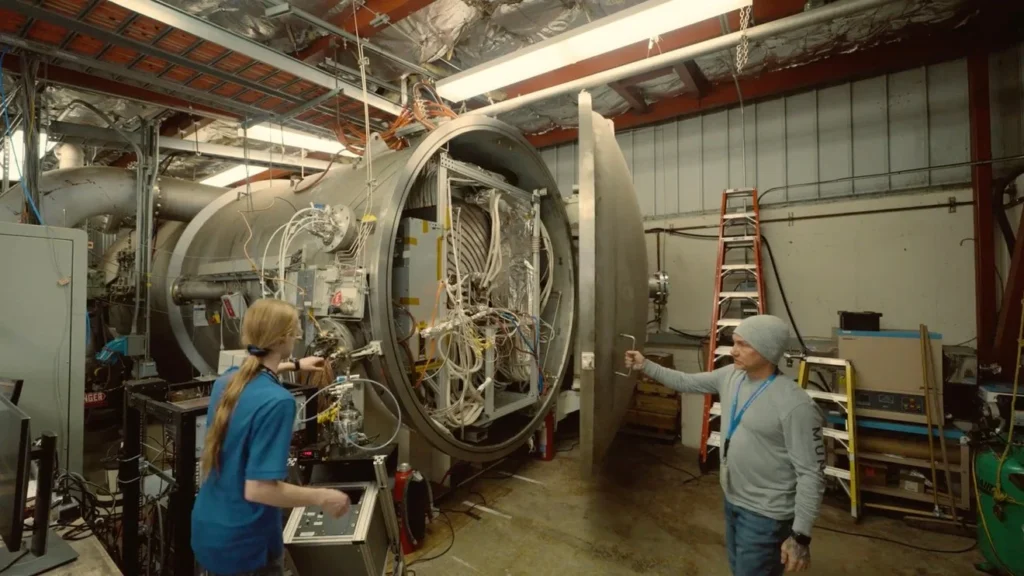
Cover Image: JPL’s condensable metal propellant (CoMeT) vacuum facility – Credit- NASA_JPL-Caltech
At a time when ambitions for human exploration of Mars are shifting from aspiration to engineering reality, propulsion remains the central bottleneck. Rockets can lift us off Earth, but sustaining efficient, high-speed travel across tens of millions of kilometers is a different challenge altogether. A recent breakthrough at NASA Jet Propulsion Laboratory suggests that the solution may lie not in more powerful chemical rockets—but in electrifying propulsion itself.

Halloween on the International Space Station: How Astronauts Celebrate in Orbit
ESA’s Hera and NASA’s DART: What Europe’s Asteroid Mission Will Measure at Didymos

Executive Guide to Space at Space Park Leicester: Three Days Inside a Space Mission
MO-Nav on Talon-A: What a Mach 5 GPS-Denied Test Proves
Scariest Objects in Space: Ghost Nebula, Witch Head Nebula and the Demon Star
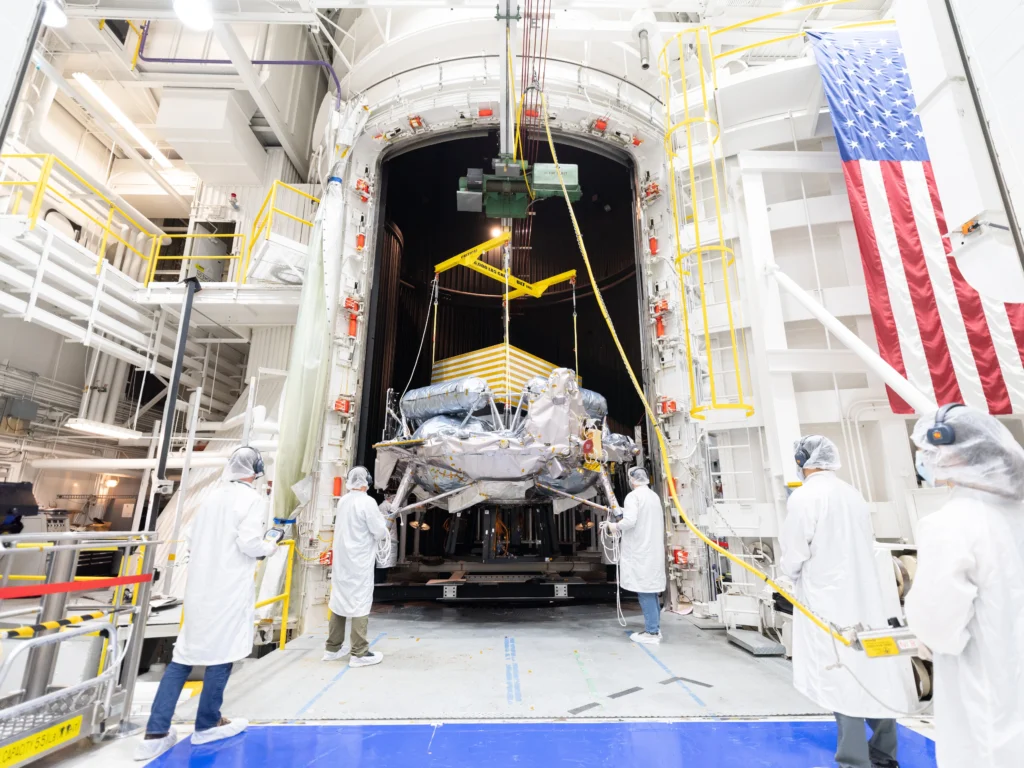
Griffin-1 Lunar Lander Completes Environmental Testing at NASA JPL
A Test Years in the Making
On February 24, engineers at JPL ignited a prototype electromagnetic thruster powered by lithium vapor, marking a milestone in high-power electric propulsion. The test, conducted inside a specialized vacuum chamber designed for metal-propellant systems, reached power levels of up to 120 kilowatts—the highest ever achieved for this class of thruster in the United States.
This was not merely a proof of concept. It was a validation of decades of theoretical and experimental work surrounding magnetoplasmadynamic (MPD) propulsion, a technology first explored in the 1960s but never brought to operational maturity.
At the heart of the system, a tungsten electrode endured temperatures exceeding 2,800°C, glowing white-hot as it helped generate and accelerate plasma. The visual was striking—but the data was what truly mattered. Engineers confirmed stable operation at unprecedented power levels, opening the door to further scaling.
Why Lithium—and Why Now?
Electric propulsion is not new. Missions like Psyche mission already use ion thrusters to achieve extraordinary efficiency, consuming up to 90% less propellant than chemical systems. However, these engines produce relatively low thrust, making them ideal for robotic missions but less suited for transporting humans.
MPD thrusters aim to bridge that gap.
Instead of using electrostatic acceleration (as ion thrusters do), MPD systems rely on electromagnetic forces: a powerful electric current interacts with a magnetic field to accelerate plasma—here, derived from lithium vapor—at high speeds. Lithium is particularly attractive due to its low atomic mass and favorable ionization properties, making it efficient for plasma generation.
The result is a propulsion system that could combine high efficiency with significantly greater thrust, a critical requirement for crewed missions.
Scaling Up: From Kilowatts to Megawatts
While 120 kilowatts is a remarkable starting point, it is only the beginning. Engineers at NASA are targeting 500 kilowatts to 1 megawatt per thruster in the coming years. For context, a human mission to Mars could require 2 to 4 megawatts of total propulsion power, likely distributed across multiple engines.
Achieving this scale presents formidable challenges. Materials must withstand extreme thermal stress over prolonged operation—potentially more than 23,000 hours for a single mission. Thermal management, electrode erosion, and plasma stability all remain critical engineering hurdles.
Yet the payoff is enormous. A megawatt-class electric propulsion system could:
- Reduce overall spacecraft mass
- Enable faster transit times to Mars
- Support heavier payloads, including life-support systems and return fuel
- Improve mission flexibility and safety margins
The Nuclear Connection
One key piece of the puzzle lies beyond propulsion itself: power generation.
Solar arrays, while effective near Earth, become less practical farther into the solar system or for megawatt-scale demands. That’s why this thruster is being developed under NASA’s broader nuclear electric propulsion initiative. When paired with a compact nuclear reactor, MPD thrusters could operate continuously at high power, independent of solar constraints.
This integration is being coordinated through the agency’s Space Technology Mission Directorate, with contributions from Princeton University and NASA Glenn Research Center—institutions with long-standing expertise in plasma physics and propulsion systems.
From Laboratory to Deep Space
For now, the lithium-fed MPD thruster remains an experimental system, confined to the controlled environment of JPL’s vacuum chambers. But its successful ignition at record power levels signals a transition—from theoretical promise to practical engineering.
James Polk, a veteran of electric propulsion programs including Deep Space 1 and Dawn mission, described the test as a pivotal moment. Not because it solved all problems—but because it proved the path forward is viable.
A Step Toward Mars—and Beyond
If fully realized, MPD propulsion could fundamentally reshape how we explore the solar system. Faster trips to Mars would reduce astronaut exposure to radiation and microgravity. Cargo missions could become more efficient, enabling sustained human presence. Even missions to the outer planets could benefit from continuous, high-power propulsion.
In the broader context of space exploration, this technology represents a shift in philosophy: from explosive bursts of energy to sustained, controlled acceleration—more akin to sailing than launching.
The road to Mars is still long, and propulsion is only one piece of a complex puzzle. But with lithium plasma igniting inside a vacuum chamber in California, the journey just became a little more tangible.