
Join the mailing list Free weekly briefing, no spam.
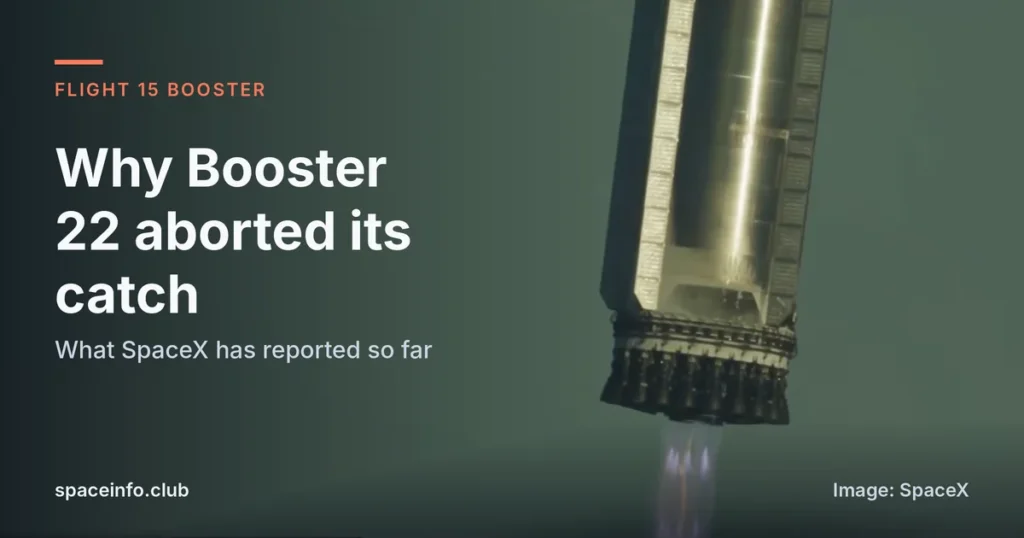
Booster 22 never reached the tower. SpaceX says it ended its boostback burn early after a low fuel mass alarm, flew itself to an offshore contingency zone and came down in the Gulf of Mexico about 6.5 minutes after liftoff. As of November 14, the root cause was still under investigation.
What SpaceX said, and how the explanation changed
On Friday, SpaceX webcast host Dan Huot first attributed the abort to a guidance, navigation and control (GNC) problem. On Saturday he corrected that. The GNC system had worked as designed: it detected that the booster was out of position for a catch, triggered an automated abort and steered it to an offshore splashdown.
Later on Saturday, SpaceX’s Kate Tice said early indications pointed to a different cause. The booster had ended its boostback burn early because of a low fuel mass alarm. SpaceX did not confirm that as the root cause.
The end of the flight was also less gentle than the first reports suggested. Space.com wrote that the booster hovered, cut its engines and triggered its flight termination system, then exploded a few feet above the waves about 6.5 minutes after liftoff. Source: Space.com.
Boostback on 32 engines and an early cutoff
Booster 22 carries 33 Raptor engines. According to Huot, one of them dropped out after hot staging, so 32 lit for the boostback burn. That burn turns the booster around and cancels its downrange velocity so it can fly back toward Starbase.
Tice said early indications were that the burn ended early on a low fuel mass alarm. A vehicle uses an alarm like that to protect propellant it needs later, mainly for the landing burn. SpaceX has not said whether the alarm came from a real shortfall, from an error in the propellant estimate, or from the missing engine. Nor has it said whether the engine loss and the early cutoff are linked. Those are open questions, and any answer here would be a guess.
What the record does show is the order of events. The landing burn began with 13 engines lit, as planned. The booster then judged that it could not reach the catch position and aborted.
An abort is a feature, and the questions left open
The tower catch has a small tolerance for position and velocity. A booster that arrives outside it threatens the pad, so a flight computer that refuses a bad approach is doing its job. Booster 22 gave up one vehicle and protected the tower. That reading is engineering logic, not a SpaceX statement.
Four questions were open as of November 14:
- What caused the low fuel mass alarm: a real propellant shortfall, a faulty estimate or something else.
- Whether the engine that dropped out after staging is connected to the early boostback cutoff.
- Whether the catch-position check was tripped by the boostback or by something later in the coast.
- What SpaceX changes before the next catch attempt.
The first three are for SpaceX’s investigation to answer. Until SpaceX publishes a finding, treat any single cause as unconfirmed.
For the overview of the whole flight, including the ship catch, read the Starship Flight 15 recap.
Frequently asked questions
Was the abort a guidance failure?
No. SpaceX first blamed guidance, navigation and control, then said the system worked as designed and triggered the abort after detecting a bad position for the catch.
What is a boostback burn?
A burn after stage separation that turns the booster around and sends it back toward the launch site.
Was Booster 22 recovered?
No. It hovered, cut its engines and was terminated by its flight termination system just above the Gulf of Mexico, about 6.5 minutes after liftoff.
Has SpaceX named the cause?
Not as of November 14. SpaceX described a low fuel mass alarm as an early indication and said it was still investigating.
Sources
About the author
Sebastiano is a space engineer. He runs SpaceInfo Club, where he writes about spaceflight and aerospace engineering.