
Join the mailing list Free weekly briefing, no spam.
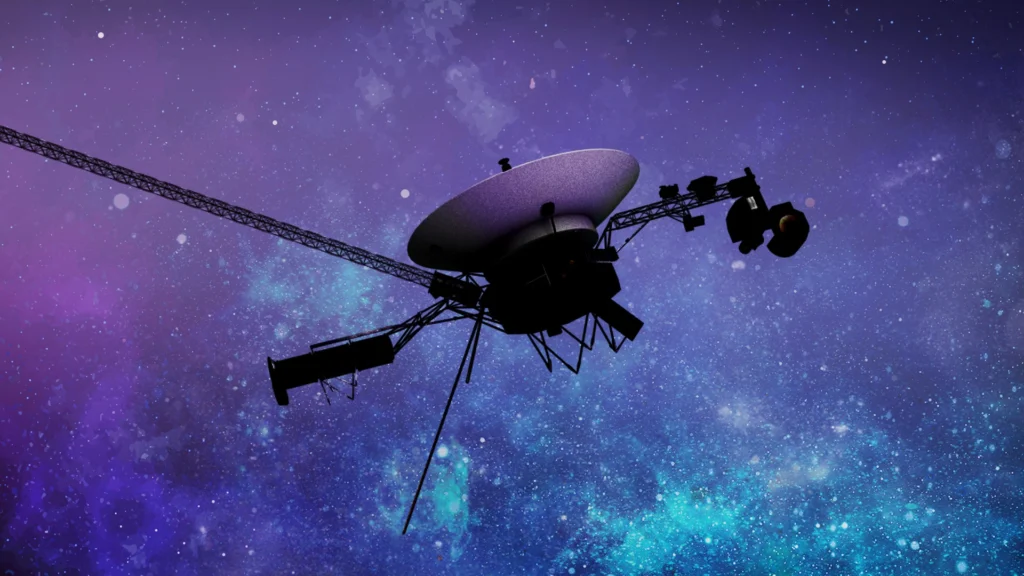
NASA JPL Engineers turned off the Low-energy Charged Particles experiment aboard Voyager 1 on April 17, 2026. Credit: NASA/JPL-Caltech
On April 17, a quiet but deeply symbolic decision echoed across the vastness of space. Engineers at NASA Jet Propulsion Laboratory sent a command to humanity’s most distant messenger, Voyager 1, instructing it to switch off one of its longest-running instruments: the Low-Energy Charged Particles experiment (LECP).
At first glance, this might sound like the gradual fading of a mission nearing its end. In reality, it is something far more profound: a deliberate act of preservation, a strategic sacrifice to extend the life of a spacecraft that has already rewritten the boundaries of exploration.
A 49-Year Watch on the Invisible
Since its launch in 1977, Voyager 1 has been more than a spacecraft—it has been a witness to environments no human-made object had ever encountered. Among its instruments, LECP has played a crucial role in unveiling the invisible architecture of space.
By measuring ions, electrons, and cosmic rays, the instrument has helped scientists map the dynamic behavior of charged particles both within and beyond our solar system. Long after Voyager 1 crossed the heliopause—the boundary where the Sun’s influence fades into interstellar space—LECP continued to detect subtle changes: pressure waves propagating through the interstellar medium, variations in particle density, and echoes of distant astrophysical events.
These observations are not just data points. They are the first direct measurements of the environment between the stars, a region once accessible only through theory and indirect observation.

Astronomy Basics
🌠 Explore the Universe Like Never Before!🔭 Discover the secrets of stars, planets, and galaxies…

[Preview] Orbital Mechanics – An Introduction
Discover the fundamentals of orbital mechanics in this beginner-friendly course—no prior experience needed! Explore how…

Human Factors and Performances
Human factors and human performance in space are critical areas of study in spaceflight operations,…
Space Physics – Basics
Explore the dynamic forces that shape our space environment in this exciting journey beyond Earth’s…
The Physics of Survival
Voyager 1 is powered by a radioisotope thermoelectric generator (RTG), a nuclear battery that converts heat from decaying plutonium into electricity. But even nuclear power has limits. Each year, the spacecraft loses a small but irreversible fraction of its energy budget.
To continue operating, the mission team has had to make difficult decisions: which systems to keep alive, and which to let go.
This is not improvisation. Decades ago, scientists and engineers mapped out a careful shutdown sequence—a kind of long-term survival plan. Each instrument was ranked based on its scientific value and power consumption, ensuring that when the time came, sacrifices would be made methodically, not reactively.
Out of the original ten instruments onboard each Voyager spacecraft, only a few remain active today. With the LECP now switched off on Voyager 1—following a similar step on Voyager 2 in March 2025—the mission enters a new phase: leaner, quieter, but still scientifically vital.
The Value of What Remains
What makes this moment remarkable is not just what is being turned off, but what is being preserved.
Voyager 1 is currently traversing interstellar space, a region no other spacecraft has reached. The remaining instruments continue to measure magnetic fields, plasma waves, and cosmic radiation—parameters that are essential for understanding the nature of the interstellar medium and how our solar system interacts with it.
In this sense, every watt saved is a choice to keep listening to the unknown.
Engineering as Storytelling
There is a human dimension to this decision that often goes unnoticed. The engineers and scientists working on Voyager today are not the same ones who built it in the 1970s. And yet, they are part of a continuous narrative—one that spans generations.
The shutdown sequence itself is a message sent forward in time: a plan crafted by one team, executed by another, all in service of a mission that has outlived its creators’ expectations.
Turning off the LECP is not an ending. It is a continuation of that story, written in careful trade-offs and quiet resilience.
The Long Goodbye That Isn’t
It is tempting to frame Voyager 1 as a mission in decline, slowly dimming as its power fades. But that perspective misses the deeper truth.
Voyager is not simply surviving—it is still exploring.
Nearly half a century after launch, it continues to send back data from a place where no other probe can go. Each decision to power down an instrument is not a step toward silence, but a way to delay it—to stretch the mission just a little further into the unknown.
In space exploration, progress is often measured in bold launches and dramatic discoveries. But sometimes, it is defined by something quieter: the wisdom to let go of one capability in order to preserve many others.
And somewhere, over 24 billion kilometers away, a spacecraft keeps moving forward—lighter, quieter, but still telling us what lies beyond the edge of our world.