

Join the mailing list Free weekly briefing, no spam.
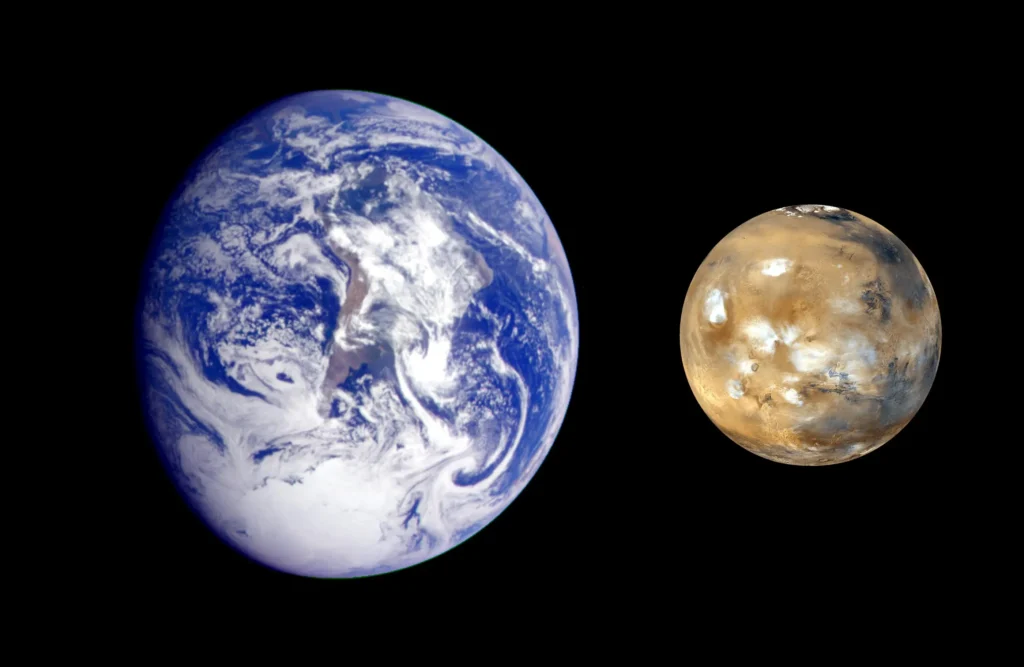
Mars and Earth – Credit NASA
Some of our Italian friends may have come across a podcast episode where a supposed “space expert” confidently claimed that while we sleep, the effects of radiation on our bodies are almost zero.
If that made you smile, you’re not alone — that was exactly our reaction.
Because here’s the point: physics doesn’t take a break when we close our eyes.
Space radiation does not pause, slow down, or become harmless just because we are asleep. It interacts continuously with our bodies — with our cells, our DNA, and our biological systems — regardless of whether we are active or resting.
And here’s the irony: sleep is one of the most biologically active phases of our day. It’s when the body carries out critical processes such as tissue repair, immune regulation, and hormone release — including growth hormone. Suggesting that radiation effects vanish during this phase is not only incorrect, but it also reveals a deeper misunderstanding of both physics and human biology.
So today, even if space radiation is a complex topic, we’ll break it down into clear ideas and give you a solid starting point to understand why its effects are never negligible.
This is the first article in our series on space physics — if you’re curious to go deeper, keep following us and subscribe to our free newsletter here.
What Do We Mean by “Space Radiation”?
On Earth, we are constantly exposed to low levels of radiation from natural and artificial sources. However, we are largely protected by two powerful shields: the atmosphere and the planet’s magnetic field.
In space, those protections disappear.
Space radiation is fundamentally different from what we experience on Earth. It consists mainly of three components:
- Galactic Cosmic Rays (GCRs): high-energy particles originating outside our solar system
- Solar Particle Events (SPEs): bursts of energetic particles emitted by the Sun
- Trapped radiation belts: regions like the Van Allen belts surrounding Earth
These particles — especially heavy ions in cosmic rays — travel at extremely high speeds, often close to the speed of light. When they pass through the human body, they deposit energy along their path, interacting directly with biological tissues.
Scariest Objects in Space: Ghost Nebula, Witch Head Nebula and the Demon Star
Griffin-1 Lunar Lander Completes Environmental Testing at NASA JPL
NASA 4-D Executive Space Programme: Eight Questions Answered by Paul Hawkins
Halloween Fireballs 2026: When to See the Orionid and Taurid Meteor Showers
Perseverance Passes Opportunity’s Driving Record: What 45 Kilometers on Mars Really Means
Why Space Teams Fail: Paul Hawkins on NASA’s 4-D Leadership System
What Happens Inside the Human Body?
At the microscopic level, radiation interacts with atoms and molecules in our cells. One of the most critical targets is DNA.
Radiation can:
- break one or both strands of DNA
- alter chemical structures within the molecule
- generate reactive compounds that damage nearby cellular components
The body is not defenseless. Cells have sophisticated repair mechanisms that constantly fix DNA damage. However, these repairs are not always perfect.
When errors occur, they can lead to:
- mutations
- malfunctioning cells
- long-term health risks such as cancer
This process happens continuously — not only during activity, but also during rest.
Why Sleep Doesn’t Protect You from Radiation
Let’s address the original claim directly.
The idea that radiation effects are “almost zero” during sleep assumes that the body somehow becomes less exposed or less affected when inactive. But radiation exposure depends on external physical conditions, not on whether we are awake.
Particles do not “see” whether a person is sleeping. They interact with matter — including human tissue — in exactly the same way at any time.
In fact, from a biological perspective, sleep is a period of intense internal activity:
- Cells are actively repairing damage
- The brain clears metabolic waste
- Hormonal regulation peaks, including growth hormone release
- The immune system reorganizes and strengthens
This means that if anything, the body is deeply engaged in maintaining and restoring itself — including responding to radiation-induced damage.
Radiation exposure during sleep is therefore not reduced, and its biological consequences remain fully relevant.
Short-Term vs Long-Term Effects
The impact of space radiation depends on both dose and duration.
Short-term effects
During intense solar events, astronauts may experience:
- radiation sickness (at very high doses)
- fatigue and nausea
- temporary damage to blood-forming cells
Long-term effects
More commonly, the concern is cumulative exposure over time, which can lead to:
- increased cancer risk
- damage to the central nervous system
- cardiovascular issues
- potential degenerative diseases
One of the key challenges is that space radiation includes high-energy heavy ions, which produce dense and complex damage tracks in tissue. These are more difficult for the body to repair compared to typical Earth-based radiation.
Beyond DNA: The Whole-Body Impact
Radiation doesn’t only affect isolated cells — it can influence entire biological systems.
Research suggests potential impacts on:
- the brain, including cognitive performance and memory
- the immune system, reducing the body’s ability to respond to threats
- the cardiovascular system, increasing long-term disease risks
For long-duration missions — such as a journey to Mars — these effects become a major concern.
Why This Matters for Space Exploration
Understanding space radiation is not just an academic problem — it’s one of the biggest obstacles to human deep-space exploration.
Astronauts traveling beyond low Earth orbit lose much of the protection provided by Earth’s magnetic field. Missions to the Moon, Mars, or beyond will require:
- improved shielding technologies
- optimized spacecraft design
- biological countermeasures
- precise monitoring of radiation exposure
Even mission timing can be critical, as solar activity influences radiation levels.
Physics Never Turns Off
The claim that radiation effects become negligible during sleep might sound reassuring — but it’s simply not how the universe works.
Radiation is governed by physical laws that operate continuously. It interacts with our bodies regardless of our state of consciousness. Meanwhile, our biology continues working just as continuously to repair, adapt, and survive.
Understanding this interaction — between constant external exposure and constant internal response — is key to protecting human life in space.

Astronomy Basics
🌠 Explore the Universe Like Never Before!🔭 Discover the secrets of stars, planets, and galaxies…
[Preview] Orbital Mechanics – An Introduction
Discover the fundamentals of orbital mechanics in this beginner-friendly course—no prior experience needed! Explore how…
Human Factors and Performances
Human factors and human performance in space are critical areas of study in spaceflight operations,…
Space Physics – Basics
Explore the dynamic forces that shape our space environment in this exciting journey beyond Earth’s…
5cic2x