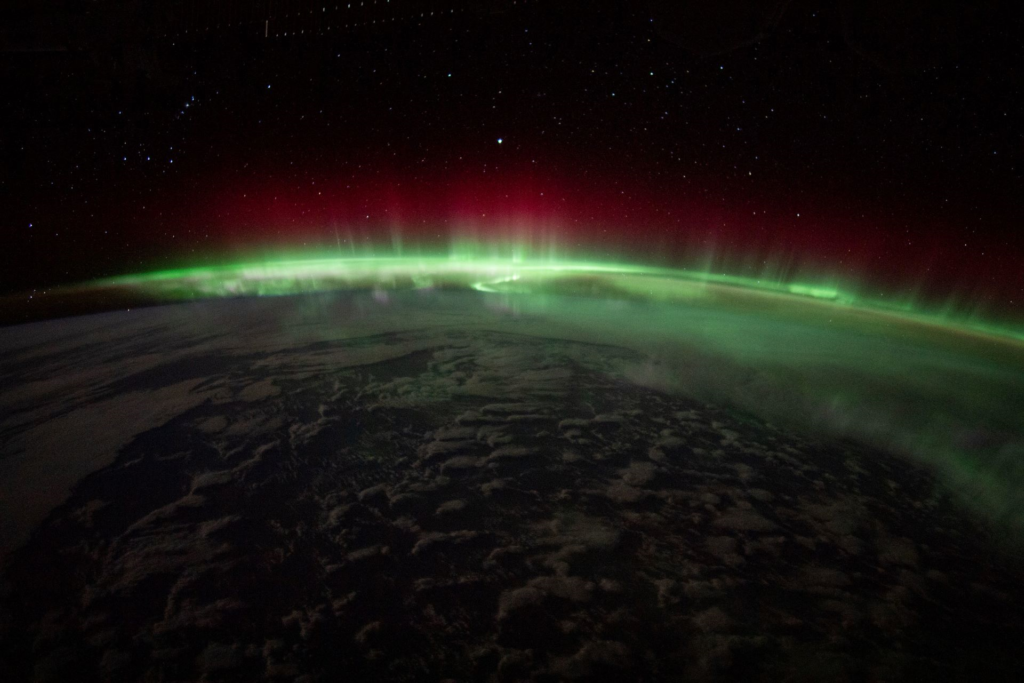
Aurora from ISS – Credit NASA
Last week we talked about Space Radiation, this time we want to go deeper into detail. What you’ll read will give you a real scientific idea about what’s the impact of Space Radiation, with the rigor of a research approach.
We have asked to our friend Dr Francesca Faedi, among else, Research Lead and Lecturer at the University of Leicester. Here her words.
Dr. Francesca Faedi is an internationally recognized Italian astrophysicist specializing in exoplanet research and space science. She has contributed to the discovery of over 60 planets beyond our Solar System and has worked with leading international collaborations, including projects linked to missions like Kepler and ESA’s PLATO.
Currently active at the intersection of research and the space economy, she is also a lecturer at the University of Leicester and director of Orbital Innovation Ltd, bringing scientific expertise into the future of space exploration and industry.
Alongside her research, Dr. Faedi is a passionate science communicator and advocate for diversity in STEM, recognized in Italy with honors such as the title of Cavaliere dell’Ordine al Merito for her outreach work.
How does the recent Artemis II mission position itself in the context of human spaceflight?
The conversation around human space exploration is changing. With missions like Artemis II bringing humans back beyond low Earth orbit, and increasingly serious discussions about long-duration missions to Mars, the focus is no longer just on reaching space — but on how we survive there.
There is a growing sense of momentum, even inevitability, around the idea that humans will live and work beyond Earth. But alongside that excitement, there is a quieter, less negotiable reality: the space environment does not adapt to us. We have to adapt to it.
One of the most fundamental constraints is space radiation. Outside the protection of Earth’s magnetic field and atmosphere, astronauts are continuously exposed to galactic cosmic rays and solar particle events. This is not an occasional hazard; it is a constant condition of deep space. As described by National Aeronautics and Space Administration’s Human Research Program, radiation is one of the primary risks for long-duration missions because of its cumulative and stochastic effects on human health.
Could our body be naturally predisposed to bear with radiation, maybe transitioning into a less active metabolic state?
This is where an important misconception often appears in public discussions: the idea that the body’s state — for example, being asleep — might somehow reduce the impact of radiation. It doesn’t. Radiation exposure is governed by external physical conditions, not by human consciousness. Whether an astronaut is awake, resting, or asleep, high-energy particles continue to pass through the body, depositing energy in tissues and interacting with DNA. As outlined in Cucinotta et al. (2013), radiation damage at the cellular level occurs through ionisation processes that are independent of behavioural state.
In fact, from a biological perspective, sleep is not a passive condition. It is a period of intense physiological activity: DNA repair mechanisms are active, the immune system is regulated, and hormonal cycles — including growth hormone release — are at their peak. None of this reduces exposure; it simply means the body is continuously responding to damage that may also be continuously occurring.
What about hibernation? Is it different?
Where the discussion becomes more interesting — and more relevant to future missions — is when we move beyond sleep and consider a very different state: hibernation, or induced torpor. This is not science fiction. Space agencies such as the European Space Agency have been actively exploring the feasibility of torpor-like states for astronauts, particularly in the context of long-duration missions (ESA, 2021).
Hibernation differs fundamentally from sleep. In hibernating animals, metabolic rate drops dramatically, body temperature decreases, and cellular processes slow to a fraction of their normal levels. Research into synthetic torpor in mammals (Cerri et al., 2021) suggests that it may be possible to induce similar states in humans, at least temporarily.
This raises a subtle but important question for space medicine. Radiation itself does not change — particles still interact with the body in the same way. But if the biological system they interact with is operating more slowly, could the downstream effects also evolve differently?
In a low-metabolic state, cell division is reduced and DNA replication occurs less frequently. Since many radiation-induced risks — such as mutations becoming fixed in the genome — are linked to replication processes, it is plausible that the rate at which damage becomes biologically significant could be altered. Some studies in radiobiology and hibernation suggest that reduced metabolic activity may influence how damage is processed and repaired, although the mechanisms remain poorly understood (Carey et al., 2003; Tinganelli et al., 2019).
Is this the solution for long-duration space travel? I’m thinking about Mars…
This does not imply that hibernation protects against radiation in any straightforward way. On the contrary, the total dose received would remain the same. What changes is the biological context in which that dose is experienced. DNA repair pathways may behave differently, immune responses may be altered, and the long-term risks — such as cancer or neurodegeneration — could follow different trajectories.
For missions to Mars, this distinction matters. The challenge is not only how much radiation astronauts are exposed to, but how their bodies cope with that exposure over time. As highlighted in reports by National Aeronautics and Space Administration and the European Space Agency, mitigating radiation risk will likely require a combination of shielding, operational strategies, and biological countermeasures. Induced torpor is increasingly being considered as part of that broader toolkit, not because it eliminates radiation, but because it may reshape the way the body responds to prolonged exposure.
In many ways, this captures the deeper challenge of human space exploration. The question is no longer just how to engineer spacecraft that can survive the journey, but how to design biological systems — or interventions — that allow humans to remain viable within an environment fundamentally unlike the one we evolved in.
The excitement around Mars is understandable. But the real frontier lies in this interaction between constant external forces and adaptable internal systems. Radiation does not stop. Sleep does not change that. Hibernation might — not by reducing exposure, but by altering the tempo of life itself.
And that raises a question that sits at the heart of future exploration: are we trying to bring Earth into space, or are we beginning to redesign what it means to be human in order to go there?
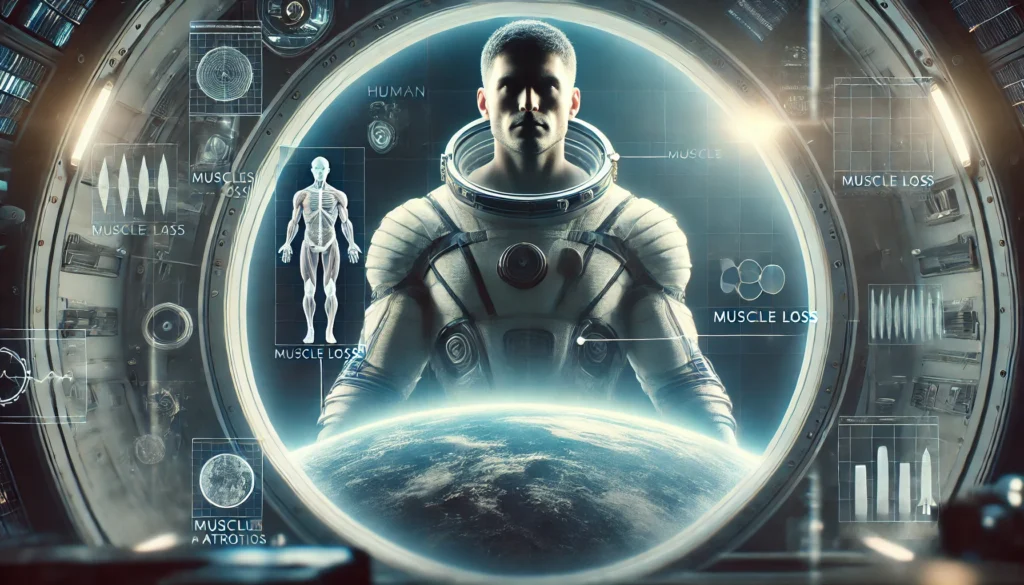
When the Hype Meets Physics: Space Radiation and the Reality of Living Beyond Earth
A New Map of the Asteroid Belt Is Rewriting the Solar System’s Origin Story
New Glenn 3: A Landmark Landing, an Orbital Miss — and What It Means for Blue Origin’s Future
When Silence Becomes Strategy: Voyager 1 and the Art of Letting Go
Space Radiation Doesn’t Sleep: Why Its Effects on the Human Body Are Never “Almost Zero”
From Leicester to Lunar Orbit: The Voice Behind Artemis II
Celeste Takes Flight: Europe’s Next Step in Satellite Navigation Innovation

Dallas Campbell to Bring the Story of Space Exploration to Life at Space Park Leicester
BIBLIOGRAPHY:
Carey, H.V., Andrews, M.T. and Martin, S.L. (2003) ‘Mammalian hibernation: cellular and molecular responses to depressed metabolism and low temperature’, Physiological Reviews, 83(4), pp. 1153–1181.
Cerri, M. (2017) ‘The central control of energy expenditure: exploiting torpor for medical applications’, Annual Review of Physiology, 79, pp. 167–186.
Cerri, M. et al. (2021) ‘Inducing torpor in humans: current knowledge and future perspectives’, Neuroscience & Biobehavioral Reviews, 128, pp. 541–554.
Cucinotta, F.A., Kim, M.H.Y. and Chappell, L.J. (2013) ‘Space radiation cancer risk projections and uncertainties’, NASA Human Research Program.
Durante, M. and Cucinotta, F.A. (2011) ‘Physical basis of radiation protection in space travel’, Reviews of Modern Physics, 83(4), pp. 1245–1281.
European Space Agency (ESA) (2021) Hibernation for space exploration. Available at: https://www.esa.int
Hall, E.J. and Giaccia, A.J. (2019) Radiobiology for the Radiologist. 8th edn. Philadelphia: Wolters Kluwer.
Jackson, S.P. and Bartek, J. (2009) ‘The DNA-damage response in human biology and disease’, Nature, 461(7267), pp. 1071–1078.
National Aeronautics and Space Administration (NASA) (n.d.) Human Research Program: Space Radiation Element. Available at: https://www.nasa.gov/hrp
National Aeronautics and Space Administration (NASA) (n.d.) Space Radiation and Human Health. Available at: https://www.nasa.gov
Simonsen, L.C. et al. (2020) ‘NASA’s first ground-based Galactic Cosmic Ray Simulator: Enabling a new era in space radiobiology research’, PLoS Biology, 18(5), e3000669.
Tinganelli, W. et al. (2019) ‘Radiation protection strategies in space: a role for hibernation?’, Life Sciences in Space Research, 22, pp. 1–9.
Tinganelli, W. and Cerri, M. (2021) ‘Hibernation and radioprotection: gene expression and DNA repair’, Life Sciences in Space Research, 28, pp. 1–9.
United Nations Scientific Committee on the Effects of Atomic Radiation (UNSCEAR) (2020) Sources, Effects and Risks of Ionizing Radiation. Vienna: United Nations.
Zada, E. et al. (2019) ‘Sleep increases chromosome dynamics to enable reduction of accumulating DNA damage in single neurons’, Nature Communications, 10, 895.