
Join the mailing list Free weekly briefing, no spam.
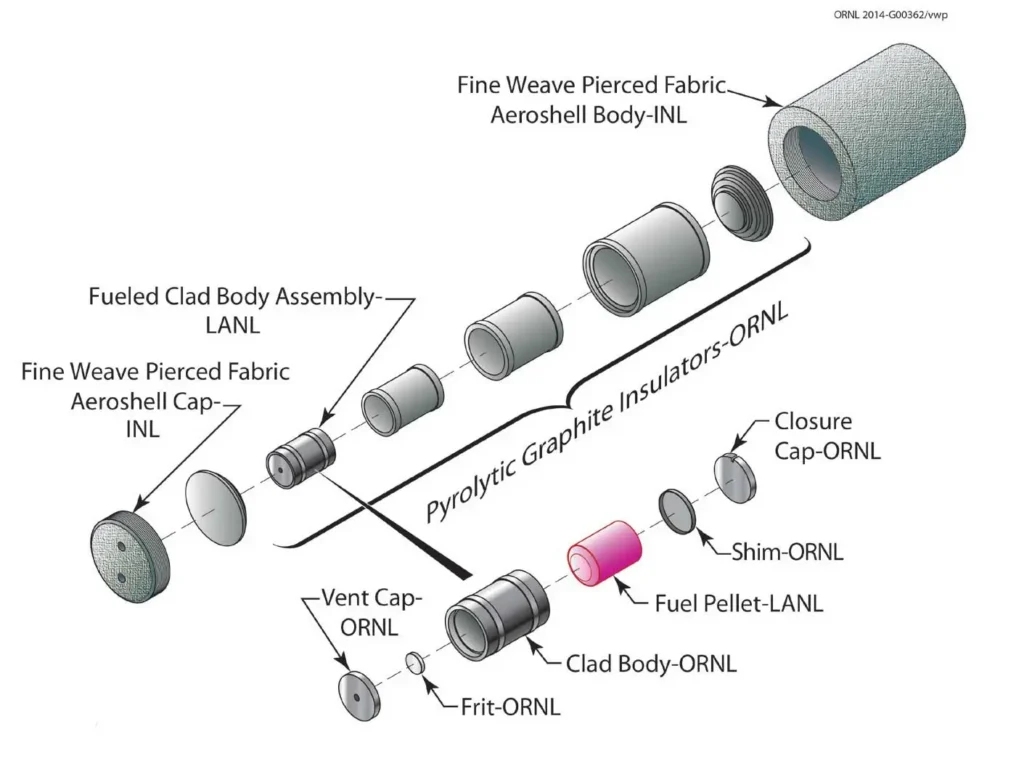
Cover Image: RHU – Credits: Department of Energy | Oak Ridge National Laboratory (ORNL) | Idaho National Laboratory (INL) | Los Alamos National Laboratory (LANL)
In the silent, sunless regions of our Solar System—where temperatures plunge, sunlight vanishes for months, and conventional power systems falter—survival depends on one thing: reliable heat. A recent breakthrough by the University of Leicester and Perpetual Atomics marks a decisive step toward making that reliability a reality for future missions.
Engineering for the Harshest Environments
The two partners have successfully completed a critical phase in the development of their Generation 5 Americium Radioisotope Heater Unit (Am-RHU), a compact device designed to provide continuous heat in extreme environments. Supported by the European Space Agency through its ENDURE programme, the project has now demonstrated that this technology can endure both the violence of launch and the unforgiving conditions of deep space.
Testing pushed the system well beyond standard mission requirements. The unit survived vibration loads exceeding 25 G in sine testing and 28 Grms in random profiles—levels representative of the intense forces experienced during rocket ascent. It was then subjected to thermal cycling between +80 °C and −70 °C in vacuum conditions while operating, simulating the brutal swings encountered on planetary surfaces.
This is more than a technical checkbox. It is a validation that the system can function when it matters most—far from Earth, with no margin for failure.
Why Americium Matters
Radioisotope heater units are not new, but the choice of fuel is evolving. Traditionally, missions have relied on plutonium-based systems, largely dominated by US capabilities. The shift toward americium represents a strategic move for Europe.
Americium-241, derived from nuclear waste streams, offers a more accessible and sustainable alternative. While it produces less power than plutonium-238, it is particularly well-suited for heater units, where consistent thermal output—not electrical generation—is the priority.
In practical terms, this means spacecraft can survive:
- The long lunar night, which lasts about 14 Earth days
- Permanently shadowed craters on the Moon, among the coldest places in the Solar System
- Deep-space missions venturing far from the Sun, where solar panels become ineffective
Without such systems, exploration in these environments becomes severely constrained.
Beyond the Rocket Revolution: Connecting Space Innovation with Society
ESA and Vast: the new MoU and Europe’s future after the ISS
Photonic Quantum Processor in Orbit: What the First Test Proved, and What It Didn’t
Argotec and Rheinmetall Put an Air Defence Satellite in Orbit
Starship Flight 14 Recap: It Reached Orbit, Delivered 26 Satellites — and Came Home the Hard Way

Aurora and Saturn at Opposition: The Sky on October 2–4, 2026
From Research to Reality
The development of americium-based systems has been led by the University of Leicester for over a decade, culminating in the creation of Perpetual Atomics to commercialise the technology. This transition from academic research to industrial application is a defining feature of Europe’s growing space ecosystem.
At the heart of this effort is Space Park Leicester, a £100 million hub designed to bring together research, manufacturing, and industry collaboration. Facilities like this are increasingly critical as space technology moves toward faster development cycles and mission-driven innovation.
The emphasis is clear: build, test, iterate—quickly.
Enabling the Next Era of Exploration
Reliable thermal systems are often overlooked in public discussions about space exploration, overshadowed by propulsion or scientific payloads. Yet they are foundational. Without heat, electronics fail, batteries degrade, and missions end prematurely.
This milestone changes that equation.
By proving both launch resilience and operational durability, the Am-RHU programme is now moving closer to integration into real missions. That opens the door to:
- Sustained robotic operations on the Moon
- Long-duration missions to Mars and beyond
- Infrastructure that supports eventual human presence in extreme environments
In essence, this is enabling technology—the kind that quietly determines whether ambitious mission concepts are feasible or not.
A Strategic Step for Europe
Beyond the engineering achievement, this milestone carries geopolitical and industrial significance. Developing independent nuclear power capabilities for space reduces reliance on external partners and strengthens Europe’s position in the global space sector.
As missions push further into harsher environments, the demand for dependable, long-duration power and heat systems will only grow. With americium-based technology maturing, Europe is positioning itself not just to participate in that future—but to help define it.