
Join the mailing list Free weekly briefing, no spam.
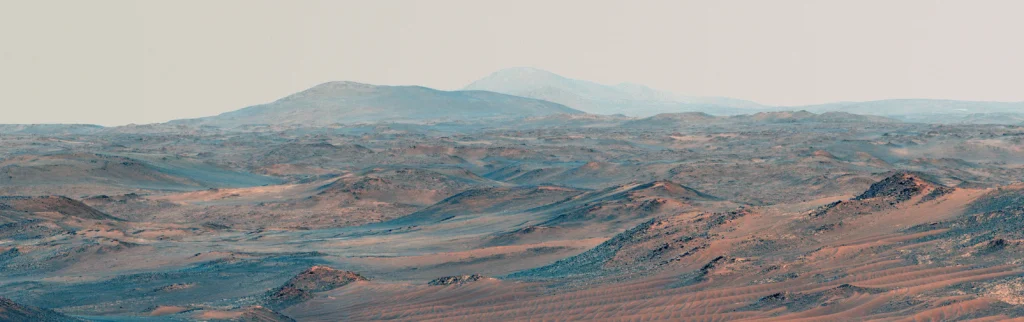
Image: Lac de Charmes – Credits NASA/JPL-Caltech/ASU/MSSS
On a planet defined by silence and dust, two robotic explorers are quietly assembling one of the most detailed geological narratives ever constructed beyond Earth. NASA’s twin rovers — Mars Science Laboratory (Curiosity) and Mars 2020 (Perseverance) — have recently delivered stunning 360-degree panoramas that do far more than showcase Martian scenery. They reveal a story unfolding in opposite directions through time.
Separated by 3,775 kilometers — roughly the distance between Los Angeles and Washington, D.C. — these two missions are not just exploring different regions of Mars; they are exploring different eras of its history. Together, they form a coordinated scientific effort to reconstruct the Red Planet’s transformation from a potentially habitable world to the cold desert we see today.
Halloween on the International Space Station: How Astronauts Celebrate in Orbit
ESA’s Hera and NASA’s DART: What Europe’s Asteroid Mission Will Measure at Didymos
Executive Guide to Space at Space Park Leicester: Three Days Inside a Space Mission

MO-Nav on Talon-A: What a Mach 5 GPS-Denied Test Proves
Scariest Objects in Space: Ghost Nebula, Witch Head Nebula and the Demon Star
Griffin-1 Lunar Lander Completes Environmental Testing at NASA JPL

NASA 4-D Executive Space Programme: Eight Questions Answered by Paul Hawkins
Halloween Fireballs 2026: When to See the Orionid and Taurid Meteor Showers
A Planet Frozen in Time — But Not Uniformly
Mars may appear geologically quiet at first glance, but its surface preserves a deep and complex past. Both rovers are investigating terrains billions of years old, yet their strategies differ in a crucial way.
Curiosity, which landed in Gale Crater in 2012, is effectively climbing forward in time. As it ascends the layered slopes of Mount Sharp, it moves from older to younger geological deposits, reading Mars’ history like a book from bottom to top.
Perseverance, on the other hand, landed in Jezero Crater in 2021 and is heading in the opposite temporal direction — toward some of the oldest accessible rocks on the planet. Its journey is a descent into Mars’ earliest chapters, where conditions may have been most favorable for life.
Curiosity’s View: Traces of Water and Chemistry
Curiosity’s latest panorama — composed of over a thousand images captured between November and December 2025 — highlights a striking geological feature: intricate “boxwork” formations. These spiderweb-like ridges are not random; they are the mineralized remains of ancient groundwater systems.
Long ago, water flowed through fractures in the Martian bedrock. As it moved, it deposited minerals that hardened the surrounding rock. Over billions of years, erosion stripped away the softer material, leaving behind these resistant ridges — a fossilized imprint of Mars’ hydrological past.
But Curiosity’s contributions go beyond visual evidence.
The rover has:
- Confirmed that Mars once hosted environments capable of supporting microbial life.
- Identified carbonate minerals like siderite, suggesting a thicker, carbon-rich ancient atmosphere.
- Detected increasingly complex organic molecules, including long-chain hydrocarbons — potential precursors to life.
Each discovery strengthens the case that early Mars was not just wet, but chemically active in ways that could support prebiotic processes.
Perseverance’s Perspective: Hunting for Biosignatures
While Curiosity analyzes powdered rock on-site, Perseverance is taking a more ambitious approach: sample return.
Its recent panorama, centered on a region nicknamed “Lac de Charmes” just outside Jezero Crater’s rim, captures a landscape shaped by both volcanic activity and ancient water flow. Billions of years ago, this crater hosted a lake fed by a river — an ideal environment for preserving signs of microbial life.
One of Perseverance’s most intriguing discoveries so far is a rock formation known as “Cheyava Falls,” marked by distinctive “leopard spot” patterns. On Earth, such features are often associated with microbial activity, formed through chemical reactions mediated by living organisms.
While not definitive proof of past life, these patterns represent one of the most compelling biosignature candidates yet identified on Mars.
Perseverance is also:
- Collecting intact rock cores for eventual return to Earth.
- Recording phenomena never before observed directly on Mars, such as electrical activity in dust devils.
- Capturing visible-light auroras from the Martian surface — a first for planetary exploration.
These efforts are laying the groundwork for future laboratory analysis that could answer one of humanity’s oldest questions: Are we alone?
Complementary Missions, Unified Goal
Despite their different approaches, Curiosity and Perseverance are deeply interconnected.
Curiosity tells us how Mars changed — documenting the gradual shift from wet to dry conditions through layered sedimentary records. Perseverance, meanwhile, asks whether life ever took hold during those earlier, more hospitable periods.
Together, they form a powerful scientific synergy:
- One reconstructs environmental evolution.
- The other searches for biological evidence within that context.
Their combined datasets are transforming Mars from a static world into a dynamic system with a rich, evolving history.
The Road Ahead
Curiosity has now moved beyond its boxwork region and is exploring sulfate-rich layers higher on Mount Sharp — deposits that may represent some of the driest periods in Martian history.
Perseverance continues its journey toward even older terrains, including a region evocatively named “Singing Canyon,” where some of the planet’s earliest geological records may be preserved.
Both missions remain operational, productive, and far from finished.

Astronomy Basics

[Preview] Orbital Mechanics – An Introduction

Human Factors and Performances
Space Physics – Basics
A Planet, Reconstructed
The true achievement of these panoramas is not their visual impact — though they are undeniably breathtaking. It is their scientific depth.
Each image, each rock sample, each data point contributes to a larger reconstruction of Mars as it once was: a world with water, chemistry, and perhaps even biology.
By moving through time in opposite directions, Curiosity and Perseverance are closing the gaps in that story.
And with every meter traveled across the Martian surface, they bring us closer to understanding not just Mars — but the conditions that make life possible anywhere in the universe.