
Join the mailing list Free weekly briefing, no spam.
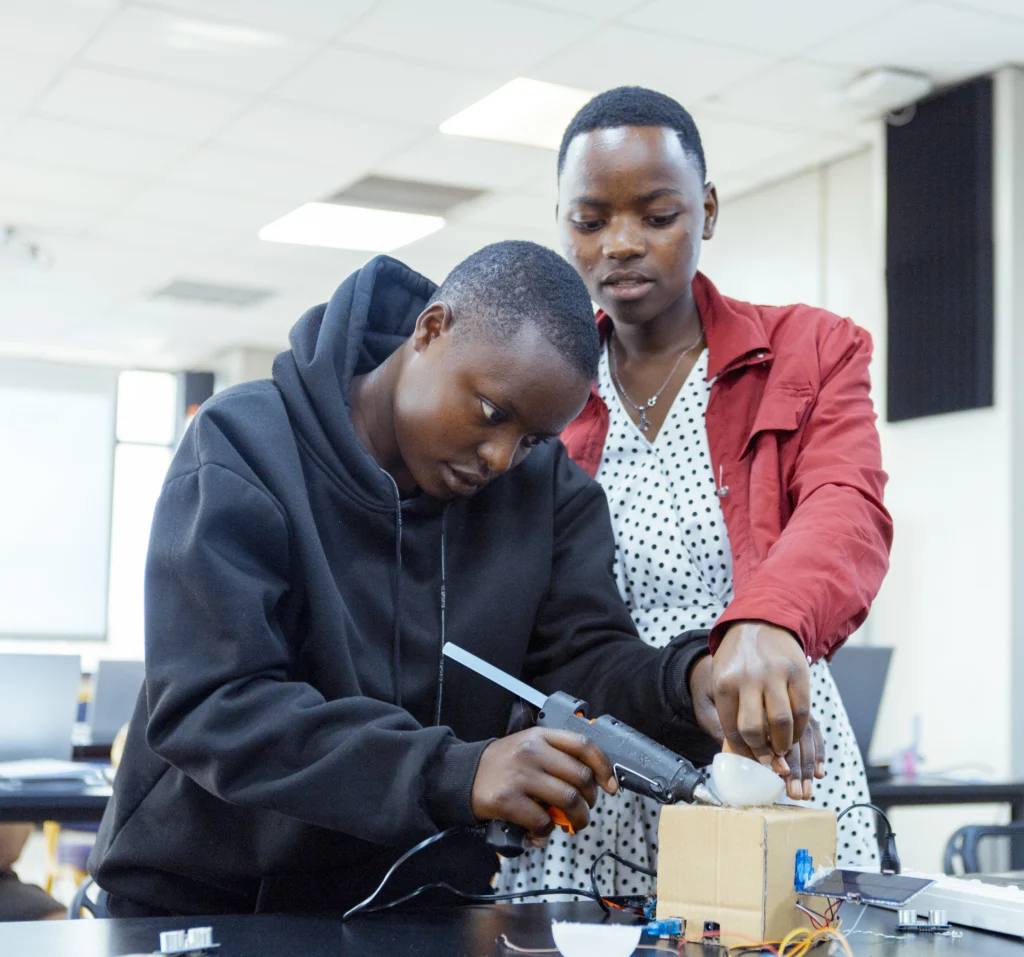
Cover Image: Physics Camp members build a model satellite – Credits SPL
A UK-Rwanda-Tanzania project called IKIRERE is studying droughts and heatwaves in East Africa while teaching physics, climate science and satellite technology to students and early career scientists.
In brief
- IKIRERE stands for Innovation and Knowledge Integration for Resilience in East Africa through Climate Research and Education. It is led by Dr Rob Parker of the University of Leicester’s School of Physics and Astronomy.
- Researchers from the University of Leicester and the National Centre for Earth Observation (NCEO), based at Space Park Leicester, work with the African Institute for Mathematical Sciences Research and Innovation Centre (AIMS RIC) in Rwanda and with Tanzanian partners.
- In 2026 the team ran a Physics Camp for more than 30 secondary school pupils and an Early Career Researchers Academy for 33 participants in Rwanda.
- The Academy drew more than 900 applications from across Africa for 30 places.
- IKIRERE is one of the projects in the £10.7 million Africa-UK Physics Partnership Programme.
What IKIRERE sets out to do
IKIRERE has two goals that feed each other. The first is scientific: to understand better how droughts and heatwaves behave in East Africa. The second is educational: to build local expertise in physics, mathematics, climate science, satellite technology and space science, so that African researchers can lead this work themselves.
The project belongs to the Africa-UK Physics Partnership Programme, which has £10.7 million to spend on this kind of collaboration. UKRI describes the programme as a response to a gap in the region’s research base: an Institute of Physics study found that only five per cent of research in Sub-Saharan Africa involves physics. UKRI funds the programme through the UK Department for Science, Innovation and Technology, and the Science and Technology Facilities Council leads it together with the Institute of Physics.
Partners at AIMS RIC in Rwanda lead the capacity-building work package. That includes IKIRERE International Project Co-lead Dr Mouhamadou Bamba Sylla. The UK team co-designs the activities and helps deliver them.
Why droughts and heatwaves in East Africa
Much of East African agriculture depends on rainfall rather than irrigation. When rains fail or temperatures spike, harvests and incomes suffer quickly. Dr Cristina Ruiz Villena, who works at NCEO and in the University of Leicester’s School of Physics and Astronomy, put it this way:
“Africa is particularly vulnerable to climate change because it depends on rain-fed agriculture. In IKIRERE, our aim is to improve our understanding of droughts and heatwaves in East Africa, supporting adaptation efforts and contributing to greater climate resilience across the region.”
Better understanding supports practical decisions: when to plant, which crops to rotate, how to warn farmers about a coming dry spell. That is the link between the research and the training, because the people who make those tools need the skills to build them.
The 2026 Physics Camp: robots, weather and satellite missions
A Leicester team travelled to Rwanda to support the 2026 IKIRERE Physics Camp. It consisted of Dr Cristina Ruiz Villena, Catherine Fitzsimons and Charlie Gamblin. The camp challenged more than 30 pupils from 10 secondary schools to design and present projects that combined physics, climate science, robotics and satellite technology.
Over one week the pupils built robots, monitored weather patterns and designed satellite missions. They used tools and technologies that researchers use, and they worked alongside early career African scientists who specialise in climate and space science. Hands-on experiments, interactive workshops and talks filled the programme.
For pupils of that age, meeting scientists who work on satellites or climate data at close range makes those careers concrete. That is the aim: more young people choosing climate science, satellite technology and space engineering.
The Early Career Researchers Academy: 900 applications for 30 places
The second event was the Early Career Researchers (ECR) Academy, which brought together 33 researchers to strengthen their skills in climate science, innovation and research leadership. Interest was far greater than the number of places. Dr Ruiz Villena said the Academy received more than 900 applications from across Africa for only 30 places.
Attendees built working prototypes during the Academy. They included:
- a machine learning tool for crop monitoring;
- a text message based climate risk alert system for farmers;
- an air pollution exposure mapping tool;
- a satellite data driven model to support crop rotation decisions.
Several of these rely on Earth observation data. Satellites measure vegetation, rainfall and surface temperature over areas where ground weather stations are few, which is why satellite skills sit beside climate science in the project’s training.
Who backed the events
Both events had support from high-profile Rwandan institutions: the Rwanda Education Board, the Rwanda Space Agency and the Rwanda Ministry of the Environment. Dr Ruiz Villena described the two events as part of the ongoing collaboration between the University of Leicester, NCEO and AIMS RIC, and said they were highly successful.
What comes next
IKIRERE continues as part of the wider partnership programme, which involves the UK, Ghana, Kenya, Rwanda, South Africa, Tanzania and Uganda. The Leicester team says its capacity-building work with AIMS RIC is ongoing. Readers who want to follow the research can look to Space Park Leicester and the University of Leicester for updates.