
Join the mailing list Free weekly briefing, no spam.
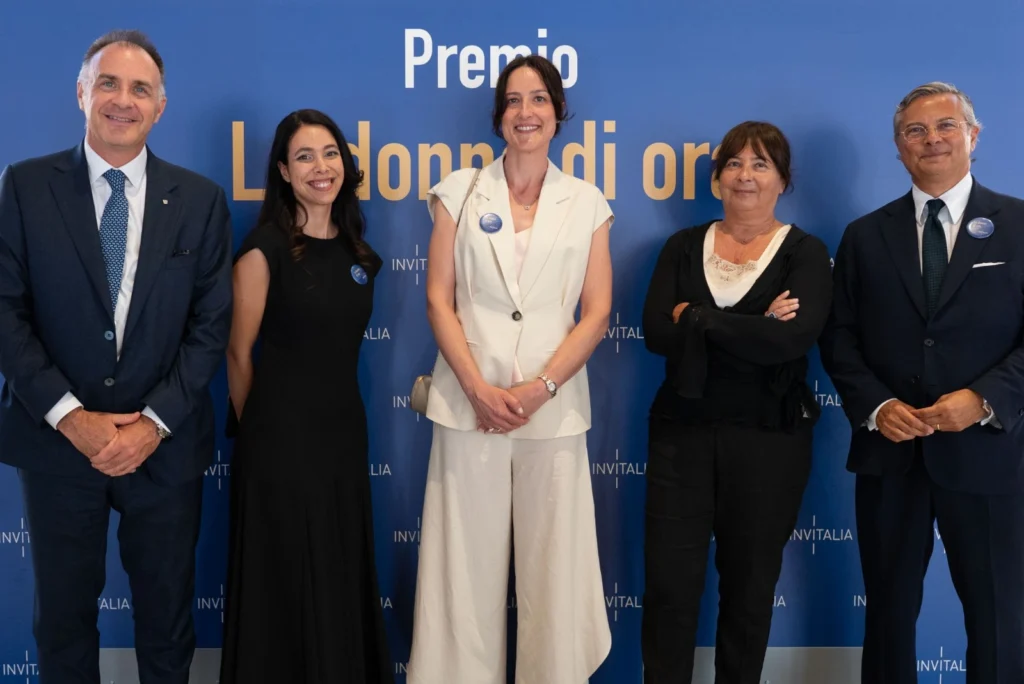
Cover Image: Le Donne di Ora Prize – Credits Invitalia
The recognition highlights a growing role for textile innovation in the future of human spaceflight.
The Italian space sector continues to demonstrate that innovation does not only emerge from rockets, satellites, or propulsion systems. Sometimes, it begins with the materials astronauts wear every day.
Corinna Sperandini, co-founder and CEO of Spacewear, has been named the winner of the first edition of the “Le donne di ora” award, an initiative promoted by Invitalia and Italy’s Ministry of Enterprises and Made in Italy (MIMIT). The award recognizes women entrepreneurs whose leadership combines vision, technical expertise, creativity, and social responsibility.
The ceremony took place on 1 July at L’Opificio in Rome and brought together representatives from Italian institutions and industry, including Minister of Labour and Social Policies Marina Calderone, Minister of Enterprises and Made in Italy Adolfo Urso, Confindustria President Emanuele Orsini, and Invitalia CEO Bernardo Mattarella.
For the Italian aerospace ecosystem, the recognition extends beyond an individual achievement. It reflects the growing importance of companies capable of combining advanced manufacturing, scientific research, and sustainable innovation in sectors traditionally dominated by large industrial players.
Particularly valuable is also the work of Dr. Francesca Faedi as Academic Liaison for Commercial and Innovation Activities at Space Park Leicester, connecting the dots between companies as SpaceWear, the academic world and the innovation hubs such as Space Park Leicester.
From Traditional Textiles to Space Technology
Spacewear has established itself as one of Italy’s most distinctive space startups by focusing on an often overlooked aspect of human spaceflight: intravehicular clothing.
Unlike pressurized spacesuits used during spacewalks, Spacewear develops smart garments designed for astronauts living and working inside spacecraft and orbital stations. Its Smart Flight Suit platform integrates ergonomic design, advanced fabrics, and wearable technologies aimed at improving comfort, safety, and physiological monitoring during long-duration missions.
The company has already achieved a significant milestone by flying two generations of its interactive suits in space, making it one of the few Italian companies with flight-proven wearable technologies.
Sperandini believes the same research developed for astronauts can also help address challenges on Earth.
In comments accompanying the award, she highlighted the potential for Italy’s textile manufacturing sector to evolve toward high-value technological applications instead of competing solely on production costs. She also pointed to Spacewear’s long-lasting antibacterial fabrics, originally developed to reduce water consumption in space missions and already tested during astronaut training, as an example of how aerospace research can generate sustainable solutions for everyday use.
The approach reflects one of the defining characteristics of the modern space economy: technologies created for extreme environments often find valuable applications in terrestrial industries. These are the real benefits of Space Technology applied on Earth, for everyone’s needs.
Have you ever reflected on the clothes we wear everyday? Are they so different from those worn in 1800s?
Leadership Beyond the Space Sector
The “Le donne di ora” award also sends a broader message about the changing landscape of technological entrepreneurship in Italy.
Innovation in aerospace increasingly depends on multidisciplinary expertise, where engineering, industrial design, materials science, manufacturing, and business strategy work together. Companies like Spacewear illustrate how smaller, highly specialized firms can contribute to national competitiveness by occupying technological niches that larger organizations may overlook.
In this context, recognizing entrepreneurial leadership is also a recognition of the ecosystems that enable innovation to reach operational space missions.
Spacewear and the SpaceInfo Club
Readers of the SpaceInfo Club will already be familiar with Spacewear’s work.
Let’s pickup the question I’ve asked you few lines above. Textile technology finds here a great margin for improvement: filling two centuries of low-technological progress from the clothes and textile point of view. New materials have been invented, true. But what about the technology we may insert into our clothes? Sensors, displays and electronics. Could ergonomics be improved? I’m sure the answer is yes. And also SpaceWear is committed towards this direction.
Over the past two years, we have followed several milestones in the company’s development, from the introduction of its Smart Flight Suit technology and the successful in-orbit testing of its astronaut garments to more recent advances in radiation-resistant textiles and the unveiling of the new SFS3 platform for future missions. We have also examined how the company’s research is transforming technologies developed for astronauts into sustainable solutions with potential applications on Earth.
This latest recognition adds another chapter to that story.
While the award celebrates Corinna Sperandini’s entrepreneurial journey, it also highlights an increasingly important reality for the European space sector: innovation is not defined solely by launch vehicles or spacecraft. Advances in materials, wearable systems, human factors engineering, and sustainable manufacturing will play an equally important role as humanity prepares for longer missions aboard commercial space stations, lunar habitats, and eventually Mars expeditions.
As the space economy continues to mature, companies capable of connecting industrial tradition with cutting-edge research may become some of Europe’s most valuable contributors to the next generation of human spaceflight.