
Join the mailing list Free weekly briefing, no spam.
In short: Space missions rarely fail only because of broken hardware. In this interview, Paul Hawkins, founder of Crazy Might Work and lead facilitator of the NASA 4-D leadership programme, explains why NASA looked at team culture after its past failures, what Antarctica reveals about how teams behave under pressure, and why leadership “is a team sport” that cannot be learned in theory.
This is part 1 of a short SpaceInfo Club series on human performance in high-stakes environments. Last updated: 14 October 2026.
Watch the interview
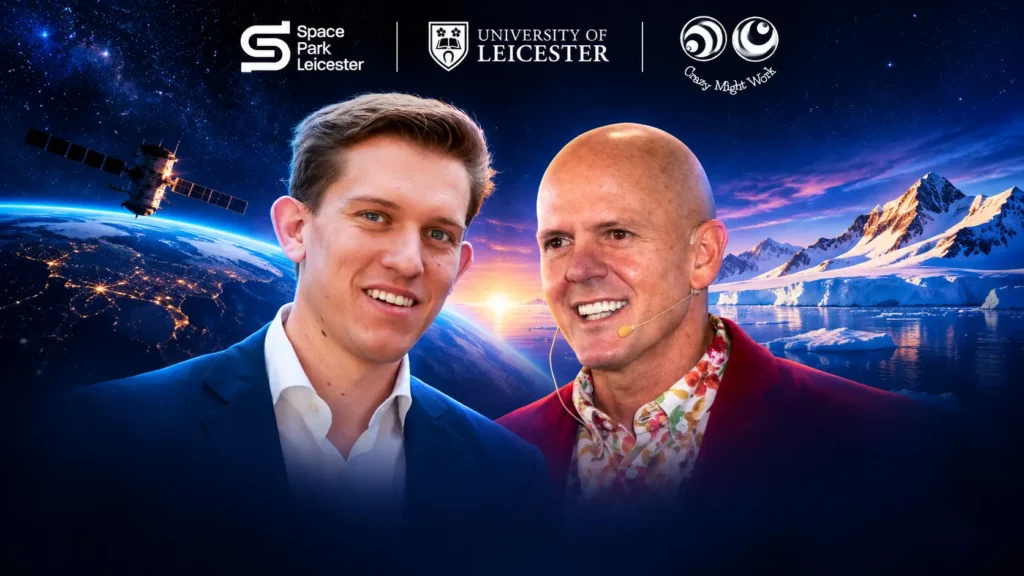
Video: Paul Hawkins on NASA’s 4-D leadership system, hosted by Sebastiano, aerospace engineer, for SpaceInfo Club.
Key takeaways
- Culture is part of the system. In Paul’s words, past failures “weren’t just a technical problem”. There was a culture in which people did not feel free to speak up.
- Invisible problems must become visible. The NASA 4-D system gives teams a language to talk about unwritten rules and redefine them.
- Antarctica separates teams. Under the same harsh conditions, some teams come out “like family” and others fractured.
- Simulations show real behaviour. Putting strangers into realistic, pressured scenarios reveals how people actually act, which theory cannot do.
- It applies beyond space. The lessons are relevant to any high-performance team.
Who is Paul Hawkins?
Paul Hawkins is the founder and “Chief Combobulator” of Crazy Might Work, an Australian leadership and innovation academy he founded in 2015 and launched in Antarctica. The company delivers the NASA 4-D leadership programme and has worked with governments, space agencies, universities and multinational organisations. Paul also presents regularly to the Space Generation Advisory Council of the United Nations, according to the company’s website.
What is the NASA 4-D system?
NASA’s four-dimensional (4-D) system is a human performance programme originally developed by Charlie Pellerin, a former Director of Astrophysics at NASA. Crazy Might Work now delivers an updated version that adds contemporary neuroscience and simulations drawn from the current space programme. According to Crazy Might Work, about 1,500 NASA teams have completed it voluntarily, and teams typically improve 4-5% each time they benchmark their behaviours.
The four dimensions describe what a leader builds:
| Dimension | What it addresses |
|---|---|
| People-building | Linking personal and team interests to the organisation’s purpose; developing people around their strengths |
| Team-building | Sharing attention, information and recognition appropriately; rewriting unspoken team norms |
| System-building | Clarifying roles, responsibilities and authority; managing stress and disagreement constructively |
| Mission-building | Co-designing an ambitious but realistic mission and communicating it clearly |
Source: Crazy Might Work, NASA 4-D programme brochure.
These dimensions are put into practice through eight observable behaviours: expressing authentic appreciation, establishing shared interests, expressing reality-based optimism, securing 100% commitment, addressing drama and “red story lines”, clarifying roles, accountability and authority, appropriately including others, and setting standards and keeping agreements.
Why NASA looked at culture, not only hardware
The 4-D approach is linked to the aftermath of NASA’s space shuttle disasters. Official inquiries into both the Challenger accident and the Columbia accident examined organisational factors alongside the technical causes. In the interview, Paul describes the cultural side of that story:
“It wasn’t just a technical problem… There was actually a culture at that time within the organization that didn’t allow people to speak up freely.”
— Paul Hawkins
This is the central idea of the whole programme: if concerns cannot travel through a team, technical excellence alone cannot protect a mission.
Making invisible problems visible
Paul explains that the NASA programme is voluntary, so it attracts people who want change. The main challenge is the invisible side of teamwork: unwritten rules, assumptions and habits that shape what people feel able to say. The programme’s aim is to make these issues visible, so teams can have a meaningful conversation and redefine their rules together.
What Antarctica teaches about teams
Antarctica is not only the place where Crazy Might Work was launched. Paul describes it as a setting where extended pressure, isolation and harsh conditions reveal how teams really function. The difference between teams, he says, often comes down to how they interact and support each other when things get hard.
“Some teams will go through that whole experience and they come out of that like family… Other teams will come out of there fractured and wanting to murder each other.”
— Paul Hawkins
Why realistic simulations work
Whether the goal is testing or training, Paul’s point is that simulations should expose true behaviour under pressure. By putting strangers together in challenging scenarios, participants experience team dynamics directly and can adjust them in the moment.
“Leadership and team performance is a team sport… you can’t learn that theoretically.”
— Paul Hawkins
An engineer’s takeaway
Aerospace engineering is built on procedures, margins and verification, and rightly so. The interview is a reminder that procedures work best inside a team where people can raise doubts early and be heard. That is why the human side of a mission deserves the same attention as the technical one.
Experience it in person: NASA 4-D Executive Space Programme
For readers who want to go further, Space Park Leicester and Crazy Might Work are launching the NASA 4-D Executive Space Programme from 9 to 13 November 2026 at Space Park Leicester in the United Kingdom.
- Days 1-2 (9-10 November): NASA 4-D leadership programme, delivered by Crazy Might Work.
- Days 3-5 (11-13 November): Executive Guide to Space, delivered by Space Park Leicester, covering how space missions are conceived, built, launched and operated.
- Who it is for: technical and non-technical professionals; participants can attend the full week or either part.
Full details and pricing are on the Space Park Leicester programme page.
Frequently asked questions
What is the NASA 4-D system?
It is a human performance system originally created by former NASA Director of Astrophysics Charlie Pellerin. It focuses on the social context of teams rather than individual skills, using four dimensions (people, team, system and mission) and eight observable behaviours.
Who is Paul Hawkins?
Paul Hawkins is the founder and Chief Combobulator of Crazy Might Work, a leadership and innovation academy founded in 2015 and launched in Antarctica. He is also the lead facilitator of the NASA 4-D leadership programme.
Why does team culture matter in space missions?
Because complex missions depend on information flowing freely. If people do not feel able to raise concerns, problems can stay hidden until they become critical.
What does Antarctica have to do with team performance?
Antarctica was where Crazy Might Work was launched, and Paul describes it as an environment that reveals team dynamics under pressure: some teams become close, others fracture.
Can people outside the space industry benefit from NASA 4-D?
Yes. According to Crazy Might Work, the programme is open to leaders from any industry, and its lessons apply to any team that works under pressure.
When and where is the NASA 4-D Executive Space Programme?
It runs from 9 to 13 November 2026 at Space Park Leicester, United Kingdom, and participants can join the full five days or either component separately.
Sources
- Space Park Leicester: NASA-proven leadership training comes to Leicester
- Crazy Might Work: NASA 4-D programme
- Crazy Might Work: About us
- NASA History: Report of the Presidential Commission on the Space Shuttle Challenger Accident
- NASA History: Columbia STS-107 and Columbia Accident Investigation Board materials
- SpaceInfo Club interview with Paul Hawkins (YouTube)
About the author
Sebastiano is an aerospace engineer and the founder of SpaceInfo Club, an educational space and aerospace channel and website. He conducted this interview with Paul Hawkins.
More in this series
Part 1 of the SpaceInfo Club series on human performance in high-stakes environments. More conversations are coming soon.