Join the mailing list Free weekly briefing, no spam.
What was announced
The University of Leicester has released the first in-space calibration results from the Mercury Imaging X-ray Spectrometer (MIXS), an instrument on ESA’s Mercury Planetary Orbiter (MPO) that flies on the ESA/JAXA BepiColombo mission. The data come from observations of the Crab Nebula made on 11 and 12 September 2026, days after the spacecraft stack shed its propulsion module and MIXS could look into open space for the first time.
The team reports that MIXS works well after eight years in flight. Its angular resolution, the measure of how sharply the telescope separates nearby features, came out slightly better than in the last laboratory test in 2015. The detector shows no radiation damage and the optics let in no stray optical light. A few effects are still under study, and the team plans some fine-tuning once the spacecraft is at Mercury.
The first half of this article describes the instrument, the observing campaign and the people behind it. The second half reads the announcement from a technical point of view and lists what it leaves open.
Where BepiColombo is now
BepiColombo launched on 20 October 2018 and has since covered 9.9 billion km through nine planetary flybys: one of Earth, two of Venus and six of Mercury. A power problem with the transfer module’s solar arrays forced a lower-thrust trajectory, which pushed the arrival from December 2025 to November 2026.
The arrival phase began on 3 September 2026, when the Mercury Transfer Module separated from the two science orbiters. That left MPO and JAXA’s Mio stacked together for the final approach, and more than three million km from Mercury. Per ESA’s arrival schedule, the composite spacecraft enters orbit around Mercury on 21 November 2026. MPO and Mio separate on 9 and 10 December, and the science phase starts in April 2027.
MPO will fly as close as 480 km from the surface. Mio will follow an elliptical orbit reaching out to 11,000 km.
What MIXS is
MIXS is the only UK-led science instrument on BepiColombo, supported by the UK Space Agency. It maps the chemistry of Mercury’s surface by X-ray fluorescence. Solar X-rays strike the rocks, and the rocks re-emit X-rays at energies set by the elements they contain. A companion instrument, the Solar Intensity X-ray and particle Spectrometer (SIXS), records the incoming solar flux so the surface signal can be converted into abundances. On the nightside, MIXS will look for X-rays produced when magnetospheric particles hit the surface.
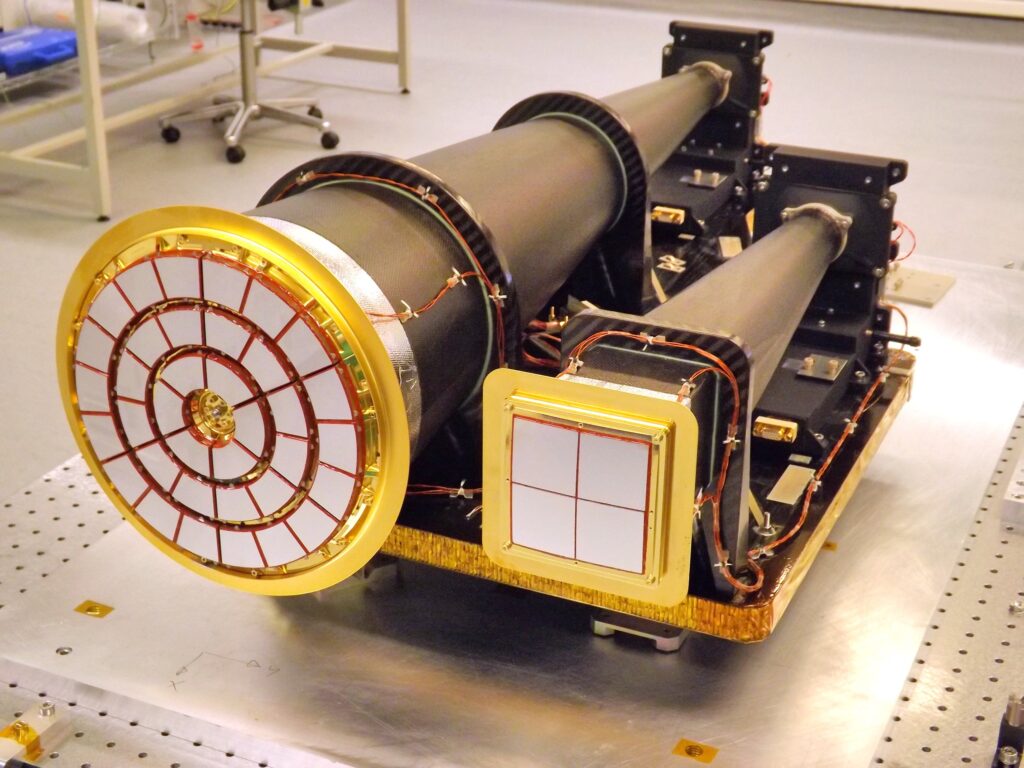
The instrument has two channels. MIXS-T is a narrow-field telescope with a 1 degree field of view and a 64 x 64 pixel detector. Its instrument kernel lists an angular resolution of about 9 arcminutes. MIXS-C is a collimator with a field of view of about 10 degrees. It forms no image and is built for global coverage.
Neither channel uses lenses. The optics are arrays of micropore channels, a design inspired by the eye of a lobster, which steer X-rays by grazing reflection and carry an aluminium coating against stray light. A 2007 conference abstract from the instrument’s first principal investigator described MIXS-T as the first true imaging X-ray telescope used in planetary science.
The calibration campaign
The Crab Nebula lies about 6,500 light years away and is among the best-characterised X-ray sources in the sky. By observing it, the team could measure how MIXS behaves in space and compare the result with calibration data taken on the ground in 2015 with the same instrument. It was also the first time MIXS saw an astronomical X-ray source.
The main sequence used 55 spacecraft slews and 39 hours of observing on 11 and 12 September 2026. The team measured how widely the Crab’s image spreads across the detector, which gives the angular resolution, and found it slightly better than in 2015.
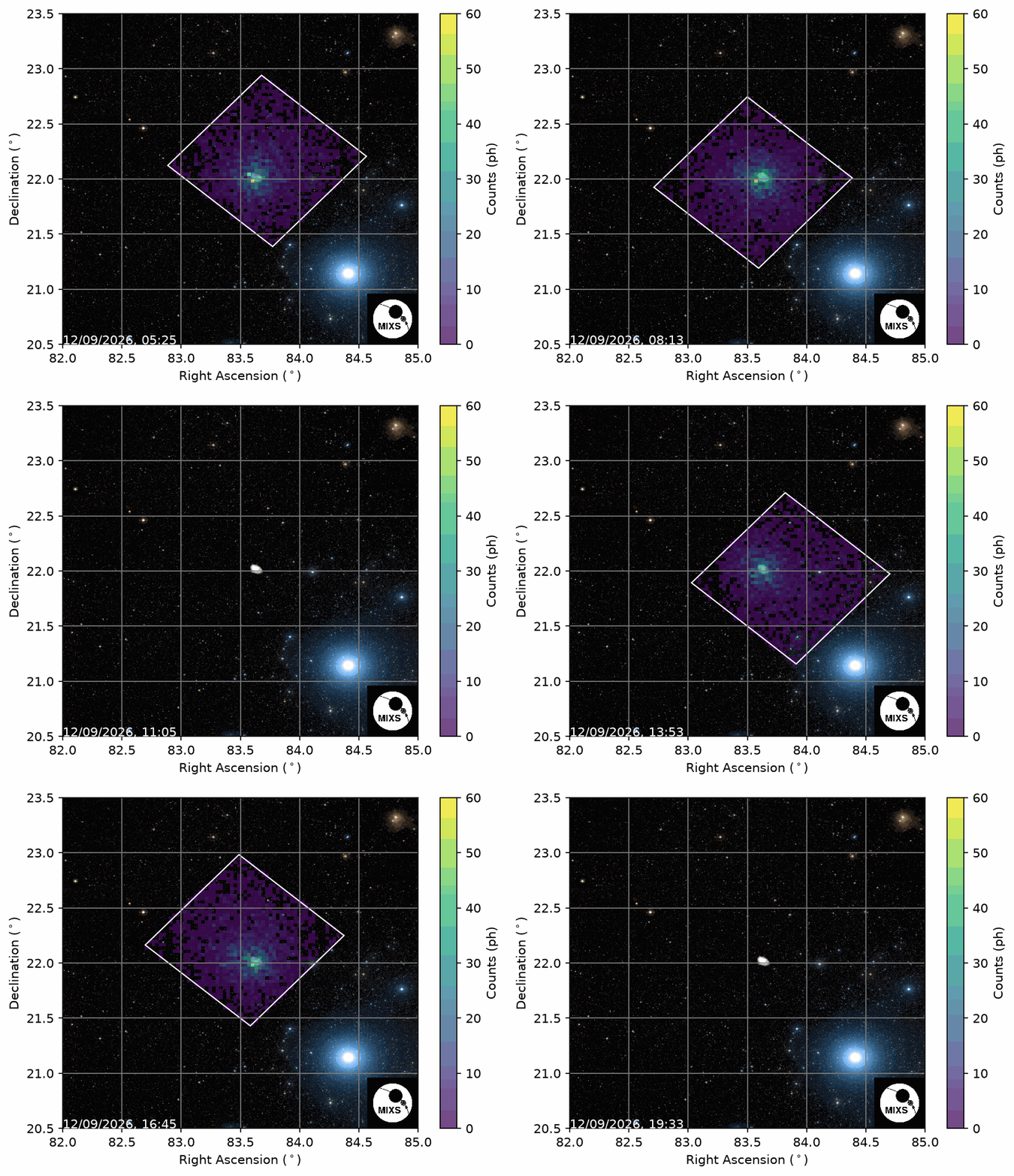
Background images from the Digitized Sky Survey 2 (McLean & Greene, 2000), accessed by NASA’s Sky View facility (http://skyview.gsfc.nasa.gov) located at NASA Goddard Space Flight Center.
The Principal Investigator, Professor Emma Bunce, listed the other findings. No stray-light effects appear in the images. Galactic cosmic rays still leave tracks, as they did during cruise, but the team understands them well enough to filter them out. Some self-fluorescence appears when the Sun illuminates the optic, which she says will not affect dayside observations of Mercury. The detector shows no radiation damage after eight years. Some effects are still being studied, with optimisation planned for the commissioning phase at Mercury.
The people behind the instrument
Professor Emma Bunce is Principal Investigator of MIXS and Director of the Institute for Space at the University of Leicester. Dr Adrian Martindale, of the university’s School of Physics and Astronomy, is the Instrument Scientist. He joined the project in 2003 as an undergraduate. The original Principal Investigator, Professor George Fraser, died in March 2014. He devised the optical design, and Bunce said the team was thinking of him as it operated MIXS in space for the first time.
MIXS was built by a European consortium led by the University of Leicester:
| Country | Institutes and companies |
|---|---|
| UK | University of Leicester, The Open University, RAL, Magna Parva |
| Finland | University of Helsinki, FMI, Patria, SSF, Oxford Instruments, Beneq |
| Spain | INTA, CAB, Lidax, Crisa |
| Germany | MPS, MPG-HLL, MPE, PNSensor |
| France | PHOTONIS (now Exosens) |
UK funding comes from the UK Space Agency as lead agency, STFC, the European Space Agency and the University of Leicester.
A critical read: the headline and the content
The title of the release promises the first X-ray imaging instrument at another planet. At the time of the observations, MIXS was still in cruise, more than three million km from Mercury at the point of module separation, and the target was the Crab Nebula. The “first picture since launch” is therefore the first astronomical image from MIXS in space. It is not a first look at another planet, and a reader who skims the headline will take it that way.
The release also never says which channel produced the data. Only MIXS-T forms images, so only MIXS-T is the imaging X-ray telescope the bullets refer to. MIXS-C is a collimated detector, and its calibration results would read very differently. The primacy claim itself holds up. The 2007 description of MIXS-T as the first true imaging X-ray telescope in planetary science still stands, and earlier planetary X-ray spectrometers such as MESSENGER’s XRS did not form images.
A critical read: “better than in the laboratory”
The headline claim rests on one sentence in the body. The angular resolution is “slightly better” than the 2015 measurement. No value, no uncertainty and no comparison with the requirement are given. The instrument kernel lists about 9 arcminutes for MIXS-T, but the release does not say how far above or below that figure the new measurement sits.
The method deserves a question too. The Crab Nebula is not a point source. In X-rays it spans several arcminutes, which is the same order as the telescope’s own blur. Measuring how far its image spreads across the detector therefore means separating the nebula’s real structure from the instrument response. A high-resolution X-ray map of the nebula from another observatory would be a natural template, but the release does not say what was used. That choice sets the size of the systematic error.
A lab test and a sky test also differ in geometry, source spectrum and detector state, so the two numbers are not a like-for-like pair. The Crab’s X-ray output is also not perfectly constant. Hard X-ray monitors have reported slow flux changes of several percent over the years, which matters for any absolute flux calibration against it.
The release gives nothing on effective area, energy resolution or detector gain either. For a spectrometer built to resolve element lines, those figures matter at least as much as sharpness.
A critical read: radiation damage and self-fluorescence
The statement that the detector “has suffered no radiation damage” is a strong one. MIXS reads out with a cooled, radiation-hard silicon macropixel array. Damage in such a device usually shows up as higher leakage current and a degraded energy resolution. The release quotes neither. The claim is plausible, and it is also a quote from the Principal Investigator, not a measurement the reader can check.
The self-fluorescence point carries more technical weight. When the Sun illuminates the optic, the optic itself emits X-ray lines. Bunce says this will not affect dayside observations of Mercury. Yet the main targets of MIXS are the lines of magnesium, aluminium and silicon, the principal rock-forming elements on the surface. The optics are coated with aluminium and built from silicate glass, so any spurious emission in that band would land on the very lines the instrument is meant to measure.
The release does not say which lines were seen. The effect may be small, or removable with a good background model, and the team may well have shown this already. As written, though, “will not affect” asks the reader to take the conclusion on trust.
A critical read: the science promise
The release says MIXS will produce a global map of Mercury’s surface atomic composition in unprecedented detail. That sentence blends two instruments with different reach. MIXS-C is expected to give global coverage at a spatial resolution similar to the 50 to 100 km MESSENGER achieved in the northern hemisphere only. The sharper view comes from MIXS-T, and it is local, not global.
There is also a dependence the release leaves out. X-ray fluorescence needs solar X-rays to excite the surface, and strong signals come mostly during solar flares. The science phase starts in April 2027. Solar Cycle 25 reached its maximum phase around late 2024, so activity should be declining by then. Fewer strong flares would shorten the time MIXS-T has enough excitation for its best work. This is an inference from the cycle, not a statement from the team, and the mission planners will have their own estimates.
Finally, “atomic composition” overstates what the technique returns. MIXS measures the abundances of the main rock-forming elements, usually as ratios to silicon, not a full census of the surface.
What comes next
The composite spacecraft is due to enter orbit around Mercury on 21 November 2026. MPO and Mio separate on 9 and 10 December, and commissioning follows before the science phase begins in April 2027. Several open points from the calibration release can be settled by data MIXS has yet to return. These include a quoted angular resolution with its uncertainty, the energy resolution of the detector, the identity of the self-fluorescence lines and the first fluorescence spectra from Mercury’s dayside, read alongside SIXS.
Sources
- University of Leicester press office, media release on the first MIXS images, embargoed until 00.01 GMT on 20 November 2026
- ESA, Latest updates: BepiColombo’s arrival at Mercury
- ESA, BepiColombo begins Mercury arrival with MTM separation success
- ESA Cosmos, MIXS instrument page
- NAIF, MIXS instrument kernel
- Space Science Reviews, 2020, paper on MIXS
- Fraser and the MIXS Team, EGU 2007 abstract
- University of Leicester, MIXS optics
- Space.com, BepiColombo begins Mercury arrival
- Sky at Night Magazine, BepiColombo journey video
- Philippine Daily Inquirer (AFP), tricky arrival