
Join the mailing list Free weekly briefing, no spam.
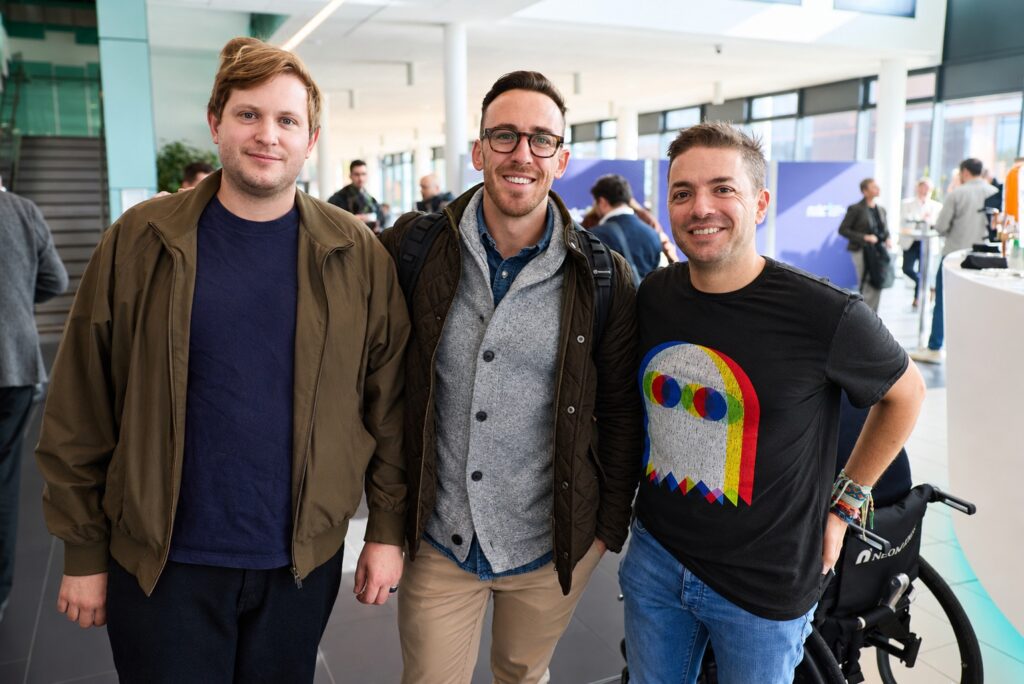
The Hyve Dynamics team has joined Space Park Leicester. Credits: SPL
Hyve Dynamics has joined Space Park Leicester, the University of Leicester’s £100m hub for space research, innovation and teaching. The company builds thin, flexible sensor arrays that read pressure, temperature and strain directly from the surface of an object, and it describes the result as a nervous system for machines.
What the technology does
According to the company’s website, the sensors sit on a flexible polymer film that follows curved surfaces such as wing leading edges, control surfaces and fuselages. Each array is a 10 by 10 matrix of MEMS sensing nodes, individually calibrated. It measures both pressure and suction, handles temperature over a range that runs from cryogenic wind tunnels to brake ducts, and tracks surface deformation. Data is sampled at 1 kHz and sent out over a wired or wireless link.
The sensors attach with adhesive and can be moved and reused. That is the main contrast with pressure taps, the traditional method, where holes are made in the structure and installation can take days.
The company lists aerospace testing, automotive performance, infrastructure monitoring and robotics as its markets. It also says Tier 1 OEMs have validated the product, and that the Aerospace Technology Institute nominated it for an Innovation Award. Those are the company’s own statements, and we have not checked them independently.
Why a space park
Hyve’s Chief Operating Officer, Parker Webb-Mitchell, says the company is moving from proving the technology to validating it at industrial scale and getting it to customers. He points to the laboratories, engineering facilities and University of Leicester expertise at the park. He values just as much the neighbours working on hard problems in aerodynamics, aerospace, space and defence.
Vinay Patel, Head of Commercial and Innovation at Space Park Leicester, frames the problem from the research side. Complex aerodynamic and structural behaviour has long been studied with sparse sensors and inferred models. Continuous, high-density measurement across a real surface replaces some of those assumptions with direct readings. Hyve calls the idea surface intelligence, a data layer that could sit across aircraft, vehicles, infrastructure and robots.
What to watch
The step from a wind tunnel model to flight hardware is hard. Sensors on a real airframe have to cope with vibration, thermal cycling and certification rules. The move to industrial-scale validation that Webb-Mitchell describes is where the claims will get tested. Space Park Leicester has the facilities to help with that stage, and its tenant community already mixes academic groups with commercial teams.
We will follow how Hyve’s arrays perform once they leave the bench.
Sources
- Hyve Dynamics
- Space Park Leicester
- University of Leicester
- Space Park Leicester press release on Hyve Dynamics joining the park