
Join the mailing list Free weekly briefing, no spam.
In brief: ESA’s Hera spacecraft has reached the Didymos asteroid system to carry out the first detailed post-impact survey of a planetary defence test. It will measure the mass, density, internal structure and crater of Dimorphos, the moonlet hit by NASA’s DART in 2022, and turn a single experiment into a technique that can be trusted and repeated.
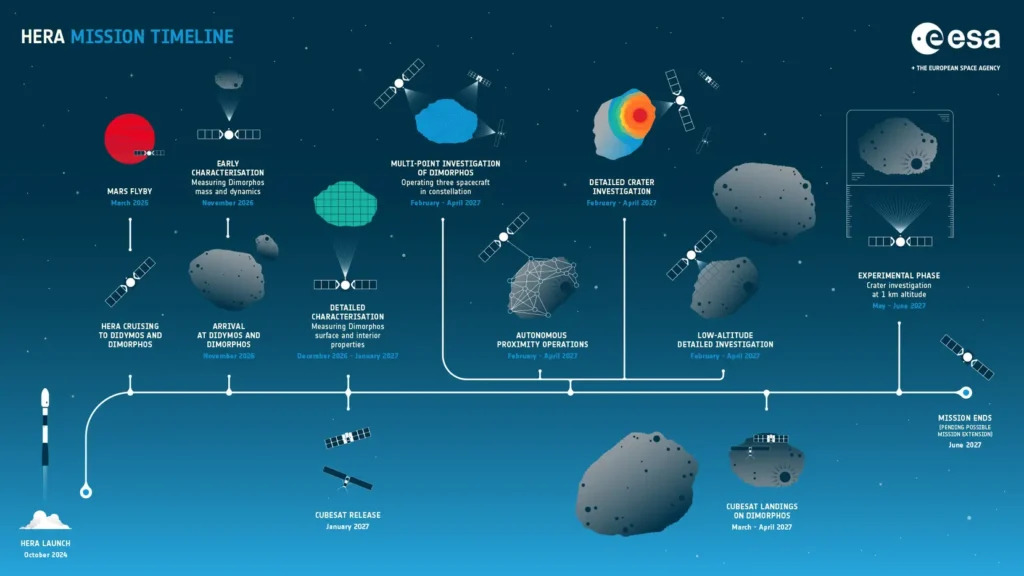
Cover Image: Hera mission timeline – Credits ESA
What is the Hera mission?
Hera is a mission of the European Space Agency (ESA) dedicated to planetary defence. Its target is Didymos, a near-Earth asteroid roughly 780 metres across, and its small companion Dimorphos, a moonlet of about 150 metres that orbits Didymos at a distance of roughly one kilometre. Hera is the European contribution to AIDA (Asteroid Impact and Deflection Assessment), a collaboration between ESA and NASA that pairs two spacecraft with complementary roles.
NASA’s DART spacecraft was the experiment. On 26 September 2022 it struck Dimorphos at about 6 km/s and shortened the moonlet’s orbital period around Didymos by about 33 minutes, the first measured change in the motion of a celestial body caused by humans. Hera is the investigation: it returns to the same system to measure what the impact left behind.
Key facts about Hera
| Parameter | Value |
|---|---|
| Mission | Hera, ESA planetary defence mission, part of the joint ESA and NASA AIDA collaboration |
| Target | Didymos and Dimorphos, a binary near-Earth asteroid system |
| Launch | 7 October 2024, from Cape Canaveral, United States |
| Mars flyby | March 2025, gravity assist that also allowed camera calibration |
| Arrival | November 2026, about one month ahead of the original plan |
| Spacecraft mass | About 1,150 kg |
| Industrial prime contractor | OHB System AG |
| CubeSats | Milani and Juventas, about 12 kg each |
| Time at the asteroids | Around six months of close investigation after arrival |
Where is Hera now?
Hera launched on 7 October 2024, flew past Mars in March 2025 for a gravity assist and, after a long deep-space cruise, completed a braking manoeuvre on 15 October 2026 that placed it on target for the asteroid system. ESA has since released the first close-up image of Didymos, taken from a distance of about 60 km. It shows the side of the asteroid that DART’s own camera never imaged, together with the equatorial ridge, boulders, craters and possible grooves, with Dimorphos partly visible in the shadow of its parent body.
ESA scheduled the presentation of detailed images of both asteroids for 25 November 2026. Arrival is the beginning of the survey, not its conclusion: the quantitative results will accumulate over the months of close operations. For a day-by-day reading of the approach, see our guide Hera arrives at Didymos: timeline, what to watch and what we won’t know yet.
The core scientific objectives
- Measure the mass and density of Dimorphos. The mass has never been measured directly. It is the missing input needed to convert the observed orbital change into a reliable momentum transfer.
- Determine the momentum enhancement factor (beta). Beta describes how much the ejected material amplified the push delivered by DART. Knowing it is essential to scale the technique to other asteroids.
- Map the DART crater. Hera will image the impact site at a resolution of about 10 cm per pixel to characterise the crater, the ejecta and any change in the shape of the moonlet.
- Probe the interior and composition. A key question is whether Didymos and Dimorphos are made of the same material, and whether Dimorphos is a loosely bound rubble pile or a more cohesive body.
- Study the binary system itself. Hera is the first spacecraft to rendezvous with a binary asteroid, which makes it a rare opportunity to observe the dynamics of a double system in detail.
How Hera does it: instruments and CubeSats
The main spacecraft, built under the leadership of OHB System AG, has a launch mass of about 1,150 kg and carries a compact payload designed for close-proximity work in very low gravity. The Asteroid Framing Cameras provide visible-light imaging and navigation, the HyperScout-H imager observes in multiple wavelengths, and the Thermal Infrared Imager, supplied by the Japanese space agency JAXA, measures surface temperature and thermal properties. A laser altimeter builds the three-dimensional shape of the bodies, and the radio link between the spacecraft and Earth is used to measure the gravity field of the system.
Two CubeSats extend the reach of the mission. Milani performs spectral observations of the surface and dust environment, while Juventas carries JuRa, a low-frequency radar that will perform the first radar sounding of the interior of an asteroid. Both are about 12 kg, and both are the first CubeSats designed to operate in close orbit around an asteroid. They communicate with Hera through an inter-satellite link, a first in interplanetary space, and their release is planned some weeks after arrival. Juventas may attempt a landing on Dimorphos late in the mission. Read more in our dedicated piece on the Milani and Juventas CubeSats.
Why Hera matters for planetary defence
DART demonstrated that a kinetic impactor can change the motion of an asteroid. A single result, however, is not yet an engineering tool. The outcome of an impact depends on the mass, the internal structure and the surface properties of the target, and until Hera measures them the DART result cannot be extrapolated with confidence. Hera therefore converts a spectacular demonstration into validated knowledge, and tests the numerical models that planners would rely on if a real threat were ever identified. The background to this link is covered in Hera and DART explained.
Planetary defence is an area where the margin of error matters. A deflection campaign would need to know in advance how much momentum a given impactor would transfer to a body of a given size and structure. Hera provides the first ground-truth dataset for that calculation, from the same target that DART hit.
Technology demonstrations and future potential
Beyond its scientific return, Hera is a test bed for technologies that future small-body missions will need. These include autonomous navigation close to a body with almost no gravity, operation of an inter-satellite link with CubeSats in deep space, and proximity operations by very small spacecraft. Each of these capabilities lowers the cost and risk of the next generation of asteroid missions.
The results are also expected to support future work well beyond Didymos. ESA is developing RAMSES, a mission designed to reach the asteroid Apophis ahead of its close approach to Earth on 13 April 2029, and the experience gained with Hera is directly relevant to that effort. The same data will inform asteroid science more broadly, from the formation of rubble-pile bodies to the resources locked in near-Earth objects, and will shape international planning for the detection and, if necessary, deflection of hazardous objects.
Frequently asked questions
What is the Hera mission?
Hera is a European Space Agency spacecraft sent to the binary asteroid system Didymos and Dimorphos. It will measure the physical outcome of NASA’s DART impact on Dimorphos, so that kinetic impact deflection can be evaluated as a planetary defence technique.
Does Hera deflect an asteroid?
No. Hera does not change the orbit of any asteroid. DART performed the deflection experiment in September 2022. Hera is the follow-up investigation that measures what DART actually did.
Is the Didymos system a threat to Earth?
No. Neither Didymos nor Dimorphos poses a hazard to Earth, before or after the DART impact. The system was chosen because its geometry makes the effect of an impact measurable from Earth.
What are the Milani and Juventas CubeSats?
They are two CubeSats of about 12 kg each carried by Hera. Milani performs spectral observations of the surface, while Juventas carries a low-frequency radar to probe the interior of Dimorphos. Juventas may attempt a landing near the end of the mission.
Why is the momentum enhancement factor important?
The factor, usually called beta, compares the momentum change of the asteroid with the momentum delivered by the impactor. It depends on the mass of Dimorphos and on the ejecta produced by the impact, which is why Hera must measure the mass directly.
When will Hera data become available?
ESA planned to present detailed images of both asteroids on 25 November 2026. Quantitative results such as mass, density and crater morphology will follow as the survey and the analysis progress.