
Join the mailing list Free weekly briefing, no spam.
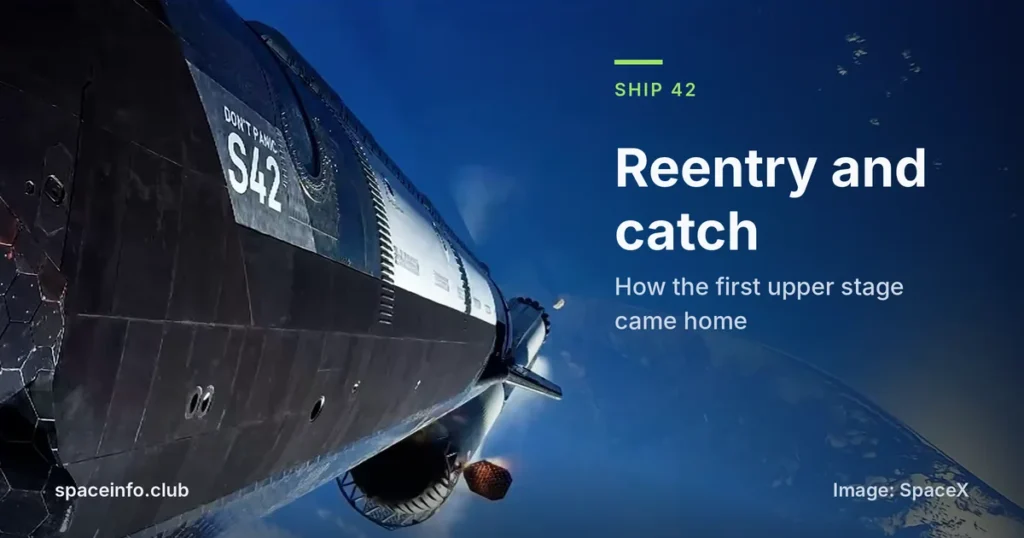
Ship 42 reentered at about 17,000 mph, flew back to Starbase and was caught by the tower arms at about 21:20 UTC on November 14, roughly 22.5 hours after liftoff. This article covers the deorbit burn, the heat shield evidence, the landing burn and what the catch does and does not change.
Deorbit burn and reentry
Ship 42 left orbit with a single-engine burn of 10 seconds at about 3:23 p.m. EST (20:23 UTC) on November 14, 21 hours 36 minutes after liftoff. SpaceX described the burn as nominal. Because the ship had already circled the Earth 14 times, that short burn set where and when it would meet the atmosphere.
In orbit the ship moves at about 17,000 mph (roughly 27,000 km/h). The atmosphere has to remove almost all of that energy as heat and drag before the landing burn. Plasma formed around the leading edges during the descent, which is expected at these speeds.
The pre-flight plan aimed the entry over the Pacific, several thousand kilometres west of Starbase. The ship then used its flaps to glide back toward Texas along a path that avoids populated areas, with an option to tumble the vehicle and let it burn up if something went wrong. The plan listed entry at T+22:10:46 and subsonic speed at T+22:30:13. Those figures are the plan, not a flight log. Source: Wikipedia, Starship flight 15, read before the flight, and Space.com live coverage.
What the heat shield had to prove
Before SpaceX committed Ship 42 to the full 22-hour mission, its heat shield team reviewed ground-tracking data and images from cameras on Starlink satellites. The team judged the shield to be in good condition for reentry and return, and SpaceX skipped the early ocean-return option.
The background matters. Ship 40 flew on Flight 13 in July and made a controlled descent into the Indian Ocean. Experts who looked at post-flight imagery reported cracked tiles, broken edges and white streaks that may show hot gas getting into gaps between tiles. Dan Rasky, a former NASA engineer who co-invented the PICA material used on Crew Dragon, called the current approach a potential “dead end” for rapid reuse. His point was about the work after landing, not about survival during entry. SpaceX has said it is testing new tile materials, shapes and layouts.
After the catch, Elon Musk said that Ship 42 “looks great.” No detailed inspection data had been published when this article was written. A catch shows that the shield survived well enough for the ship to be grabbed intact. It does not yet show how many hours of inspection and repair each flight will cost, and that figure decides how fast Starship can fly again. Sources: Space.com live coverage, Interesting Engineering and Nature World News.
Landing burn, flip and catch
The last minute is the hardest. The ship comes down belly first, with its flaps steering, and has to rotate to vertical and slow to a stop inside the narrow space between the tower arms. There is no second pass.
The pre-flight plan put the landing burn start at T+22:32:16 and the flip two seconds later. The ship would light three engines, drop to two and then to one, and shut down at T+22:32:34 as the arms closed. Interesting Engineering reports that Ship 42 relit three engines to control the final descent, which matches the start of that sequence. Two chopstick arms on the Starbase tower then secured the vehicle.
SpaceX reported the catch at about 4:20 p.m. EST (21:20 UTC), 22 hours 33 minutes after liftoff. That is within the rounding of the planned T+22:32:34. SpaceX had caught Super Heavy boosters three times before. This was the first time it did the same with an upper stage. Sources: Wikipedia, Starship flight 15 (plan, read before the flight) and Interesting Engineering.
An engineer’s view
The first thing I noticed was the precision of control over a vehicle this large, and how well controlled aerodynamics were mastered on the way down.
The part that impressed me most is the change of regime. At orbital velocity the ship carries a huge amount of kinetic energy, and what acts on it during entry is mostly the atmosphere. In front of the tower it is almost hovering, and what matters is the engines, the vehicle’s inertia and very low speed. Forces, inertia and velocity differ a great deal between those two phases. The same ship has to handle both, about an hour after the deorbit burn.
The overview of the flight is in the Starship Flight 15 recap.
Frequently asked questions
How fast was Ship 42 going at reentry?
About 17,000 mph (roughly 27,000 km/h) in orbit, before the atmosphere slowed it.
How long passed between the deorbit burn and the catch?
About 57 minutes: the 10-second burn came at about 20:23 UTC and the catch at about 21:20 UTC on November 14.
What are the chopsticks?
Two large mechanical arms on the Starbase launch tower that close around the vehicle. SpaceX has used them to catch Super Heavy boosters three times.
Does the catch make Starship fully reusable?
Not yet. Both stages have not been recovered on the same flight, and the cost of inspecting the heat shield after each flight is unpublished.
Sources
- Space.com, Flight 15 live updates
- Interesting Engineering, Ship 42 catch
- Wikipedia, Starship flight 15, read before the flight and used only for planned times
- Nature World News, heat shield concerns after Flight 13
About the author
Sebastiano is a space engineer. He runs SpaceInfo Club, where he writes about spaceflight and aerospace engineering.