
Join the mailing list Free weekly briefing, no spam.
Cover Image: Hera first images of asteroid Dimorphos. Credits: ESA/JAXA
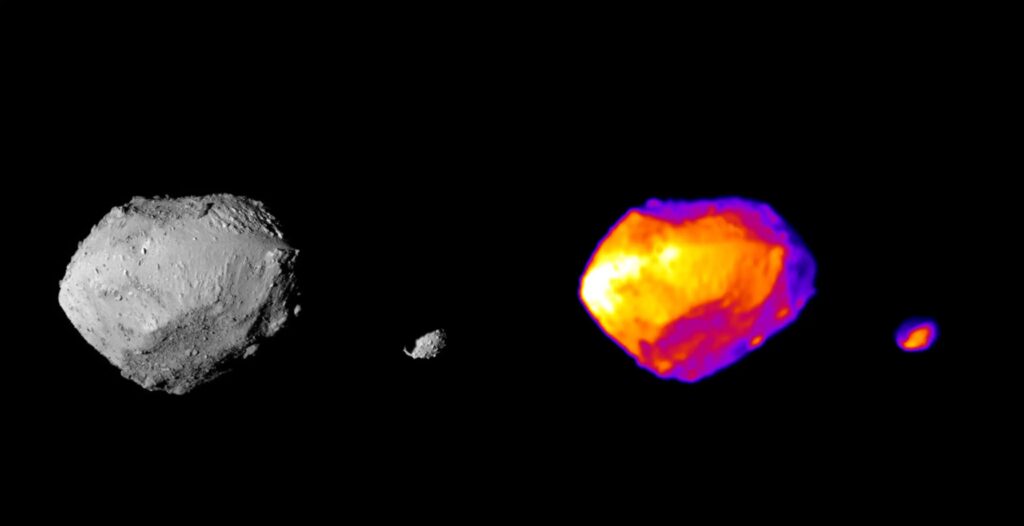
ESA’s Hera spacecraft has reached the Didymos binary asteroid system, and its first results answer a question that stayed open for four years: what did NASA’s DART impact do to Dimorphos itself? The answer, from ESA’s latest release, is that the moonlet now has a flattened face, a crater as large as a sports stadium, and a chaotic rotation. Hundreds of small boulders also orbit the pair.
What happened to Dimorphos
DART hit Dimorphos on 26 September 2022 and shortened its orbit around Didymos by about 33 minutes. Ground telescopes measured that change. Nobody could see the body that produced it. Dimorphos is only 151 metres across, and the last pictures of its surface were DART’s own, taken seconds before impact.
Hera’s pictures show that the face DART struck has been flattened into a crater, and that the crater runs across the asteroid’s entire width. The rest of the surface looks like it did in DART’s 2022 images, with boulder fields in the same places. Hera principal investigator Patrick Michel said the answer to the old debate (crater, new shape, or no change) turned out to be “all three at once”.
Hera’s team had floated this outcome before arrival. In early 2024, ESA reported that models allowed the crater to grow until it took in the whole body, which would have left Hera with no separate crater to find. The new images fit that picture. ESA has not yet published the crater’s dimensions in metres, so “stadium-sized” is a comparison for now, not a measurement.
A moon that no longer spins in step
Hera’s later images showed something nobody had planned for. According to Michael Küppers, ESA’s Hera mission scientist, the impact left Dimorphos tumbling wildly in its orbit. A small moon in a binary system normally keeps one face toward its parent. Tumbling means that is no longer true. ESA gave no rotation period or axis data in the release, so the details are still to come.
Boulders in flight
The system is also surrounded by hundreds of boulders a few metres wide. The release does not say where they came from. Hubble had already seen 37 boulders between 1 and 6.7 metres leaving Dimorphos after the impact, so a link to DART is plausible, but that is an inference, not something ESA has stated. What ESA does say is practical: the team must account for these objects as Hera moves closer.
Where Hera is and what comes next
Hera is flying about 25 to 30 km from Didymos and Dimorphos, on rectangular paths at an average speed of 12 cm/s. Three instruments are working: the Asteroid Framing Camera, the 25-band Hyperscout-H imager, and JAXA’s Thermal Infrared Imager.
In December the spacecraft is due to close to about 13 km. In January 2027 it will release two shoebox-sized CubeSats. Juventas, led from Luxembourg, carries a low-frequency radar to probe an asteroid’s interior for the first time, and will eventually try to land. The Italian-led Milani will study asteroid material and dust.
Why Dimorphos’s mass matters
The 33 minutes were far above the 73 seconds that NASA had set as the minimum for success. To turn that number into a rule for future deflections, scientists need the efficiency of the momentum transfer, and that depends on how heavy Dimorphos is. Hera will measure it. The crater and the debris matter here because the ejected material carried momentum away and pushed the moon harder than the spacecraft alone could.
Watch on SpaceInfo Club
Two recent videos cover the same story from different angles.
- Hera Reaches DART’s Asteroid: Planetary Defense Explained recaps the mission so far: the DART impact, how debris added to the push, and Hera’s journey to Didymos.
- Interview with Michael Küppers of ESA is a conversation with the scientist quoted in this release.
After Hera: Apophis
ESA is also building Ramses, with JAXA, to visit asteroid Apophis. On Friday 13 April 2029 Apophis will pass about 32,000 km above Earth’s surface. Ramses will watch how that gravitational encounter changes the asteroid. Hera tells us what a hit does to a small body. Ramses will show what a planet’s gravity does to one.
Questions people ask
Did DART change the shape of Dimorphos?
Yes. ESA reports that the impact face was flattened into a crater spanning the asteroid’s width. The other regions show no major change.
Why is Dimorphos tumbling?
ESA links the tumbling to the DART impact but has not yet released a period or a model. Rotation data from the coming closer passes should settle it.
How big is the crater?
ESA compares it to a sports stadium and says it extends across the whole asteroid. Exact dimensions have not been published.
When will Hera measure the mass of Dimorphos?
ESA lists it as a main goal of the mission. The closer approach in December and the CubeSat phase from January 2027 will provide the data, but no date for the result has been given.
Sources
- ESA press release, “Hera reveals stadium-sized crater left by spacecraft impacting asteroid” (November 2026)
- DLR, Hera spots its target, 12 November 2026
- ESA, DART impact might have reshaped Hera’s target asteroid, 2024
- ESA Hubble, Hubble sees boulders escaping from asteroid Dimorphos, 2023