Join the mailing list Free weekly briefing, no spam.
Cover Image Credit: ESA/P. Carril
On 23 and 26 October 2026, the European Space Agency (ESA) signed contract extensions for four additional Galileo Second Generation (G2) satellites. The Galileo G2 fleet now stands at 16 satellites. The new spacecraft are scheduled for delivery in 2031, with launch to follow soon after.
What was signed, and by whom
The extensions went to the two companies that already build the G2 satellites: Thales Alenia Space (Italy) and Airbus Defence and Space (Germany). Each has been under contract with ESA since 2021 for six satellites. Each now adds two more.
Thales Alenia Space signed in Rome on 23 October. Airbus signed in Ottobrunn, Germany, on 26 October.
ESA signed on behalf of the EU Agency for the Space Programme (EUSPA), which runs Galileo’s services, for the benefit of the European Union, the system’s owner. ESA is Galileo’s design and qualification authority and the prime responsible for system development.
The four new satellites are copies of the existing design
The four additional satellites will be identical to those already under development. That choice keeps risk low: the design, tooling and test procedures are already in place.
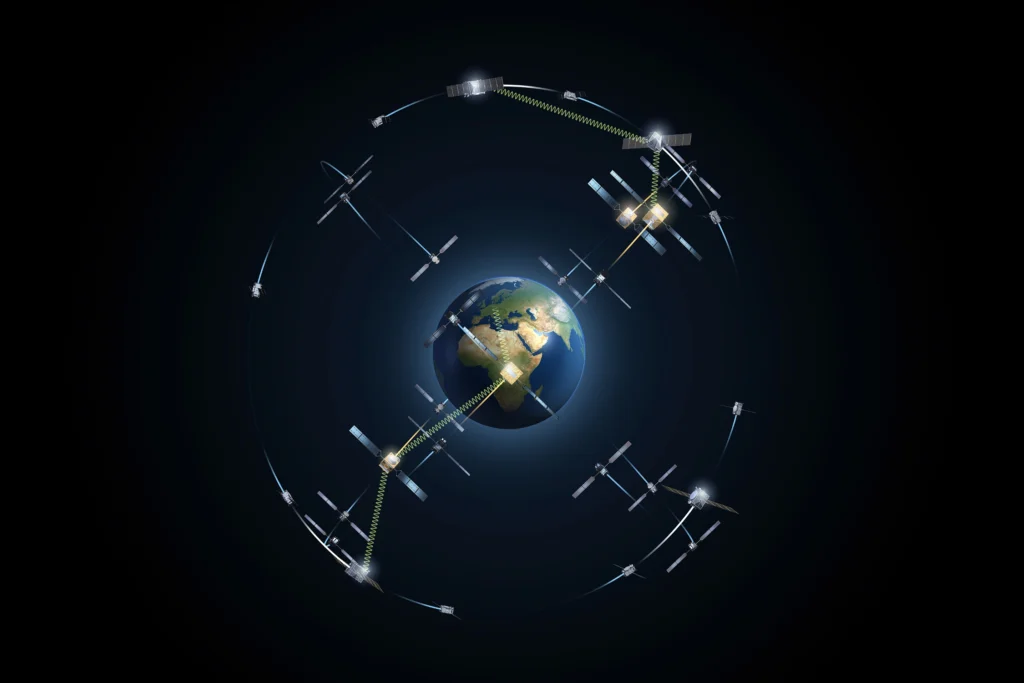
The G2 platform brings several upgrades over the first generation:
- Fully digital navigation payloads, which can be reconfigured more flexibly than earlier hardware.
- A better-performing navigation antenna.
- Inter-satellite links, so satellites can exchange data directly rather than depending only on ground stations.
- An advanced atomic clock configuration. Satellite navigation is fundamentally a timing system, so clock quality sets the ceiling on positioning accuracy.
ESA says the combined effect is more robust and reliable positioning, navigation and timing.
Where the programme stands
The first twelve G2 satellites are well advanced. Development and qualification are close to complete, and system integration and compatibility testing are under way. Flight-model integration and testing of the first satellites begins in 2027, ahead of the first G2 launch in 2028.
Galileo’s first-generation constellation counts 38 satellites, all but four already launched. G2 satellites will join them, and ESA describes the two generations as integrating seamlessly. In practice, this means new satellites replace aging ones without a service gap.
Why order more now
Navigation satellites do not last forever, and a constellation needs replacements ready before older units fail. Ordering four more today secures production continuity for the 2030s. It also lets the manufacturers keep their production lines running instead of restarting them later at higher cost.
There is a policy dimension too. ESA Director of Resilience, Navigation and Connectivity Laurent Jaffart framed the contracts as a step toward Europe’s strategic autonomy in navigation. Airbus pointed to the importance of the satellites for European security and defence.
Why Galileo matters to ordinary users
Galileo has offered its Open Service since 2016 and serves billions of users worldwide. All smartphones sold in the European Single Market are guaranteed to be Galileo-enabled. Beyond phones, the system supports rail, maritime transport, agriculture, financial timing services and rescue operations.
Frequently asked questions
How many Galileo Second Generation satellites will there be?
Sixteen: the first twelve already under contract, plus the four newly ordered.
When will the first G2 satellite launch?
ESA plans the first launch in 2028, after flight testing of the first satellites in 2027.
When will the four new satellites launch?
Delivery is scheduled for 2031, with launch right after.
Who builds them?
Thales Alenia Space and Airbus Defence and Space, each building two of the four new satellites.
Who runs Galileo?
The European Commission manages and funds the programme. ESA leads design, development and qualification. EUSPA is the service provider.
Source
ESA press release on the Galileo Second Generation contract extension, October 2026
 6ae090d06112e.html