
Join the mailing list Free weekly briefing, no spam.
In short: Paul Hawkins, founder of Crazy Might Work, answers eight questions about the NASA 4-D Executive Space Programme, a five-day course at Space Park Leicester from 9 to 13 November 2026. He explains how it differs from classic executive education, why space matters to business leaders, what the five days involve and who should attend. Registration is expected to close around 2 November.
This is part 2 of the SpaceInfo Club series on human performance in high-stakes environments. Part 1 is our video interview with Paul, also on YouTube. Last updated: 14 October 2026.
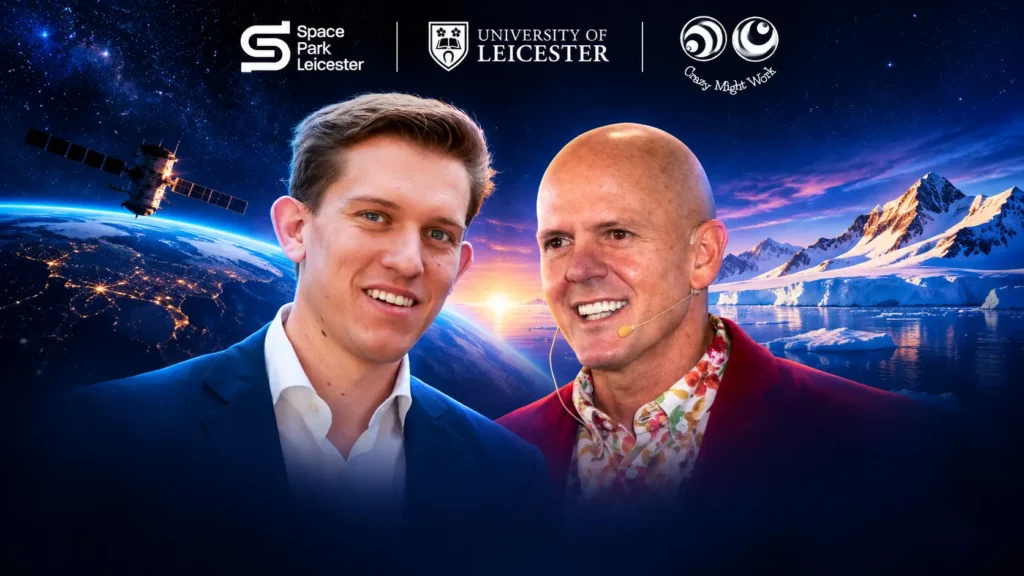
Watch the interview
Video: Paul Hawkins on NASA’s 4-D leadership system, recorded for the SpaceInfo Club YouTube channel. The written answers below cover the course itself, which the video only touches on.
The programme at a glance
| Item | Detail |
|---|---|
| Dates | 9 to 13 November 2026 (Monday to Friday) |
| Venue | Space Park Leicester, 92 Corporation Road, Leicester LE4 5SP, United Kingdom |
| Days 1 and 2 (9 to 10 November) | NASA 4-D Leadership Programme, delivered by Crazy Might Work |
| Days 3 to 5 (11 to 13 November) | Executive Guide to Space, delivered by Space Park Leicester |
| Booking options | Both courses together, or either one alone |
| Registration deadline | Expected around 2 November, one week before the start. The organisers say it will “most likely” close then; the official page does not state a date. |
Official details and booking options are on the Space Park Leicester programme page.
The interview
Alex Wheldon, Head of Strategic Communications and Marketing at Space Park Leicester, sent Paul Hawkins eight questions for the centre’s blog. Paul wrote the answers below, and the Crazy Might Work team agreed that we could publish them here as an interview. We shortened and tightened the text. The substance is his.
What is the NASA 4-D Executive Space Programme, and how does it differ from conventional executive education?
The programme joins two courses that complement each other. The first two days are NASA 4-D, a human performance system developed for NASA in the early 2000s by Charlie Pellerin, then the agency’s director of astrophysics. It works on four elements: building people, building teams, building systems and building missions. Its main difference is that it deals with the invisible social context around a team, not with individual performance, and that is how it prevents mission failures. Over 1,500 NASA teams have completed it voluntarily. It has become a benchmark for more than 100,000 alumni in over 75 countries, and it is a regular part of the work of the Space Generation Advisory Council to the United Nations.
The three days that follow at Space Park Leicester are an Executive Guide to Space. They cover what it takes to conceive, design, build, launch and operate a mission. Together the two parts build technical and human systems literacy.
Conventional executive education often treats leadership as separate from the real work. People discuss theory in a classroom, then go back to organisations where the pressures, relationships and unwritten rules have not changed. NASA 4-D starts from another premise: leadership is a set of observable behaviours that change the social context people work in. It is not a position or a personality type. Participants therefore apply the behaviours in the sessions themselves, under the ambiguity, competing priorities and time pressure of a simulation, so that they can recall and reuse them when it counts.
Why is now an interesting time for business leaders to engage with the space sector?
Space used to belong to national governments, large aerospace companies and a small scientific community. Lower launch costs, smaller satellites, commercial investment, artificial intelligence and advances in sensing and computing have opened it to new participants and new business models. The sector needs the same range of skills as any other: marketing, project management, change leadership, administration, customer service, sales, engineering. If you have been curious about space for a long time, this is a good moment to think about a career move.
Space infrastructure already supports communications, navigation, banking, agriculture, weather forecasting, environmental monitoring, logistics and emergency response. Many organisations that see themselves as unrelated to space depend on it. For executives it is a setting where technology and markets change quickly, so leaders must hold a long-term mission, adjust the route, and bring their people along. That takes leadership fundamentals and technology awareness together, which is what this programme combines.
What can leaders outside the space sector learn from how the industry handles innovation, risk and problem-solving?
Space exposes weaknesses that other settings let organisations hide. A spacecraft is a set of interdependent systems, and a decision in one area can affect mass, power, communications, thermal management and mission life. Leaders have to think about the whole system and resist optimising their own part. Resources are finite, messages can be delayed, and repair or rescue may be impossible. Teams therefore anticipate failure modes, test assumptions, and separate acceptable risks from those that could end the mission.
Many missions begin with ambitions that sound unreasonable: land on another world, look back across billions of years of cosmic history, measure change across the whole Earth. Day by day, the idea moves from laughable to possible to probable, and by launch it is palpable. Innovation and discipline are not opposing forces. The larger the ambition, the more it matters to understand constraints, test ideas, make decision rights clear and let uncomfortable information travel fast.
Space also teaches humility. Nobody holds all the knowledge a complex mission needs, so success depends on free-flowing information and on specialists who stay aware of the whole system. That needs leaders who decide firmly and still listen, invite challenge and change course when the evidence says so.
What does the NASA 4-D methodology bring to the programme?
It starts from the understanding that technical excellence does not automatically produce mission success. The programme was a response to the Challenger and Columbia disasters and to other failed missions. They forced NASA to accept that culture, more than technical failure, lay behind its worst tragedies. Looking back, people had concerns, but the social environment affected whether that information travelled and how it was weighed, particularly when the likely result was yet another delayed launch.
NASA 4-D makes that invisible context something a team can discuss and change. It uses behaviours such as expressing authentic appreciation, addressing shared interests, including others appropriately, keeping agreements, clarifying roles, accountability and authority, managing conflict and blame, and creating a compelling mission that is clearly articulated. None of this sounds like rocket science, yet it is hard to do really well. The programme builds the skill and the confidence to do it under pressure.
People begin with different personalities and strengths, but NASA 4-D treats leadership as behaviour: something that can be demonstrated, observed, practised, measured and improved. It is not charisma, and nobody improves by being told to be more inspiring or courageous. In Paul’s view this behavioural approach contributed to NASA winning Best Place to Work in the federal government 13 times in a row.
Why is Space Park Leicester the right environment?
The venue is part of the method. The main lesson of NASA 4-D is that context matters, and the environment shapes what the programme can do. Space Park Leicester brings together researchers, engineers, businesses, educators and organisations working on live space challenges. The University of Leicester has more than six decades of mission heritage and has contributed to major programmes with ESA, NASA and JAXA. Participants are among people, facilities and technologies that design instruments, interpret Earth observation data and solve real scientific and engineering problems. Laboratories, workshops, cleanrooms, advanced computing and concurrent design capability make complex mission processes tangible.
When executives leave their usual office, reporting cycle and company vocabulary, they get permission to think differently: longer horizons, bigger ambitions, other ways of working together. Crazy Might Work was launched in Antarctica, on an icebreaker, to equip and inspire leaders to innovate, collaborate and make a difference. NASA 4-D can turn a group of strangers into a high-performing team in less time than a mission countdown. Space Park offers the distance from business as usual to practise before outcomes become consequential.
What can participants expect from the five days?
An intensive, participative week, not five days of lectures. The first two days are NASA 4-D. In small teams, participants build mission groups from the ground up, work through the four dimensions and eight behaviours, and apply them straight away. They look at how team dynamics change the flow of information, the quality of decisions and the ability to respond under pressure.
The following three days cover the technical anatomy of a space mission: the UK and international space sector, mission objectives, orbital considerations, spacecraft systems, engineering processes, operations, and the legal and regulatory environment. Experts with real mission experience teach the sessions, and participants can explore Space Park Leicester’s specialist facilities. The week is designed for technical and non-technical participants. Whether you lead strategy, law, finance, marketing, policy or project management, you leave with new knowledge, a clearer view of the space sector, a practical leadership language and behaviours you can use in your own organisation.
What have previous participants taken away from the programme?
The combined five-day programme is new to Leicester, so it would be premature to claim results from a cohort that has not finished it. Participants in the NASA 4-D Leadership Programme and in the Executive Guide to Space have each reported useful outcomes from those courses separately.
NASA 4-D participants describe gaining words for aspects of performance they could sense but not name: how appreciation, inclusion, kept agreements, unclear authority and unproductive blame shape a team. Because the behaviours are practical, people use them in meetings, project reviews, difficult conversations and new teams. Some use the benchmarking and playbook tools to find specific behavioural shifts, which beats launching another broad culture initiative that is soon forgotten.
One takeaway matters most: leaders shape context whether they intend to or not. What they notice, reward, tolerate and fail to question becomes part of the organisation’s unwritten operating system. High performance also does not mean the end of disagreement. Space missions need challenge, dissent and specialist judgement. The goal is enough psychological safety for people to raise concerns, and enough accountability to reach decisions and honour them. The Executive Guide adds technical and strategic literacy, so non-specialists feel more confident working with scientists, engineers, regulators, investors and commercial partners.
What would you say to an executive who thinks space has little relevance to their organisation?
Ask whether your organisation relies on communications, navigation, weather information, financial timing, supply chains, environmental intelligence or digital infrastructure. If it does, space is probably already active in your industry. Even if you never plan to enter the sector, the leadership lessons transfer. Most executives coordinate specialists, decide with incomplete information, manage interdependence, innovate within constraints and rally people around goals that no single function can reach. Space makes those challenges easier to see.
Extraordinary performance is rarely the work of one heroic leader. Missions succeed through teams, systems, shared purpose and thousands of agreements honoured over time. If leadership depended on personal charisma alone, it would not survive space. NASA’s experience suggests that leaders become far more effective when they can change the context instead of only adapting to it. You do not need to become an astronaut for that. You can leave the familiar orbit of your organisation and spend five days at Space Park Leicester.
What to do next
If the week fits your plans, check the dates, options and booking steps on the official Space Park Leicester page. Registration is expected to close around 2 November. For the story behind the human-performance side, read Part 1 of this series, where Paul explains in the video why team culture is part of mission safety.
Sources
- Space Park Leicester: NASA-proven leadership training comes to Leicester
- Space Park Leicester: NASA 4-D Executive Space Programme page
- Crazy Might Work: NASA 4-D programme
- Crazy Might Work: About us
- SpaceInfo Club interview with Paul Hawkins (YouTube)
About this article
Written by the SpaceInfo Club editorial team, founded by Sebastiano, an aerospace engineer, who interviewed Paul Hawkins for the series. Facts about the programme come from the sources above. Statements that are our own reading are marked as such, and figures supplied by Crazy Might Work are attributed to it.
More in this series
Next in the series: a closer look at the Executive Guide to Space, the three-day technical half of the programme (scheduled for 20 October 2026).