
Join the mailing list Free weekly briefing, no spam.
In brief: Hera carries two 6U CubeSats, Milani and Juventas, to be released near the Didymos–Dimorphos asteroids a few weeks after Hera’s arrival. Juventas will probe the inside of Dimorphos with radar and is planned to land and measure gravity at the surface. Milani will map the surface composition and sample the dust, and will attempt a landing at the end of its mission.
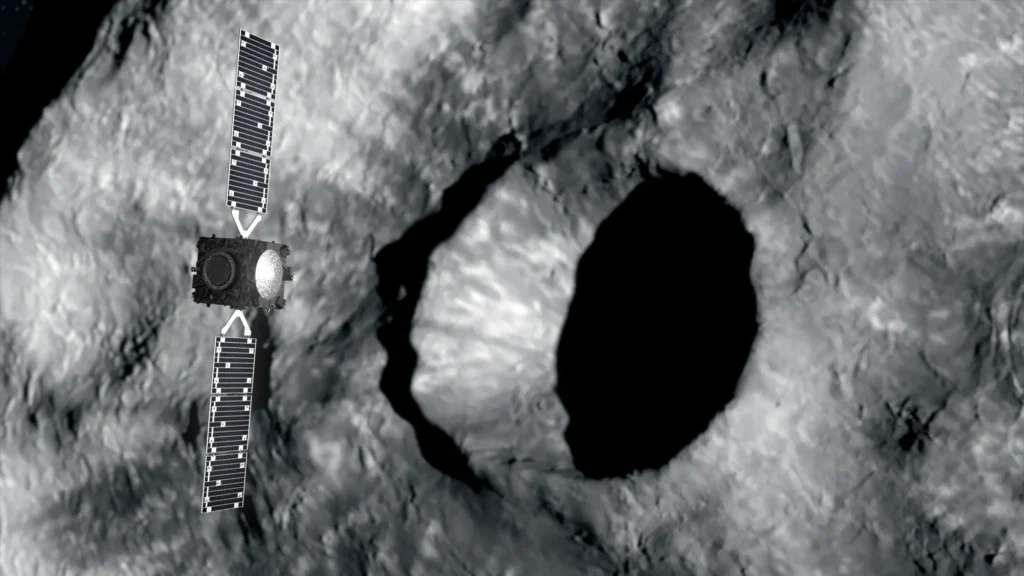
Featured image: Hera scans DART’s impact crater (artist’s impression). Credit: ESA – Science Office.
Key facts
- Milani: surface composition and dust survey. Payload: ASPECT visible/near-infrared imager (VTT, Finland) and VISTA dust detector (INAF, Italy). Built by Tyvak International in Turin, Italy. Ends with a landing attempt on Dimorphos.
- Juventas: interior structure and gravity. Payload: JuRa low-frequency radar (IPAG, France) and GRASS gravimeter. Mission led for ESA by GomSpace. Planned to land on Dimorphos.
Why send CubeSats at all?
A mother spacecraft cannot safely fly very close to a 160 m body with almost no gravity. CubeSats can: they are cheap enough to accept risk, and they carry instruments that need to be close. A radar needs to be near the asteroid to sound its interior, and a gravimeter works best at the surface. The mission design divides the labour: Hera stays at a safe distance and measures the whole system, while the CubeSats take the risky close-up measurements.
Juventas: looking inside
Juventas will be the first spacecraft to use a low-frequency radar to scan the interior structure of an asteroid. After the mapping phase it is planned to land on Dimorphos and, with the GRASS gravimeter, measure gravity directly on an asteroid’s surface for the first time. The internal structure matters for planetary defence because it determines how much material the impact throws out, and therefore how much extra push the asteroid receives. See our overview of DART and Hera for why that extra push is the key unknown.
Milani: reading the surface
Milani’s main instrument is the ASPECT hyperspectral imager, which combines visible and near-infrared light to survey the surface at up to 1 m resolution. Its second instrument, VISTA, is an Italian-built dust detector. Its objectives include mapping the global properties of Didymos and Dimorphos, characterising the surface and the dust environment, and supporting the determination of the gravity field. The CubeSat is named after Andrea Milani, a pioneer of asteroid risk analysis who came up with the original DART–Hera double-spacecraft concept. He died in 2018, before the mission flew.
Timing and the landing attempts
Both CubeSats are released after Hera has surveyed the system. ESA’s planning places the release some weeks after arrival, but the exact day depends on how the early survey goes. Milani is planned to end its mission with a landing attempt on Dimorphos. Landings on a body this small are best understood as experiments: if they succeed, the data is a bonus, and if they fail, the main results have already been collected.
What could go wrong
Asteroid proximity operations are hard. A CubeSat has little propellant, limited communications and no margin for a bad release. Milani is even designed to perform corrective manoeuvres if it risks heading into the safety “risk tubes” around either asteroid, Juventas or Hera. Treat early reports as provisional until ESA publishes its confirmation.
Frequently asked questions
What are Milani and Juventas?
Two 6U CubeSats carried by ESA’s Hera. Milani studies composition and dust; Juventas probes the interior and gravity of Dimorphos.
When will they be released?
A few weeks after Hera reaches Didymos. ESA announces the date.
Will they land on the asteroid?
Yes, landings are planned at the end of their missions, but they are experiments.
Why do the CubeSats matter for planetary defence?
They measure interior structure and gravity, which control how a kinetic impact transfers momentum.
Sources
- ESA, CubeSat will sift asteroid secrets from reflected sunshine
- Tyvak International, Milani
- The Hera Milani Mission, Space Science Reviews
- eoPortal, Hera
- Michel et al., The ESA Hera Mission, Planetary Science Journal
- ESA, Hera operations
Related: Hera and DART explained · Hera arrival guide · All articles