
Join the mailing list Free weekly briefing, no spam.
In brief: ESA’s Hera is due to reach the Didymos–Dimorphos system in November 2026, after a rendezvous manoeuvre in October. Arrival does not mean answers on day one: the first weeks are a careful survey, and the headline measurements (Dimorphos’s mass, the crater, the interior) come after the CubeSats are released and the closer orbits begin.
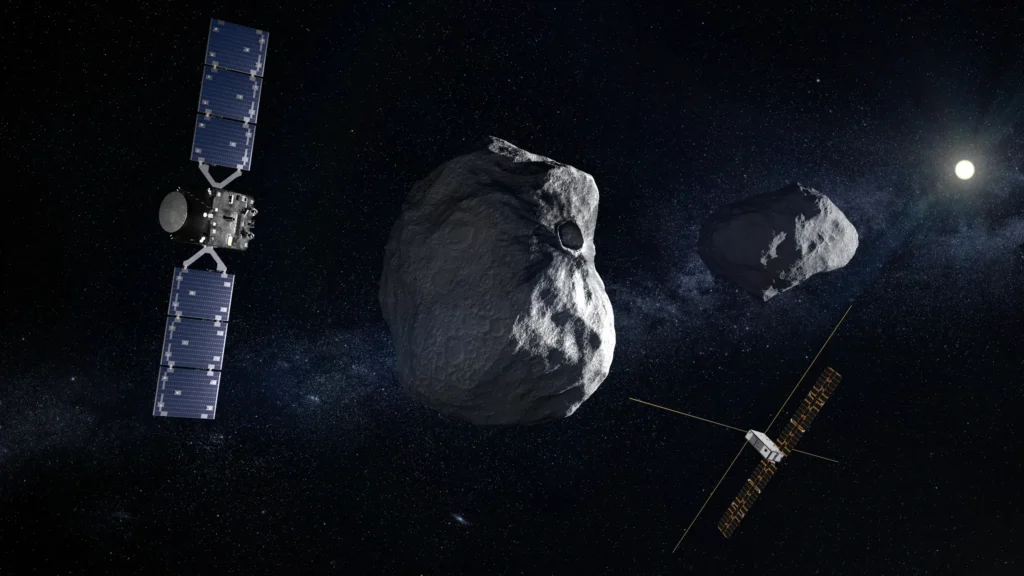
Featured image: Hera and her CubeSats (artist’s impression). Credit: ESA – Science Office.
Key facts
- Launch: 7 October 2024
- Mars flyby: March 2025
- Large deep-space manoeuvre: early 2026
- Rendezvous manoeuvre: October 2026 (ESA planning)
- Arrival at Didymos: November 2026 (ESA planning; ESA announces the exact day)
- CubeSat release: some weeks after arrival (ESA planning)
- Mission duration at the asteroids: at least six months
What arrival actually means
Hera does not brake into orbit in a single dramatic burn like a planetary orbiter. Around such a tiny pair of asteroids gravity is almost negligible, so the spacecraft approaches slowly and holds its position relative to the system, then moves to progressively closer distances. Instrument papers describe the mission as a sequence of phases: an early characterisation phase, a payload deployment phase for the CubeSats, then a detailed characterisation phase and a close observation phase.
What to watch for
- First resolved images. Didymos will go from a bright point to a shape over days, giving the first post-impact views of the system.
- The first look at the crater. Do not expect clean results immediately: the crater’s depth and rim need images from several angles and distances.
- Orbit determination. Tracking Hera’s motion around the pair is how the system’s gravity field, and therefore Dimorphos’s mass, is estimated. It improves slowly over weeks.
- CubeSat release. See our Milani and Juventas guide.
What we will not know on day one
- The momentum enhancement factor β, which needs Dimorphos’s mass. See our DART and Hera article for why that number decides everything.
- The interior structure of Dimorphos, which needs the Juventas radar.
- The lasting state of the ejecta, which needs months of observation.
Our advice for reading the news: treat the first days as a successful rendezvous, and wait for ESA’s data releases for the science.
How to follow
ESA publishes updates on its Hera pages and on its operations channels, and it is likely to stream key moments. This article is updated when ESA confirms the exact arrival day and time.
Frequently asked questions
When does Hera reach Didymos?
November 2026, according to ESA’s plan. ESA announces the exact day nearer the time.
Will we see images immediately?
Early images are expected as the spacecraft approaches, but detailed crater results take longer.
Does Hera crash into the asteroid?
No. It is an observer that approaches to about 4.5 km from Dimorphos.
How long will Hera operate at the asteroids?
At least six months.
Sources
- ESA, Hera operations · Early arrival at Didymos
- ESOC, Hera operations and asteroid-phase planning, Space Science Reviews
- HyperScout-H, instrument paper
Related: Hera and DART explained · Milani and Juventas · ESA’s science roadmap beyond 2030