

Join the mailing list Free weekly briefing, no spam.
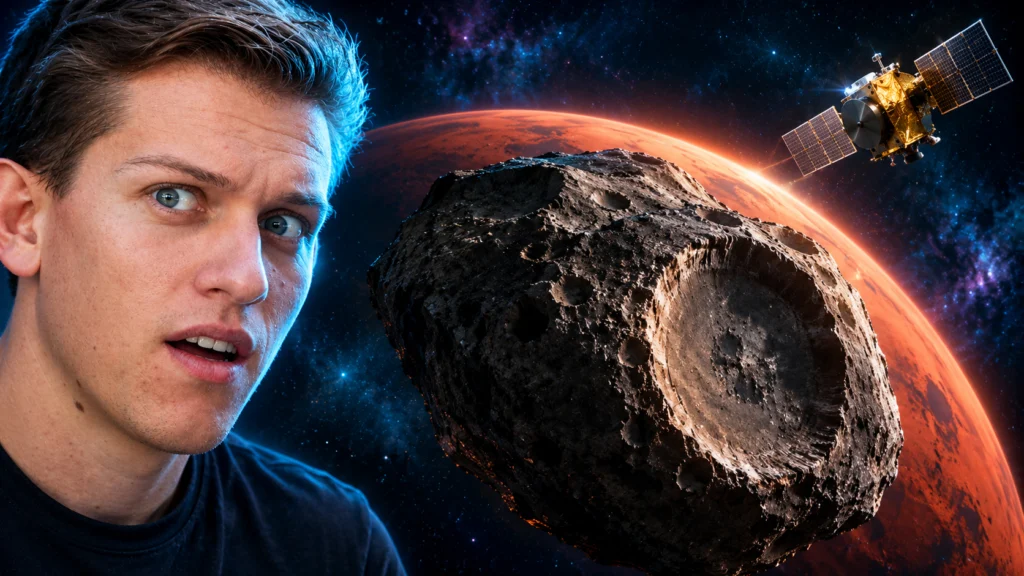
Quick answer: nobody knows yet how Mars’s two moons, Phobos and Deimos, formed. The three leading ideas are that they are captured asteroids, that they are debris from a giant impact on young Mars, or that they come from a disk of material that once produced several moons. JAXA’s MMX (Martian Moons eXploration) spacecraft, launched on 19 October 2026 (20 October in Japan), is designed to settle the question by bringing back more than 10 grams of Phobos in 2031.
This is the first of two articles on the mission. Here we look at where Phobos and Deimos may have come from and what the sample could reveal. Part 2 will focus on the landing and sampling operations.
MMX key facts
- Agency: JAXA, with contributions from NASA, CNES, DLR and ESA.
- Launch: 19 October 2026, 19:41 UTC (04:41 JST on 20 October), H3-24L rocket, Tanegashima Space Center.
- Spacecraft mass: about 4,480 kg, with 13 elements in its science payload.
- Mars arrival: expected in August 2027, followed about a month later by a quasi-satellite orbit around Phobos.
- Landings on Phobos: planned no earlier than December 2028, lasting two to three hours each.
- Sample: more than 10 grams of Phobos material, with the capsule due to land in Australia in 2031.
All dates after launch are planned, not guaranteed.
What is the MMX mission?
MMX is JAXA’s Martian Moons eXploration mission. It will be the first spacecraft to land on Phobos and the first to return a sample from the Mars system. The spacecraft carries NASA’s MEGANE gamma-ray and neutron spectrometer, the French-led MIRS near-infrared spectrometer, cameras, a laser altimeter, a dust monitor and a mass spectrum analyzer. It also carries Idefix, a small rover built by CNES and DLR that will be released onto Phobos. After arrival, MMX is expected to leave the Mars system in 2030 and deliver its capsule to Earth in 2031.
Why the origin of Phobos and Deimos is a puzzle
Phobos has a mean diameter of about 22 km and Deimos about 12.5 km. They were discovered by Asaph Hall in 1877. They are small, dark, irregular bodies that look like asteroids, yet they orbit Mars on nearly circular paths close to the planet’s equatorial plane. Those two facts pull in opposite directions, and that tension is the heart of the problem.
| Hypothesis | What it says | Main strength | Main weakness |
|---|---|---|---|
| Captured asteroids | Phobos and Deimos formed elsewhere and were caught by Mars’s gravity | Dark, primitive-looking surfaces similar to some asteroids | Nearly circular, equatorial orbits are hard to explain |
| Giant impact | A large impact threw debris into orbit, which gathered into moons | Explains the orbits naturally | Composition looks more asteroid-like than Martian |
| Disk and multiple moons | A debris disk or a broken-up larger moon produced several bodies, and only two survived | Combines orbital and compositional clues | Hard to test without a sample |
Hypothesis 1: captured asteroids
In the simplest picture, Phobos and Deimos are asteroids that wandered close to Mars and were caught by its gravity. Their dark surfaces resemble primitive asteroids, and a 2025 study in Astronomy & Astrophysics by Wargnier and colleagues suggested that Z-type asteroids of the inner main belt could be a plausible source.
The weak point is dynamics. A captured body would normally end up on an elongated, tilted orbit, not the nearly circular, equatorial orbits we see. Making capture work requires extra ingredients, such as a much denser early atmosphere or other braking mechanisms.
Hypothesis 2: debris from a giant impact
In the second scenario, a large body hit the young Mars and threw material into orbit, which then gathered into moons, in a way comparable to the leading theory for Earth’s Moon. This idea explains the circular, equatorial orbits naturally. Simulations published by Canup and Salmon in Science Advances (2018) explored an impact by a body between the size of Vesta and Ceres.
The difficulty here is composition. If the moons were built from Martian debris, their spectra should resemble Mars’s crust, yet remote observations suggest something more primitive and asteroid-like.
Hypothesis 3: a disk and multiple moons
The third family of models looks at what happens after an impact or a break-up. Simulations by Rosenblatt and colleagues (Nature Geoscience, 2016) describe a debris disk in which larger, short-lived “transient” moons formed and stirred the material, with most of those moons eventually falling back onto Mars while Phobos and Deimos survived. A different idea, from Bagheri and colleagues (Nature Astronomy, 2021), proposes that the two moons are the remains of a larger moon that broke apart.
There is no clear front-runner among these scenarios. That is exactly why a sample from Phobos matters.
Molecules and material from outside Mars
One of MMX’s most interesting scientific prospects is what the sample could reveal about organic matter and about material that did not form on Mars. MIRS and OROCHI will map where organic compounds and different minerals sit on Phobos before the landing sites are chosen.
There is a second source of “foreign” material. Impacts on Mars eject rock into space, and some of it falls onto Phobos. A 2019 study led by Ryuki Hyodo estimated at least about 340 parts per million of Martian material on average, which could mean roughly 34 identifiable Martian grains in a 10-gram sample. That is a model estimate, not a guarantee, but it means Phobos could act as a natural collector of ancient Martian rock, possibly less shocked than Martian meteorites found on Earth.
Organic molecules, if found, would not be evidence of life: they form without biology and are delivered throughout the Solar System by meteorites. Their value is in telling us where Phobos’s material came from. A captured asteroid from beyond Mars and a piece of Mars itself should carry different chemical and isotopic fingerprints. JAXA also assessed the planetary-protection risk, concluding that the chance of a viable Martian microorganism in the returned sample is below one in a million with 99% confidence.
How MMX will tell the hypotheses apart
Remote sensing comes first. MEGANE will measure the elemental makeup of the surface, MIRS and OROCHI will study minerals and organics, and the Circum-Martian Dust Monitor and the mass spectrum analyzer will study dust and ions around the moons. Then comes the sample itself: two landings of two to three hours each, with a corer reaching about 2 cm deep and a pneumatic sampler using nitrogen gas. Isotopic analyses in laboratories on Earth will compare Phobos material with Martian rocks and with asteroid material. NASA will receive at least 15% of the sample.
Frequently asked questions
How many moons does Mars have?
Mars has two moons: Phobos and Deimos.
What is the MMX mission?
MMX is JAXA’s Martian Moons eXploration mission, designed to study Phobos and Deimos and bring a sample of Phobos back to Earth.
When did MMX launch?
MMX launched on 19 October 2026 at 19:41 UTC (20 October in Japan) on an H3-24L rocket from the Tanegashima Space Center.
When will the Phobos sample return to Earth?
The sample capsule is planned to land in Australia in 2031.
Will MMX prove how Mars’s moons formed?
It is expected to provide the strongest evidence yet, but scientists may find that the answer is more complex than any single hypothesis.
Sources
- JAXA MMX, science objectives
- ESA MMX factsheet
- NASASpaceflight, Japanese MMX mission launches to study Martian moons
- JAXA press release on the launch schedule
- Rosenblatt et al., Accretion of Phobos and Deimos in an extended debris disc stirred by transient moons, Nature Geoscience
- Canup and Salmon, Origin of Phobos and Deimos by the impact of a Vesta-to-Ceres sized body with Mars, Science Advances
- Wargnier et al., Insights into the origins of Phobos and Deimos, Astronomy & Astrophysics, 2025
- Space.com, Phobos and Deimos as remnants of a shattered moon (Bagheri et al., 2021)
- Space Daily, the Phobos sample and Martian grains
By The SpaceInfo Club. Last updated 27 October 2026.
