
Join the mailing list Free weekly briefing, no spam.
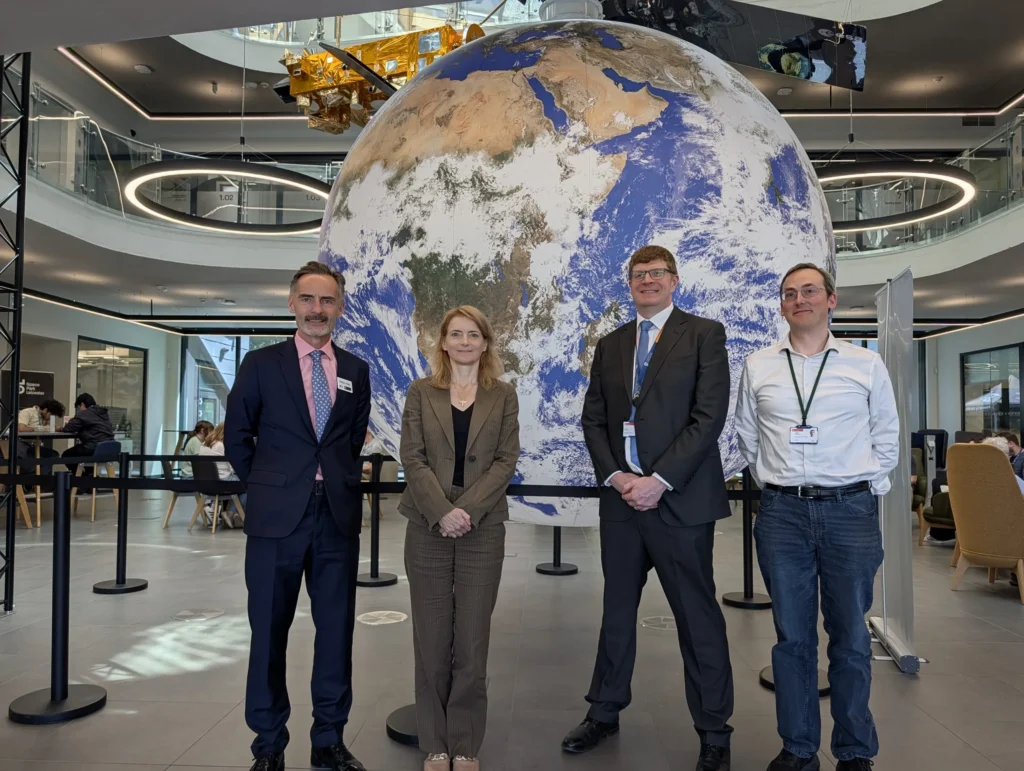
Cover Image: Baroness Lloyd of Effra CBE – Credits SPL
When people think about the space industry, rockets and satellites often steal the spotlight. Yet some of the most important advances in space exploration begin long before launch, inside laboratories where scientists design the instruments that make groundbreaking discoveries possible.
That is precisely what the UK’s Space Minister, Baroness Liz Lloyd of Effra, witnessed during a visit to Space Park Leicester, the University of Leicester’s £100 million research and innovation campus that has become one of the country’s leading centres for space science and technology.
The visit highlighted how Leicester has quietly established itself as one of the UK’s most influential contributors to international space missions, while also demonstrating how research infrastructure can fuel economic growth, technological innovation, and the development of future talent.
A Hub for Space Innovation
Space Park Leicester was created to bring together researchers, industry partners, and emerging space companies under one roof. Rather than focusing on spacecraft manufacturing alone, the facility specializes in the technologies that enable ambitious scientific missions—from advanced instrumentation and planetary science to satellite technologies and commercial innovation.
During the minister’s visit, Baroness Lloyd toured the facility alongside Space Park Leicester CEO Will Wells, Dr Adrian Martindale, Head of Space Project Instrumentation, and Nicola Deards, Project Manager for the Midlands Space Cluster.
The visit formed part of a broader tour of Leicester’s growing space ecosystem, beginning at University of Leicester spin-out Perpetual Atomics before continuing to Space Park Leicester and concluding at the National Space Centre, which recently celebrated its 25th anniversary.
Executive Guide to Space at Space Park Leicester: Three Days Inside a Space Mission
MO-Nav on Talon-A: What a Mach 5 GPS-Denied Test Proves
Scariest Objects in Space: Ghost Nebula, Witch Head Nebula and the Demon Star
Griffin-1 Lunar Lander Completes Environmental Testing at NASA JPL
NASA 4-D Executive Space Programme: Eight Questions Answered by Paul Hawkins
Halloween Fireballs 2026: When to See the Orionid and Taurid Meteor Showers
Leicester’s Instruments Journey to Mercury
One of the highlights of the visit was the University’s contribution to the ESA–JAXA BepiColombo mission, currently approaching one of the Solar System’s most challenging destinations: Mercury.
Scheduled to enter orbit around the innermost planet this year, BepiColombo carries the Mercury Imaging X-ray Spectrometer (MIXS), an instrument developed with a major contribution from University of Leicester scientists under the leadership of Professor Emma Bunce, Director of the Institute for Space.
MIXS will map Mercury’s surface using X-ray fluorescence, allowing researchers to determine the planet’s elemental composition with unprecedented precision. These observations will help scientists better understand how Mercury formed and evolved, offering valuable clues about the early history of the Solar System.
Developing instruments capable of surviving Mercury’s extreme thermal environment represents a significant engineering challenge, making Leicester’s contribution particularly noteworthy.
Watching Earth’s Invisible Shield
While one Leicester-built instrument will soon study the Solar System’s innermost planet, another is designed to observe a region much closer to home.
The Solar Wind Magnetosphere Ionosphere Link Explorer (SMILE), a joint mission between the European Space Agency and the Chinese Academy of Sciences, aims to reveal how charged particles flowing from the Sun interact with Earth’s magnetic field.
Central to the mission is the Soft X-ray Imager (SXI), a wide-field X-ray telescope that was delivered using Space Park Leicester’s advanced facilities.
Unlike traditional space telescopes that observe distant galaxies or stars, SXI will image the boundaries of Earth’s magnetosphere—the invisible magnetic bubble that protects our planet from the solar wind. By tracking how these boundaries change over time, scientists hope to improve our understanding of space weather, a phenomenon capable of disrupting satellites, communications systems, navigation networks, and even terrestrial power grids.
Preparing Humans for Deep Space
The visit also showcased research extending beyond astronomy and planetary science into human spaceflight.
Inside Space Park Leicester’s Electronics Workshop, researchers recently developed a miniature laboratory known as the Petri Pod, designed to fly aboard the International Space Station.
Created in collaboration with the University of Exeter and supported by the UK Space Agency, the compact experiment carries microscopic worms that allow scientists to investigate how biological organisms respond to the space environment.
Although tiny, these organisms provide valuable insights into muscle deterioration and other biological changes caused by microgravity. The findings could ultimately help researchers develop strategies to protect astronauts during future long-duration missions to the Moon and Mars.
Building the UK’s Space Economy
Alongside its scientific achievements, Space Park Leicester represents a broader national strategy aimed at strengthening the UK’s space economy.
During the visit, Baroness Lloyd emphasized that facilities such as Space Park Leicester are creating highly skilled jobs, attracting international collaborations, and positioning the Midlands as a major centre for space innovation.
The region’s ecosystem combines academic research, commercial startups, established industry partners, and public engagement through institutions such as the National Space Centre. Together, they illustrate how investment in space extends beyond exploration, generating economic opportunities while inspiring the next generation of scientists and engineers.
Will Wells, CEO of Space Park Leicester, highlighted the breadth of Leicester’s contributions, pointing to missions ranging from SMILE and BepiColombo to ESA’s Jupiter Icy Moons Explorer (JUICE), as well as emerging technologies being developed by spin-out company Perpetual Atomics in the field of space nuclear power systems.
Looking Beyond Earth
Leicester’s growing role in international space exploration reflects a wider trend across the UK, where universities increasingly serve as engines of both scientific discovery and commercial innovation.
Whether developing instruments that will reveal Mercury’s composition, imaging Earth’s magnetic shield, studying the effects of spaceflight on living organisms, or exploring future nuclear power systems for deep-space missions, the work taking place at Space Park Leicester demonstrates that modern space exploration depends as much on advanced engineering and research as it does on rockets.
As global interest in space continues to expand, facilities like Space Park Leicester are ensuring that the UK remains not only a participant in major international missions, but also a key contributor to the technologies that make them possible.