
Join the mailing list Free weekly briefing, no spam.
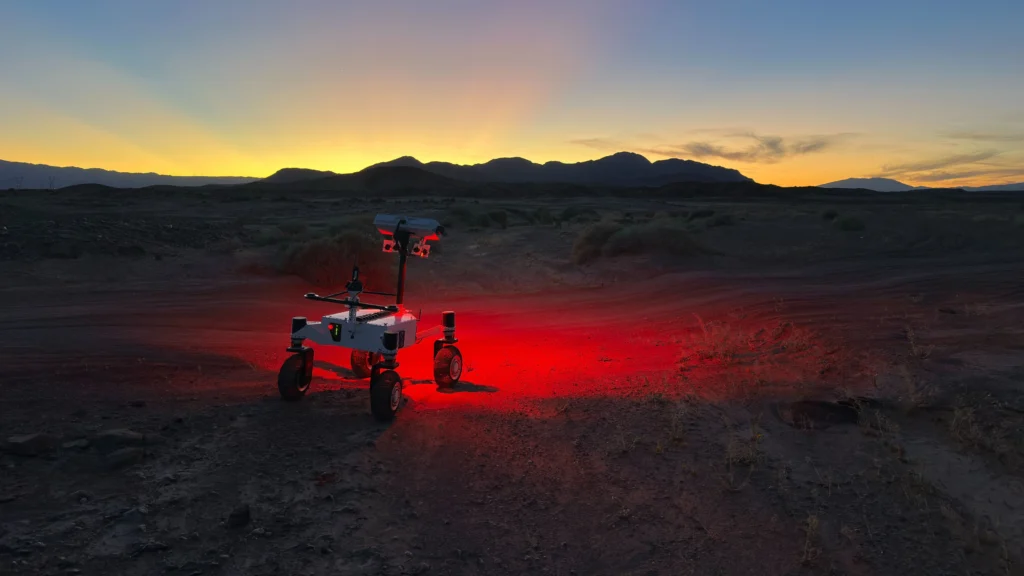
Cover Image: ERNEST (Exploration Rover for Navigating Extreme Sloped Terrain) – Credits NASA JPL-Caltech
NASA is taking another step toward the next generation of planetary exploration with the development of an innovative rover prototype designed to travel farther, move faster, and tackle terrain that remains out of reach for today’s robotic explorers.
Named ERNEST (Exploration Rover for Navigating Extreme Sloped Terrain), the experimental vehicle has recently completed an extensive field campaign in California’s Colorado Desert, where engineers evaluated new mobility systems and autonomous navigation technologies that could support future missions to both the Moon and Mars.
A Rover Built for Extreme Terrain
Developed by NASA’s Jet Propulsion Laboratory (JPL), ERNEST represents a significant departure from the mobility systems used by current Mars rovers such as Curiosity and Perseverance. Measuring approximately 1.2 meters in length, the four-wheeled prototype incorporates an active suspension system that allows each wheel to move independently, enabling the rover to overcome obstacles and negotiate steep slopes with greater efficiency.
Unlike traditional planetary rovers, ERNEST can redistribute its weight while driving and adopt multiple locomotion strategies depending on the terrain. The vehicle is capable of climbing over large obstacles, performing wheel-walking maneuvers, and even moving sideways thanks to its four independently steerable wheels. When conditions allow, it can also switch to a passive suspension mode, reducing energy consumption while maintaining reliable mobility.
The project builds upon more than three decades of experience gained from NASA’s successful rocker-bogie suspension, which has powered every Mars rover since Sojourner landed on the Red Planet in 1997. Rather than replacing that proven architecture outright, ERNEST explores how modern engineering advances can expand the range of environments future robotic missions will be able to investigate.
Executive Guide to Space at Space Park Leicester: Three Days Inside a Space Mission
MO-Nav on Talon-A: What a Mach 5 GPS-Denied Test Proves
Scariest Objects in Space: Ghost Nebula, Witch Head Nebula and the Demon Star
Griffin-1 Lunar Lander Completes Environmental Testing at NASA JPL

NASA 4-D Executive Space Programme: Eight Questions Answered by Paul Hawkins

Halloween Fireballs 2026: When to See the Orionid and Taurid Meteor Showers
Testing Autonomy in the Desert
The recent field trials were conducted in the Colorado Desert, chosen because its rugged landscape offers conditions comparable to some of the environments expected on future lunar missions.
During seven days of testing, ERNEST covered nearly 26 kilometers while requiring only limited intervention from engineers. The rover operated for a total of 37 hours and reached speeds of approximately 1 km/h, around ten times faster than the maximum operational speed of Curiosity and Perseverance.
Equally important was the validation of its autonomous navigation capabilities. Engineers tested software that enables the rover to make independent decisions while traversing complex terrain, reducing the need for continuous commands from mission controllers on Earth. This level of autonomy will become increasingly important as future missions venture farther from established landing sites or operate in regions where communication delays make real-time control impossible.
Preparing for Long-Range Lunar Missions
NASA envisions ERNEST as a technology demonstrator rather than a flight-ready vehicle. The lessons learned from the prototype are expected to contribute to the design of a larger rover capable of supporting long-distance scientific expeditions on the Moon.
Such missions would require vehicles able to travel far beyond the limited ranges achieved by current planetary rovers, opening access to scientifically valuable locations that have remained unexplored. Permanently shadowed craters near the lunar poles, rugged volcanic formations, and extensive geological features could all become accessible with more capable robotic explorers.
The same technologies could later be adapted for Mars, allowing future rovers to investigate regions that are currently considered too hazardous or difficult to reach.
From Laboratory Concept to Future Missions
ERNEST is the result of an iterative development process. Before reaching the current design, engineers constructed two smaller prototypes to evaluate 11 different active suspension configurations. Extensive testing was carried out using simulated lunar regolith on adjustable slopes, allowing the team to compare performance under a wide range of operating conditions before selecting the final architecture.
Although the rover is still an experimental platform, it demonstrates how advances in robotic mobility and onboard autonomy can significantly expand the scientific potential of future exploration missions.
As NASA continues preparing for sustained lunar exploration through Artemis and looks ahead to eventual human missions to Mars, technologies like ERNEST could play an essential role in scouting challenging environments, transporting scientific instruments, and extending the reach of robotic exploration well beyond today’s limits.
Executive Guide to Space at Space Park Leicester: Three Days Inside a Space Mission
MO-Nav on Talon-A: What a Mach 5 GPS-Denied Test Proves
Scariest Objects in Space: Ghost Nebula, Witch Head Nebula and the Demon Star
Griffin-1 Lunar Lander Completes Environmental Testing at NASA JPL
NASA 4-D Executive Space Programme: Eight Questions Answered by Paul Hawkins
Halloween Fireballs 2026: When to See the Orionid and Taurid Meteor Showers
Perseverance Passes Opportunity’s Driving Record: What 45 Kilometers on Mars Really Means
Why Space Teams Fail: Paul Hawkins on NASA’s 4-D Leadership System
Leicester Scientists Help Train East Africa’s Next Generation of Climate Researchers
Beyond the Rocket Revolution: Connecting Space Innovation with Society