
Join the mailing list Free weekly briefing, no spam.
What PROMISE is
PROMISE, short for Polar Rover for Observation, Mapping, and In-Situ Exploration, is a six-wheeled, nuclear-powered rover that NASA plans to send to the lunar South Pole in late 2028. On November 7, 2026, NASA awarded Blue Origin a $94 million base contract, with an option of up to $140 million, to deliver it on the Mark 1 lander. NASA’s Jet Propulsion Laboratory (JPL) will build the rover from spare flight parts and engineering test models left over from the Curiosity and Perseverance Mars rovers.
| Quick fact | Detail |
|---|---|
| Builder | NASA JPL |
| Hardware heritage | Spare parts and engineering test models from Curiosity and Perseverance |
| Power | Nuclear. Space.com reported a radioisotope thermoelectric generator (RTG) in June 2026 |
| Target region | Lunar South Pole, including permanently shadowed regions |
| Drill depth | About 1 meter (3 feet) |
| Delivery | Blue Origin Mark 1 lander |
| Delivery contract | $94 million base, option up to $140 million |
| Target launch | Late 2028 |
| Planned mission length | 18 months |
Source for all rows except power: NASA and JPL announcement.
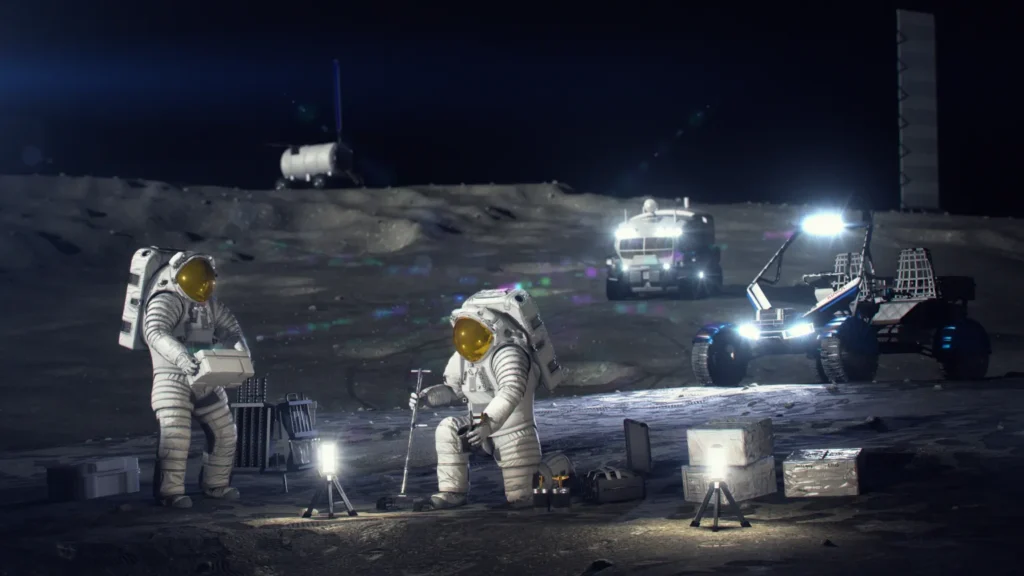
Featured image: artist’s concept of working on the NASA Moon Base. Credits: NASA.
Why the lunar South Pole needs a nuclear rover
The places NASA most wants to study at the South Pole are the places a solar-powered rover struggles to reach and to survive. A lunar night lasts roughly 14 Earth days, and current commercial landers cannot survive it. A radioisotope power source does not depend on sunlight, so it removes that limit.
The permanently shadowed regions are even harder. NASA’s Lunar Reconnaissance Orbiter measured minimum daytime temperatures below -397 degrees Fahrenheit, about -238 degrees Celsius, in parts of south polar craters. That cold can trap water ice for very long periods, and future bases could use such ice for drinking water or split it into hydrogen for fuel.
NASA’s Moon Base program manager, Carlos García-Galán, described the contrast with the VIPER rover in GeekWire’s report: “VIPER uses solar power, so we’re constrained to the terrain that we put it on.” PROMISE is meant to fill that gap, with a drill that reaches about 1 meter (3 feet) below the surface and instruments to look for what is buried there.
Built from Mars spare parts
PROMISE started as an engineering model. Space.com reported in June 2026 that it was built at JPL to mirror Perseverance and Curiosity and used as a ground test platform, where engineers try fixes and commands before sending them to the rovers on Mars. It was formerly called Optimism. Science Focus describes it as a twin of Perseverance.
The November announcement widens the hardware pool. NASA says JPL will assemble the lunar rover from spare flight parts and engineering test models left from both Mars programs, which it says reduces cost and schedule. NASA has also determined that the hardware can tolerate South Pole conditions.
The reasoning is practical. A planetary rover takes years of design, testing and qualification, and much of that work already exists. Administrator Jared Isaacman said in June that the hardware needs “a little refurbishment” before a lunar mission, according to Space.com.
The public sources do not list the specific changes needed for the Moon, so the details remain to be seen. One cost is already clear: sending the engineering model to the Moon would leave the Mars rovers without an Earth-based testbed, a trade-off Space.com noted in its report.
Power, instruments and autonomy
NASA’s announcement calls PROMISE nuclear-powered and says it can work through long lunar nights and in permanently shadowed regions. It does not name the generator. The Mars rovers use a radioisotope thermoelectric generator, which turns the heat of decaying plutonium-238 into steady electricity, and reporting in June pointed to the same approach for PROMISE.
For scale, Perseverance’s generator gives about 110 watts at the start of its mission, declining a few percent each year, and charges two batteries that cover peaks of up to 900 watts. Its waste heat also keeps the rover’s systems within operating temperatures. These are Mars figures. They show how the technology works, not what PROMISE will carry.
According to NASA, the science payload includes:
- A drill that reaches about 1 meter (3 feet) below the surface.
- Spectrometers to identify the materials it samples.
- Temperature and radiation sensors.
- Visible-light cameras.
PROMISE will also demonstrate NASA’s High Performance Spaceflight Computing, a next-generation flight computer, along with advanced autonomy sensors and algorithms. Autonomy matters at the South Pole, where terrain, lighting and communications make step-by-step commanding from Earth slow and limited.
Delivery on Blue Origin’s Mark 1 lander
Blue Origin will carry PROMISE to the South Pole on its Blue Moon Mark 1 (MK1) lander. The contract is a $94 million base with an option of up to $140 million tied to performance, and it expands a May 2026 task order for two lunar terrain vehicles. NASA targets a late 2028 launch and an 18-month mission, which would run into 2030.
MK1 is a large cargo lander. Gizmodo’s description puts it at about 8 meters (26 feet) tall, able to place up to roughly 3 metric tons on the surface, and designed for a single launch on New Glenn, with a South Pole landing site near Shackleton crater. The sources we reviewed do not give PROMISE’s mass, so we cannot say how much of that capacity it uses.
The lander’s schedule has already moved. A New Glenn rocket exploded on May 28, 2026, damaging Launch Complex 36. Spaceflight Now reported on June 30 that the first MK1 lander, Endurance, which had been slated for as soon as late summer 2026, was now expected in early 2027. NASA said the lander itself was intact and not involved in the anomaly, so it could fly on a different rocket, although Administrator Isaacman called New Glenn “Plan A.” Headlines on November 5 say New Glenn’s return to flight slipped to January 2027. We could not open those articles, so treat that date as unconfirmed.
Risks and open questions
Reusing flight-proven parts lowers cost and development risk, but it does not remove risk. Four points will decide whether the late 2028 date holds.
- The ride. PROMISE depends on MK1 landing at the South Pole, and MK1 depends on New Glenn, which is still recovering from the May 2026 failure. A year or more separates the first MK1 flight from PROMISE’s target date, so a successful first landing would be a strong signal.
- Lunar requalification. NASA says the hardware can tolerate South Pole conditions, but the analysis behind that statement is not public. Mars hardware was qualified for a different environment, so the modifications will be worth watching.
- The Mars testbed. Space.com noted that if the engineering model goes to the Moon, Curiosity and Perseverance lose their Earth-based twin for rehearsing commands and fixes. The sources we reviewed do not say how that gap will be covered.
- Unpublished numbers. The sources we reviewed do not give PROMISE’s mass, its total mission cost or its generator model. Expect these to appear as the design matures.
The 18-month mission also has to survive repeated lunar nights, which is exactly what the nuclear power source is for.
Frequently asked questions
What is the PROMISE rover?
PROMISE, the Polar Rover for Observation, Mapping, and In-Situ Exploration, is a six-wheeled, nuclear-powered lunar rover that NASA’s JPL is building for the Moon’s South Pole.
Is PROMISE a repurposed Mars rover?
It is built from spare flight parts and engineering test models left over from the Curiosity and Perseverance programs. It began as a JPL engineering model of the Mars rovers, formerly called Optimism.
When will PROMISE launch?
NASA’s target is late 2028, with an 18-month mission. The date depends on the Blue Origin Mark 1 lander and its New Glenn rocket.
Who delivers PROMISE to the Moon?
Blue Origin, using its Mark 1 lander, under a $94 million base contract with an option of up to $140 million.
Why does PROMISE need nuclear power?
A lunar night lasts about 14 Earth days, and permanently shadowed craters near the South Pole can stay below -238 degrees Celsius. A nuclear power source works without sunlight.
What will PROMISE look for?
Its drill reaches about 1 meter below the surface, and spectrometers, temperature and radiation sensors and cameras will study the ground, including regions that may hold water ice.
Sources and verification notes
Figures were checked against the pages below, opened on November 8, 2026 unless noted.
- NASA and JPL: NASA Awards Moon Base Transportation, Technology, Science Projects for the rover description, instruments, schedule and contract values.
- Space.com, June 30, 2026 for the engineering-model origin, the RTG and the testbed trade-off.
- Science Focus for the Perseverance twin description and the former name.
- GeekWire for the VIPER comparison quote.
- SpacePolicyOnline, June 30, 2026 for the 14-day lunar night and the initial PROMISE announcement.
- Space.com, Diviner measurements, 2009 for south polar crater temperatures. The Celsius value is a conversion from Fahrenheit.
- JPL Mars 2020 power page for Perseverance generator figures, used only as a Mars reference.
- Gizmodo on Blue Moon MK1 for lander size, payload and landing site.
- Spaceflight Now, June 30, 2026 for the New Glenn failure and the lander schedule.
Not verified: PROMISE’s mass, generator model, total cost and lunar modifications are not stated in the pages we could open. A New Glenn return date of January 2027 appears only in headlines we could not open.