
Join the mailing list Free weekly briefing, no spam.
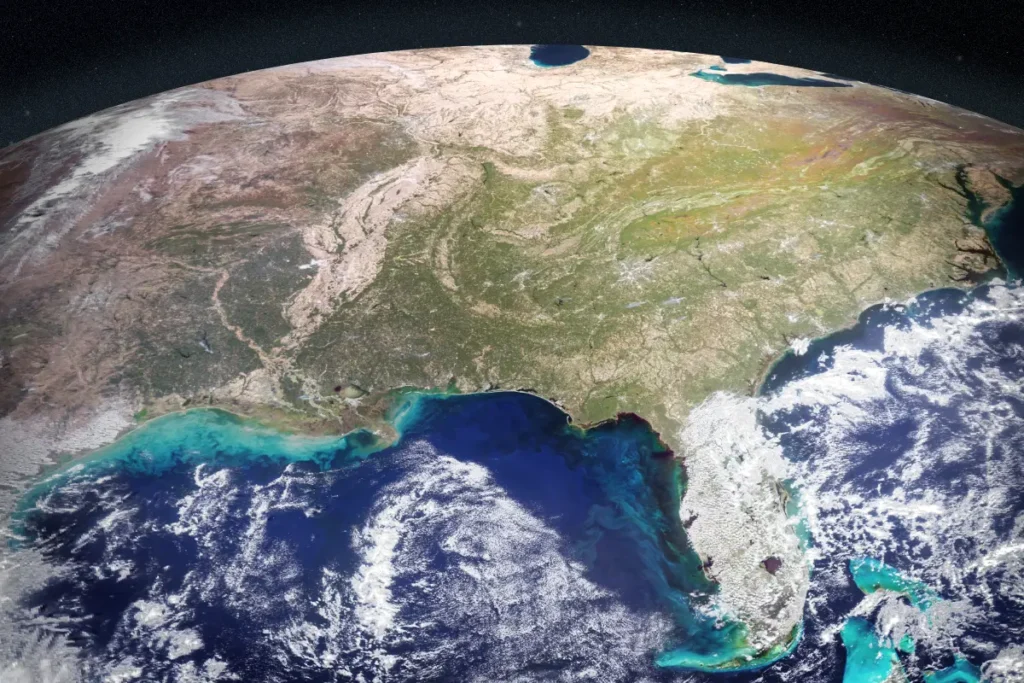
Cover Image: NASA – NASA Uses AI to Hunt Algae
When people hear about artificial intelligence in space science, they often imagine autonomous spacecraft, planetary exploration, or the search for life beyond Earth. But some of the most immediate benefits of AI are emerging much closer to home.
NASA researchers have developed an innovative machine-learning system capable of identifying harmful algal blooms by combining observations from multiple Earth-observing satellites. The new technology could help scientists monitor coastal ecosystems more efficiently, provide earlier warnings to affected communities, and reduce the environmental and economic damage caused by these increasingly common events.
The project is another example of how space technology is being leveraged to solve real-world challenges on Earth, transforming satellite data into actionable environmental intelligence.
A Growing Problem in Coastal Waters
Harmful algal blooms (HABs) occur when certain species of microscopic algae multiply rapidly and release toxins into the surrounding water. These blooms can devastate marine ecosystems, threaten public health, and cause substantial economic losses for coastal regions.
In Florida, recurring outbreaks of the algae Karenia brevis are responsible for the infamous “red tide” events that kill fish, contaminate beaches, and cause respiratory problems in people exposed to airborne toxins. Meanwhile, along the U.S. West Coast, blooms of Pseudo-nitzschia have been linked to mass poisoning events affecting dolphins, sea lions, and other marine animals.
PRIMA Far-Infrared Telescope: NASA’s First Probe Explorer and What It Means for Astrophysics
Image Credits: NASA On September 23, 2026, NASA announced that PRIMA (PRobe far-Infrared Mission for…
HMS Daring Representative Visit Space Park Leicester as Royal Navy and Space Sector Strengthen Ties
tag: Space Park Leicester Cover image credits: SPL Representatives of HMS Daring have visited Space…
Starship Goes Orbital – How Flight 14 is going
Starship Flight 14 has put the world’s largest rocket into orbit for the first time….
BepiColombo Separates From Its Transfer Module Today
BepiColombo separates from its Mercury Transfer Module today, 3 September 2026, at 14:00 CEST (12:00…
BepiColombo Sheds Its Transfer Module as the Mercury Arrival Begins
After eight years and nine planetary flybys, ESA–JAXA’s BepiColombo mission is about to reach a…
A SpaceX Rocket Stage Is About to Crash into the Moon. Here’s Why Scientists Are Excited
As climate patterns shift and coastal environments continue to change, scientists are increasingly focused on improving detection and forecasting capabilities before these blooms reach critical levels.
Why Satellites Matter
Traditional monitoring methods rely heavily on field sampling. Researchers must collect water samples, transport them to laboratories, and perform detailed analyses to determine whether harmful algae are present. While highly accurate, this process can be time-consuming and often provides only a limited snapshot of conditions.
Earth-observing satellites offer a different perspective.
Orbiting hundreds of kilometers above the planet, they continuously monitor oceans, coastlines, and inland waters on a global scale. These spacecraft can detect subtle changes in water color, biological activity, and chemical signatures that may indicate the development of an algal bloom.
Among the most advanced tools currently available is NASA’s PACE (Plankton, Aerosol, Cloud, ocean Ecosystem) mission, whose sophisticated sensors can identify different types of phytoplankton based on their unique spectral characteristics. According to the official PACE mission website, the spacecraft was specifically designed to improve our understanding of ocean biology and its relationship with Earth’s climate system.
The mission represents a significant advance in environmental monitoring from space and complements other efforts to understand our planet’s interconnected systems, such as the ESA SMILE mission’s investigation of the Sun-Earth relationship.
Teaching Artificial Intelligence to Read the Ocean
The challenge facing scientists was not obtaining data—but making sense of the enormous quantities already available.
Modern satellites generate vast streams of information every day, often using different instruments that measure different environmental variables. Integrating all of these observations into a single, coherent picture can be extremely difficult.
To address this challenge, researchers from NASA’s Jet Propulsion Laboratory (JPL) and the Spatial Informatics Group developed a self-supervised machine-learning system capable of learning relationships between multiple data sources without requiring extensive human labeling.
The AI was trained using satellite observations collected during 2018 and 2019. Researchers then compared the system’s findings with field measurements and laboratory analyses to validate its performance.
Rather than being explicitly taught what a harmful algal bloom looks like, the system learned to identify recurring patterns on its own. Over time, it became capable of recognizing bloom signatures across multiple datasets and distinguishing them from other environmental features such as sediment plumes, coastal vegetation, and river runoff.
The results suggest that the system can successfully identify and map harmful blooms, including species such as Karenia brevis, even in complex coastal environments where traditional remote-sensing approaches often struggle.
Combining the Power of Multiple Space Missions
One of the most promising aspects of the project is its ability to merge information from several independent satellite missions.
The research team combined observations from five different instruments and missions, including PACE and the TROPOMI instrument aboard the European Sentinel-5P satellite. TROPOMI can detect faint fluorescence signals emitted by photosynthesizing organisms, providing another valuable clue for identifying algal activity.
By integrating multiple sources of information, the AI can generate a more complete understanding of ocean conditions than any individual satellite could provide on its own.
Researchers describe this vision as creating “maps without gaps”—continuous, comprehensive environmental monitoring systems that can support rapid decision-making during developing bloom events.
The Future of AI-Powered Earth Observation
Artificial intelligence is rapidly becoming one of the most powerful tools available to Earth scientists. As satellite missions continue to generate increasingly detailed observations, AI systems will play a critical role in transforming raw data into practical insights.
The same technologies being used to monitor harmful algal blooms are already finding applications across climate science, disaster response, planetary exploration, and autonomous spacecraft operations.
This growing convergence between AI and space technology is also creating new career opportunities across the aerospace sector. As discussed in our article on why the space industry could become one of the world’s most important economic sectors, expertise in data science and artificial intelligence is becoming increasingly valuable within the modern space economy.
From Research to Real-World Impact
NASA’s ultimate goal extends beyond scientific discovery.
The agency hopes future versions of the system will provide practical tools for environmental agencies, local governments, aquaculture operators, and coastal communities. Earlier detection of harmful blooms could improve public-health warnings, reduce economic losses, and help protect vulnerable marine ecosystems.
Researchers are now expanding the system to include additional coastal regions and inland lakes while incorporating more satellite datasets to improve accuracy and reliability.
As Earth-observation technologies continue to evolve, projects like this highlight an important reality: some of the most transformative applications of space science are not necessarily about exploring distant worlds. They are about using the unique vantage point of space to better understand—and better protect—the world we already call home.
For a broader look at how science and technology are helping humanity prepare for future challenges both on Earth and beyond, read our recent interview-driven feature on the realities of living beyond Earth and the challenge of space radiation.