
Join the mailing list Free weekly briefing, no spam.
After eight years and nine planetary flybys, ESA–JAXA’s BepiColombo mission is about to reach a critical turning point.
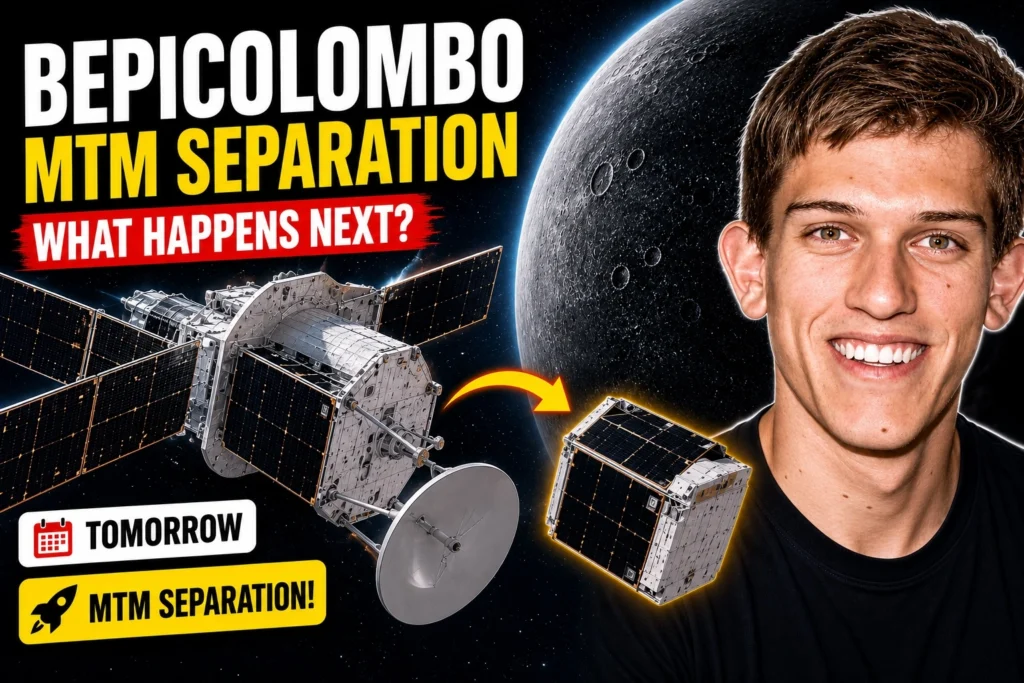
On 3 September 2026 at 14:00 CEST (12:00 UTC), the spacecraft will deliberately separate from the engine module that has carried it across the inner Solar System, an operation that might sound like something has gone wrong.
But nothing has gone wrong: the Mercury Transfer Module separation is planned, irreversible, and absolutely essential to the mission’s arrival at Mercury.
It marks the beginning of one of the most challenging phases of BepiColombo’s journey, as the spacecraft prepares for its final approach and eventual orbit insertion around the innermost planet.
Everything that follows depends on this moment going exactly as planned, from the orbit insertion burn in November to the release of Japan’s Mio orbiter in December and the beginning of scientific operations in 2027.
Once the module is released, there is no turning back.
A separation eight years in the making
BepiColombo launched from Kourou on 20 October 2018 aboard an Ariane 5 ECA, on a trajectory that had almost nothing in common with the intuitive idea of “flying to Mercury.” Falling towards the Sun is easy; arriving slowly enough to be captured by a small planet with weak gravity is not. The Sun’s gravity accelerates any spacecraft heading inwards, and Mercury has almost no atmosphere to help with braking. The mission’s answer was to spend most of a decade shedding orbital energy through nine planetary flybys — one at Earth, two at Venus and six at Mercury itself — while a bank of ion thrusters gently reshaped the trajectory in between.
That approach is the direct legacy of the man the mission is named after. Giuseppe “Bepi” Colombo (1920–1984), an Italian mathematician, worked out the gravity-assist technique that made journeys of this kind possible in the first place, and demonstrated it with Mariner 10 in the 1970s. It is the same physics NASA used earlier this year when its Psyche spacecraft used a Mars flyby to reshape its trajectory and rehearse its instruments — the technique is now so routine that it is easy to forget how counterintuitive it once seemed.
The cruise was not uneventful. In May 2024, engineers at ESOC found that the electric propulsion system was no longer delivering its expected power. The recovery cost the mission eleven months: arrival slipped from 5 December 2025 to November 2026, and the trajectory had to be redesigned around the reduced thrust. BepiColombo got there, but it got there late, and the delay is part of why the coming weeks carry so little margin.
What the Mercury Transfer Module actually did
The Mercury Transfer Module is the largest single component of the entire spacecraft stack.
At launch, it weighed 2,615 kg, including around 1,400 kg of xenon propellant, most of which has now been consumed during the journey.
Its purpose was straightforward: carry the two science orbiters toward Mercury while powering four QinetiQ T6 solar electric thrusters, which use sunlight to generate electricity, ionise xenon gas and accelerate those ions to extremely high velocities.
The resulting thrust is tiny.
It is roughly comparable to the weight of a coin resting in your hand, but unlike a chemical engine, an ion thruster can keep pushing continuously for months at a time.
Over eight years, that almost imperceptible blue glow allowed BepiColombo to achieve something a conventional chemical propulsion system could never have accomplished without a much larger launch vehicle and an enormous increase in cost.
That chapter officially ended on 15 June 2026 at 15:24 CEST.
At that moment, ESA switched off the solar electric propulsion system for the final time, leaving the transfer module with one last job to perform: stay attached until the spacecraft reaches the point where it can finally be released.
Since then, the module has essentially been dead weight, waiting for the moment when BepiColombo can let it go.
Why the module has to go
The reason is mass, and mass is the currency of orbital mechanics. Mercury orbit insertion requires a large, precisely timed burn using the Mercury Planetary Orbiter’s chemical propulsion system. The amount of velocity change that system can deliver is fixed by how much propellant it carries; how much velocity change is actually needed depends on how much mass has to be slowed down.
Keeping the transfer module attached would mean dragging more than a tonne of spent hardware into the most demanding manoeuvre of the mission. There is not enough propellant to do it. So the module is released, left to drift on its own path around the Sun, and the composite that continues to Mercury consists of just two spacecraft:
- The Mercury Planetary Orbiter (MPO) — ESA’s contribution, 1,150 kg, carrying eleven science instruments: cameras, spectrometers, an altimeter, a magnetometer and particle analysers, aimed at Mercury’s surface, interior and exosphere.
- Mio, the Mercury Magnetospheric Orbiter — JAXA’s contribution, 285 kg, carrying five instrument groups totalling 45 kg, dedicated to the planet’s magnetic field, plasma environment and the way the solar wind batters it.
From 3 September onwards, those two spacecraft fly on MPO’s chemical propulsion alone. There is no backup engine.
What happens on 3 September
ESA will begin live coverage from the European Space Operations Centre in Darmstadt at 13:45 CEST, carried on the agency’s YouTube and LinkedIn channels. Separation itself is commanded for 14:00 CEST / 12:00 UTC.
The wait that follows is the part flight controllers dislike. Releasing the module changes the spacecraft’s mass, balance and antenna geometry all at once, and the composite needs time to stabilise its attitude and re-establish a clean link with Earth. Signal acquisition and the first health checks are expected around 15:53 CEST — close to two hours in which the mission’s status is, in practical terms, unknown. ESA has scheduled a break in its broadcast at 14:30 and a return at 15:30 for exactly this reason.
The road to 21 November
Separation opens a sequence that runs well into next year:
- 21 November 2026 — Mercury orbit insertion burn. BepiColombo becomes only the second spacecraft in history to orbit Mercury, after NASA’s MESSENGER.
- Early December 2026 — Mio separates from the MPO, and the two orbiters begin working as an unprecedented two-point observatory.
- March 2027 — the MPO settles into its final science orbit.
- April 2027 — full science operations begin.
Why this arrival matters
Mercury is the least explored planet of the inner Solar System, and the least explicable. It is far denser than it has any right to be, with an iron core that occupies roughly 60% of its volume — a proportion no standard model of planet formation comfortably predicts. It has a global magnetic field, which a small, slowly rotating body of its age should not have retained. It holds water ice in permanently shadowed polar craters, a few hundred kilometres from surface temperatures above 400°C, hot enough to melt lead.
MESSENGER, which orbited from 2011 to 2015, answered some of these questions and sharpened the rest. BepiColombo’s advantage is that it brings two spacecraft to two different orbits at the same time, allowing scientists to separate what is happening at Mercury from what is happening around it — a distinction a single orbiter can never cleanly make. That is the payoff for a $2 billion mission, eight years of cruise and a transfer module the mission is about to abandon on purpose.
For the wider picture of where BepiColombo sits among Europe’s science missions and what comes after it, see our overview of ESA’s science programme and its roadmap beyond 2030.
Follow the arrival with SpaceInfo Club
We are publishing a full video explainer on the MTM separation on the SpaceInfo Club YouTube channel ahead of the event — what the transfer module did, how the separation works, what can go wrong, and what to watch for during ESA’s live coverage. It is the first in a series that will follow BepiColombo through orbit insertion in November and the start of science operations in 2027.
Watch it here → SpaceInfo Club on YouTube
More mission coverage and analysis is collected in our full article archive.