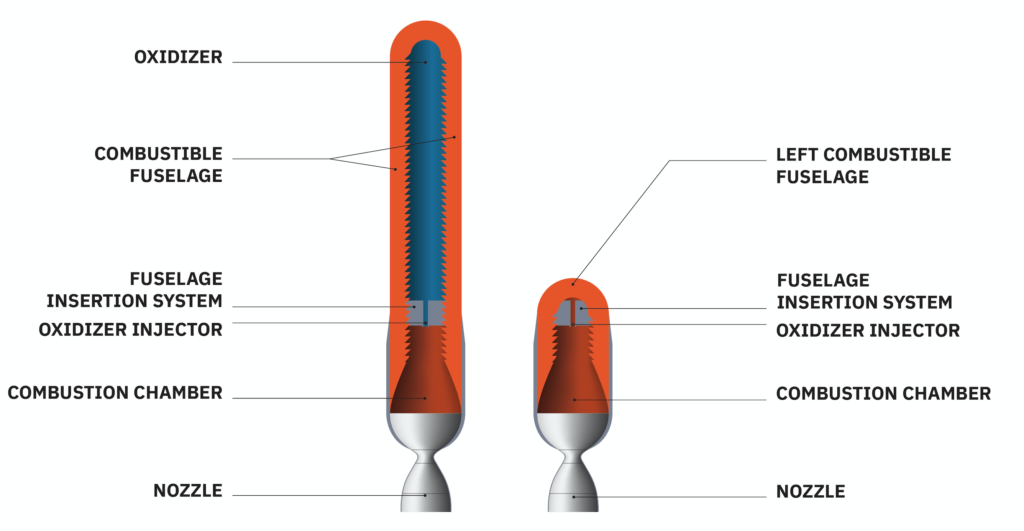
Cover Image: Autophage Combustion Principle – Credits Alpha Impulsion
A conventional rocket carries two things that, from a physics standpoint, are in tension with each other: propellant, which you need to burn, and structure, which you need to carry. The structure exists to hold the propellant. Once the propellant is gone, the structure is dead weight and in a vehicle governed by the Tsiolkovsky rocket equation, dead weight is the enemy of performance.
Alpha Impulsion’s answer to this tension is autophage combustion: a propulsion architecture in which the rocket’s structure is itself the fuel. The vehicle burns from the bottom up as it ascends, progressively consuming its own body, until nothing remains except the engine and the payload. It is, in the words of the company, an upside-down candle. Thus, it has implications for rocket design that extend well beyond a single efficiency metric.
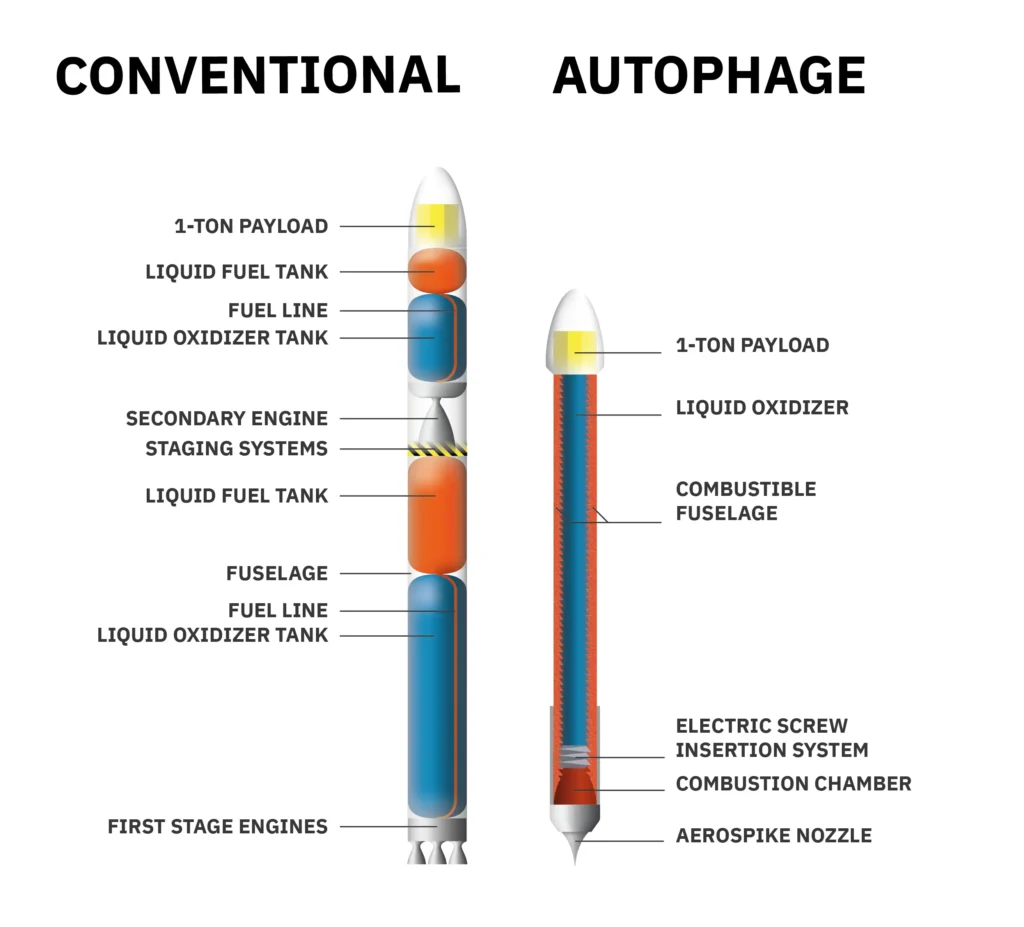
Autophage vs Conventional – Credit Alpha Impulsion
A Bi-Propellant Architecture with Zero Explosion Risk
At its core, autophage combustion is a bi-propellant system: a fuel and an oxidizer, mixed and burned together in the combustion chamber. What distinguishes it from a conventional liquid bi-propellant engine is that the fuel is not stored in a separate tank. The fuel is the structure.
For the Garnet engine, the propellant combination is polyethylene (PE) and liquid oxygen (LOx). Polyethylene is the same thermoplastic found in everyday packaging. It forms the structural body of the rocket. As the vehicle ascends, the engine consumes the lower section of this structure, drawing it into the combustion chamber where it reacts with the liquid oxygen. The solid fuel and the gaseous oxidizer meet, combust, and generate thrust. The structure recedes. The rocket gets shorter. The process continues.
For satellite applications, the material combination shifts to nylon and oxygen, optimised for the different performance requirements of in-space propulsion. This is the combination Alpha Impulsion will use for the Opal thruster, currently in development.
To those familiar with rocketry, this configuration may call to mind hybrid rocket motors, in which a solid fuel grain reacts with a liquid or gaseous oxidiser. The comparison is instructive, but the analogy has limits. Autophage combustion is more precisely described as a continuous structural consumption process rather than a static grain burn. The fuel is not just a pre-formed geometric shape sized to a combustion profile; it is the rocket itself, being consumed progressively from one end.
One consequence of this architecture is particularly notable: there is no explosion risk. The TNT-equivalent energy release in the event of a failure is zero. Liquid propellant systems carry significant stored energy; a rupture or ignition failure can be catastrophic. Here, the solid fuel cannot detonate, and the system’s energy release is controlled entirely by the combustion process.

BepiColombo Separates From Its Transfer Module Today
BepiColombo separates from its Mercury Transfer Module today, 3 September 2026, at 14:00 CEST (12:00…

BepiColombo Sheds Its Transfer Module as the Mercury Arrival Begins
After eight years and nine planetary flybys, ESA–JAXA’s BepiColombo mission is about to reach a…
A SpaceX Rocket Stage Is About to Crash into the Moon. Here’s Why Scientists Are Excited
Juno Peers Beneath Io’s Surface and Finds Heat Rising From Within
NASA Reveals “Asteroid” Is Actually an Active Comet, Highlighting the Importance of Precision Planetary Defense

Psyche’s Close Encounter with Mars Gives NASA a Crucial Dress Rehearsal
Structural Sizing: The Combustion Ratio Comes First
In a conventional rocket, structural design begins with the mass budget. Every gram of airframe, tank wall, and fastener is a gram taken from the payload. Designers work to minimise structural mass while maintaining integrity under the loads of launch.
In an autophage rocket, this logic is inverted. The structure is not minimised: it is sized to satisfy the combustion chemistry.
For complete combustion to occur, the oxidiser and fuel must be present in the correct mass ratio. Too little fuel relative to the oxidiser, and combustion is incomplete; too much, and excess unburned fuel is wasted. The combustion ratio is a chemical constraint, not a structural one, and it determines how much polyethylene the rocket needs to carry relative to its liquid oxygen supply.
Once that ratio is established (read: once the chemistry is satisfied), the amount of structural material is fixed. The rocket is then dimensioned around that chemistry, and the structural integrity almost invariably follows without additional optimisation. In equivalence terms compared to an aluminium structure of similar geometry, the polyethylene body is oversized by approximately a factor of 70. Safety margins that structural engineers spend considerable effort to achieve in conventional designs emerge here as a natural consequence of the combustion requirement.
The driver of the dimensioning is not weight. It is chemistry.
Pressurisation Without Pumps or Pressurant Gas
Managing propellant flow into a rocket combustion chamber is one of the more complex engineering challenges in launch systems design. Liquid propellants must be delivered at sufficient pressure to prevent cavitation, which is the formation of vapour bubbles that disrupt optimal flow. By doing so, a steady, controlled burn is ensured. Two primary approaches exist: pressurised gas systems, which use helium or nitrogen bladders to push propellant toward the injectors; and turbopumps, which mechanically force the propellant under high pressure. Both add mass, complexity, and potential failure modes.
In the autophage architecture, neither is required.
Because the polyethylene structure is consumed continuously during flight, the tank is in a state of constant volumetric reduction. As the walls are drawn into the combustion process, the remaining volume decreases. This progressive shrinkage maintains the pressure on the liquid oxygen automatically, without any external pressurant system. The tank compresses itself around the propellant as it burns.
The consequences are several. There is no sloshing: the liquid oxygen cannot shift unpredictably within a partially filled tank, because the tank geometry is continuously conforming to the liquid’s volume. There is no bubble formation from pressurant gas dissolved in the propellant. And re-ignition, a persistent challenge in liquid-propellant systems (as recent high-profile launch campaigns have illustrated… Starship test flights!), is substantially simplified. The pressure is always present, inherently, as a function of the combustion process itself.
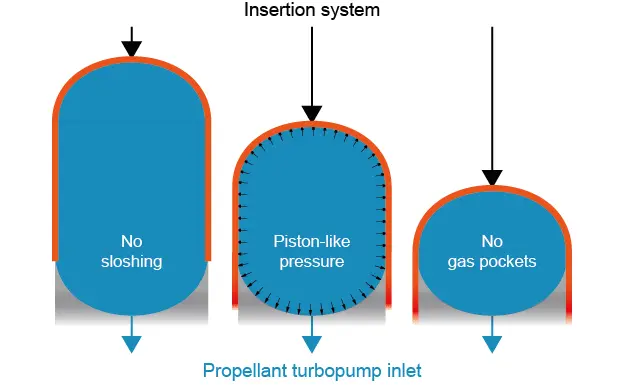
Tank Pressurization in Autophage System – Credit Alpha Impulsion
From Technology Demonstrator to Commercial Operations
Alpha Impulsion was founded in Toulouse in 2022. In 2025, the company completed the hot fire of the world’s largest autophage rocket engine, a milestone that validated the core technology at a scale relevant to the launch vehicle programme. Further demonstrators are in development, including the application of autophage combustion to satellite propulsion through the Opal thruster.
On a second path, a small-scale engine is also under development. This time, the test campaign is funded by the French Ministry of Defence, in preparation for target commercialisation in 2028. The engine under development here is, as said, small-scaled one: approximately 1 metre tall and 25 cm in diameter. So why is this so important to call-in the Ministry of Defence?
Contributing to answer this is for sure the importance of the auto phage technology and, not less important, the results emerging from this tests. These outcomes will benefit directly the development of the Opal engine itself, the in-space propulsion version of their system. Consequently, this will also contribute to Garnet.
Will this make us reflect more about the importance of research and development of space technologies? Just a side question.
Alongside the launcher programme, the team is developing a high-performance engine for spacecraft, extending the autophage principle into the in-space propulsion market.
The ambition is not simply a more efficient rocket. It is a different category of rocket! One in which the distinction between carrying mass and burning mass has been dissolved entirely.
Alpha Impulsion is a French space propulsion company headquartered in Toulouse, operating across France and Italy. Learn more at alpha-impulsion.com